
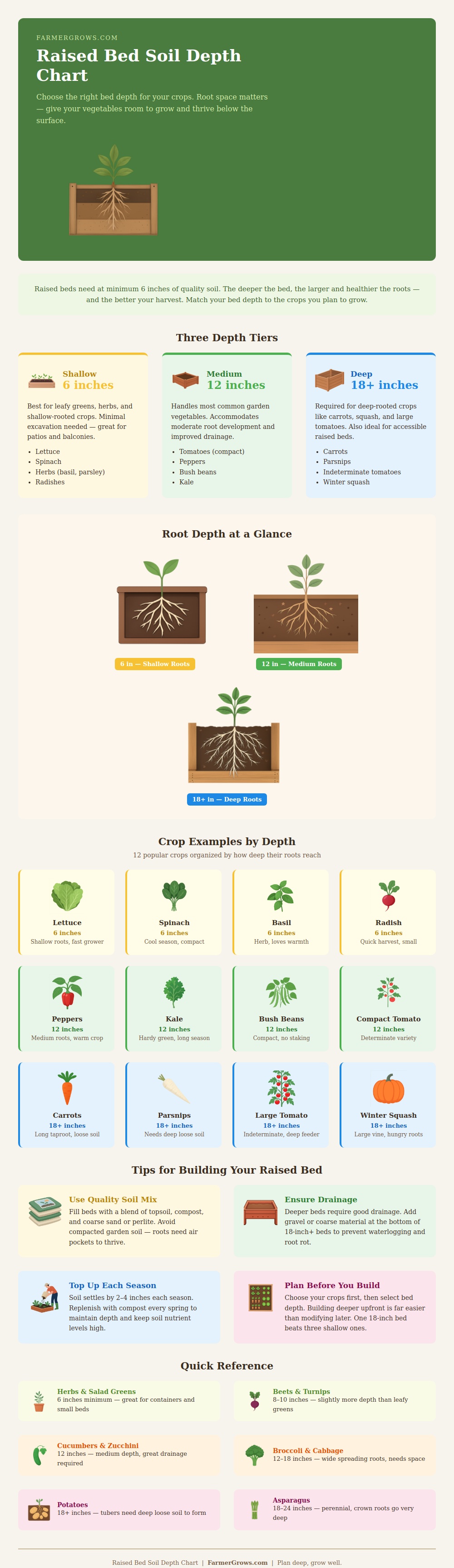
Choosing the depth of a raised bed for your garden ranks among the most important steps. Most vegetables grow well in the top 6 to 12 inches of soil, but deeper soil usually leads to healthier plants and better harvests. Some vegetables need up to 24 inches or more.
Raised beds are usually left open at the bottom, which lets roots grow down into the ground below.
How Deep Should Your Raised Bed Be
Standard depth for raised beds is 11 inches, because it matches the height of two standard 2×6 inch boards, which are commonly used to frame raised beds. For most vegetables, a depth of 8 to 12 inches is usually enough. When drainage is a problem or plants prefer drier soil, you make the bed taller and fill it with a porous growing medium.
Raised gardens on hard surfaces like rock or concrete need at least 8 inches of depth for leafy greens, beans, and cucumbers. For peppers, tomatoes, and squash, 12 to 24 inches is better. Root vegetables like carrots or potatoes benefit from 12 to 18 inches of depth.
Six inches of depth helps but filling beds to 10 or 12 inches gets expensive fast. The depth of a raised bed most directly affects the budget. A 4×4 bed at 6 inches deep needs roughly 12 cubic feet of soil.
At 12 inches it doubles to 24 cubic feet. Bagged materials cost a lot, and most raised bed mixes are purely organic, which leads to a lot of settling as it decomposes.
Soil compacts with watering too. Starting with 12 inches of good soil for tomatoes and root vegetables, by the end of the season it can snik to about half the height. More soil, mulch, and compost must be added the next year.
Using a garden fork or shovel to loosen the native soil below the bed to a depth of 6 to 10 inches improves drainage and moisture retention. It also means that even with a 5-inch-high raised bed, plants will feel like they are growing in much deeper soil. The ground soil can be improved by adding peat moss or compost.
Rock phosphate can also be sprinkled on the surface before the bed is topped up.
If quality topsoil is not available, an acceptable substitute would be a 50-50 blend of soilless growing medium and compost. Peat moss should not be more than 20 percent of the total mix since it is naturally acidic. Keeping soil health through seasonal composting improves drainage, aeration, and overall plantgrowth in raised beds.