🌾 Silage Density & Weight Calculator
Calculate total weight, dry matter tons, and days of feed for any silage storage type
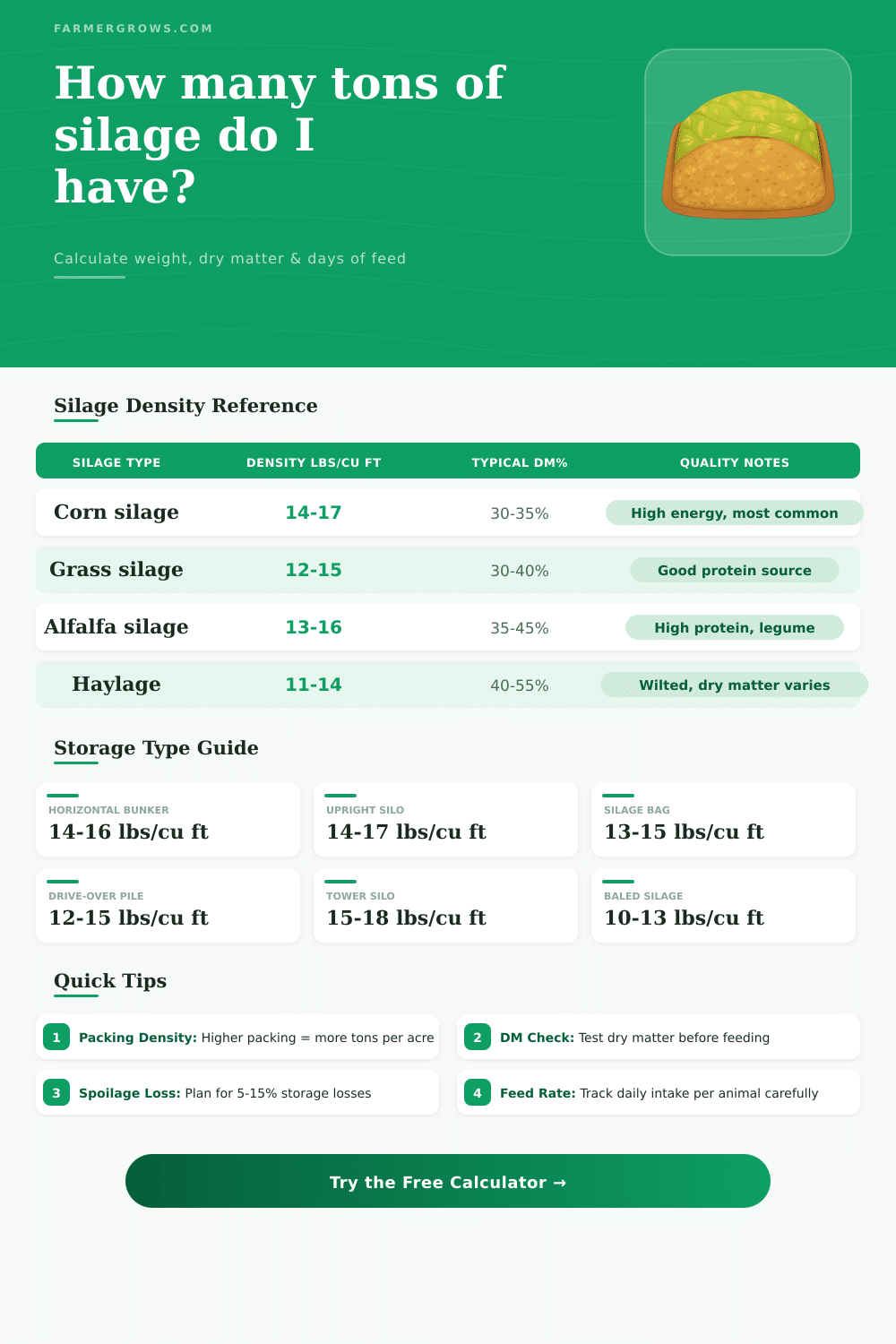
| Storage Type | Typical Density | Pros | Best For |
|---|---|---|---|
| Horizontal Bunker | 14-16 lbs/cu ft | High capacity, accessible | Large dairy herds |
| Upright Silo | 14-17 lbs/cu ft | Good preservation | Medium operations |
| Silage Bag | 13-15 lbs/cu ft | Flexible, low cost | Small-medium farms |
| Drive-over Pile | 12-15 lbs/cu ft | Very low cost | Low-budget options |
| Tower Silo | 15-18 lbs/cu ft | Excellent preservation | Premium operations |
| Storage Size | Volume (cu ft) | Approx Tons (45 lbs/cu ft) | Herd Days (50 head @ 50 lbs/day) |
|---|---|---|---|
| Bunker 50'x20'x8' | 8,000 | ~180 tons | ~144 days |
| Bunker 100'x30'x10' | 30,000 | ~675 tons | ~540 days |
| Bunker 200'x50'x12' | 120,000 | ~2,700 tons | ~2,160 days |
| Upright 16'x40' | 8,042 | ~181 tons | ~145 days |
| Tower 20'x60' | 18,850 | ~424 tons | ~339 days |
| Bag 8'x200' | 10,053 | ~226 tons | ~181 days |
The density of silage matter a lot in the agricultural practice. It affects how well silage stores and how much valuable feed stays locked in. When you reach the right density, you save time, money and much feed during the whole process.
Oxygen stops the good fermentation of silage. The more heavily you fill the silage, the less oxygen stays inside. The density together with the dry matter content affects the porosity of the silage.
Why Silage Density Matters
That porosity controls how much air moves in the silo and how much decay happens. So intense packing is not only good notion; it controls directly the quality of the silage.
Studies at the University of Wisconsin and at Cornell University show that silage packed in bunker silo in density above 14 pounds dry matter for cubic foot stores well. Minimal dry matter density of 14 until 16 pounds for cubic foot is needed for keep dry matter losses to reasonable levels. The intended density is around 15 pounds for cubic foot.
For instance, if bulk density reaches 31,2 pounds for cubic foot, but dry matter density stays only 10,9 pounds for cubic foot, that is not desirable
Silage density relates directly to the dry matter losses. For every extra pound dry matter for cubic foot, the loss declines in around one percent. That adds up quickly for whole silo.
Typical density ranges between 11 and 15 pounds dry matter for cubic foot. In one study, dry matter density of corn silage samples range of 115 until 361 kilos for cubic metre, with average of 234. Bulk densities depend also of the compaction level, chop length and fiber content.
The measure of silage density in pounds for cubic foot helps to estimate products well. It gives more precise calculation of total tons available for usage. For estimate the needed face width in feet for remove the material, you multiply the daily feed amount by means of 12, later share the result by means of the product of pile height in feet and 14,8 than 5.
Bale density is equally important. It forms the nucleus of good bale production. Moisture also affects the quality of baled forages.
Bad combined forages can lose of 5 percents until more than 40 percents. Ensiled forages are the commonly most used feed.
The kind of silo also matter. Common silos affect the stability of silage and the value of feed, but those impacts range according to silage materials. Silage density stays the mainstream factor for nutritious value and losses.
Proper planting density together with good plant density affects the volume, wanted amount and size of ears. Farmer produces grass silage from cut grasses and preserve its nutritional value by means of bacteria, that ferments the sugars.