Boom Sprayer Calibration Calculator
Calculate your actual application rate, acres per tank, boom coverage, and total output for accurate field spraying.
✅ Boom Sprayer Calibration Results
Results based on your boom and nozzle inputs
📋 Full Calculation Breakdown
(GPM × 5940 / mph / spacing)
(5940 / 12 — in to ft)
(width ft × mph / 8.25)
(for oz/min to GPM)
(L/min × 600 / kmh / spacing m)
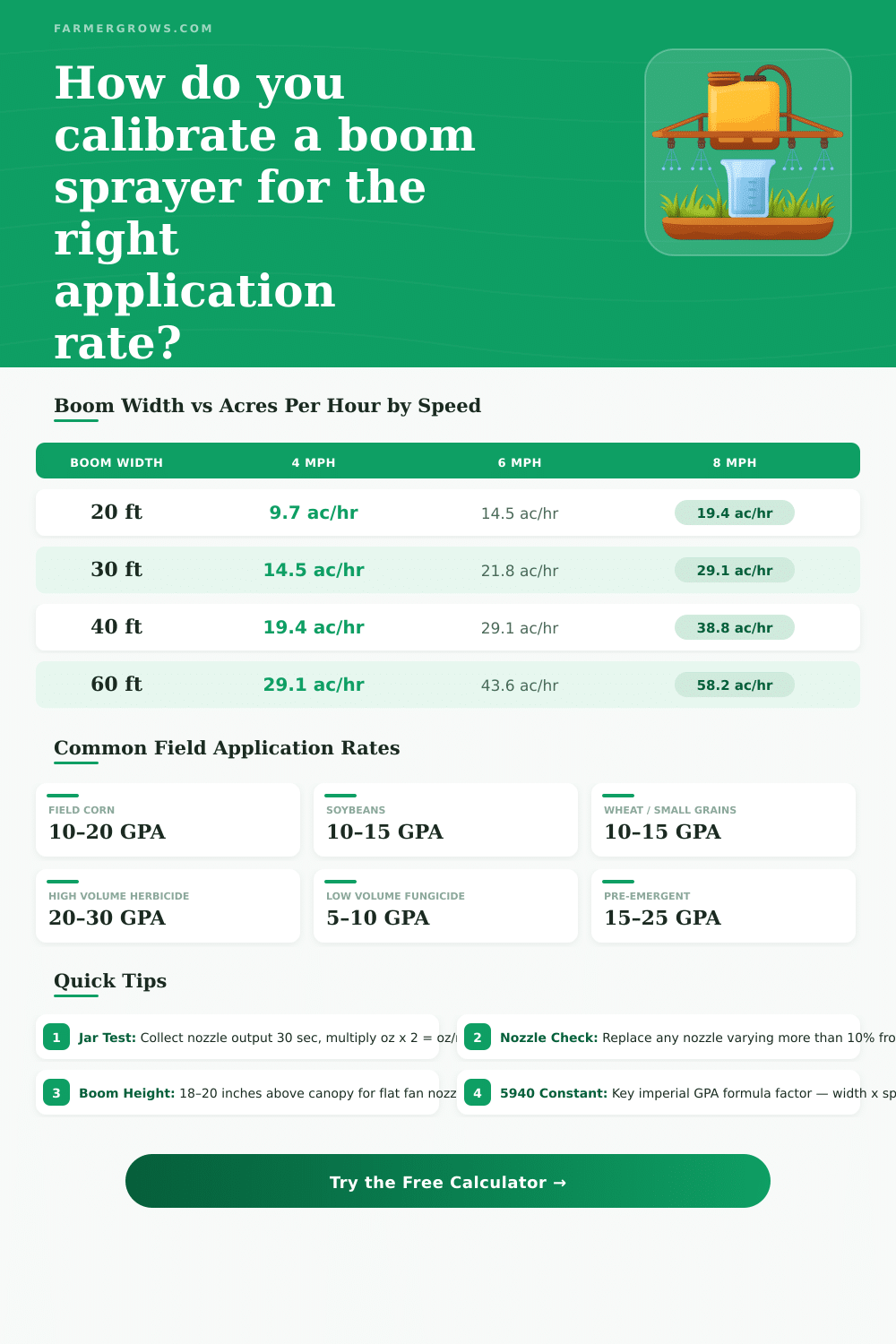
| Boom Width | 4 mph | 6 mph | 8 mph | 10 mph |
|---|---|---|---|---|
| 15 ft | 7.3 ac/hr | 10.9 ac/hr | 14.5 ac/hr | 18.2 ac/hr |
| 20 ft | 9.7 ac/hr | 14.5 ac/hr | 19.4 ac/hr | 24.2 ac/hr |
| 30 ft | 14.5 ac/hr | 21.8 ac/hr | 29.1 ac/hr | 36.4 ac/hr |
| 40 ft | 19.4 ac/hr | 29.1 ac/hr | 38.8 ac/hr | 48.5 ac/hr |
| 60 ft | 29.1 ac/hr | 43.6 ac/hr | 58.2 ac/hr | 72.7 ac/hr |
| 90 ft | 43.6 ac/hr | 65.5 ac/hr | 87.3 ac/hr | 109.1 ac/hr |
| Oz/Min (each nozzle) | 4 mph | 6 mph | 8 mph | GPM (each) |
|---|---|---|---|---|
| 8 oz/min | 14.8 GPA | 9.8 GPA | 7.4 GPA | 0.063 GPM |
| 12 oz/min | 22.1 GPA | 14.8 GPA | 11.1 GPA | 0.094 GPM |
| 16 oz/min | 29.5 GPA | 19.7 GPA | 14.8 GPA | 0.125 GPM |
| 20 oz/min | 36.9 GPA | 24.6 GPA | 18.5 GPA | 0.156 GPM |
| 24 oz/min | 44.3 GPA | 29.5 GPA | 22.1 GPA | 0.188 GPM |
| 32 oz/min | 59.1 GPA | 39.4 GPA | 29.5 GPA | 0.250 GPM |
| Crop / Application | Typical GPA | Nozzle Type | Speed Range |
|---|---|---|---|
| Field Corn — Herbicide | 10–20 GPA | Flat fan | 6–8 mph |
| Soybeans — Herbicide | 10–15 GPA | Flat fan | 6–8 mph |
| Wheat — Fungicide | 10–15 GPA | Flat fan | 6–8 mph |
| Pre-emergent Herbicide | 15–25 GPA | Flat fan | 5–7 mph |
| High Volume Insecticide | 20–30 GPA | Hollow cone | 4–6 mph |
| Low Volume Fungicide | 5–10 GPA | Drift-reduction | 7–10 mph |
| Market Garden / Vegetables | 15–30 GPA | Flat fan / cone | 3–5 mph |
| Pasture / Range | 10–20 GPA | Flat fan | 5–8 mph |
Boom sprayer calibration is to measure how many gallons it uses in acre. Calibrate pesticide applicators before the new crop season. The process is not hard when you understand some bases.
Calibrating a boom sprayer is not as hard as it sounds
How to Calibrate a Boom Sprayer
Working pressure, size and spacing of the nozzle and speed decide the amount of water used in acre for boom sprayers. To count the pesticide in the tank, first estimate how many gallons water will exit in acre. The density of the liquid alters the flow and so its output from the sprayer.
Usually you calibrate the sprayer or choose nozzle tip using clean water. Fill first the sprayer using clean water.
Before the calibration control the pressure through the whole boom, because maybe there is a leak in the line or uneven pressure. If pressure is not steady, waste no time with calibraiton.
To calibrate the sprayer you need measuring tape, a watch and measuring bowl in units. A calculator helps a lot. Flags and long tape for the way are useful too.
First measure the spacing of the nozzles on the boom. For instance, 20 inch nozzle spacing for broadcast sprayer requires 204 feet of calibration way.
Simple method for calibration requires almost no calculations. It works by spraying 1/128 of acre per nozzle and gathering the spray during the time for that area. This mode works for boom sprayers on tractors, ATVs or drawn.
Gather spray from every nozzle for exactly one minute, while the sprayer stands at the wanted pressure. Measure the units in the jar using a calibration jar. Compare the output of every nozzle with the catalog value for that type at same pressure.
Change nozzles that vary more than 10% from new.
Choose speed that you can easily repeat always. 4 miles per hour is common, which matches 352 feet per minute. Some like 3.5 miles per hour for boom spray.
With Teejet nozzles app exist, where you enter pace, boom width and gallons in acre, and it lists tips with pressures for the right amount.
Add a nozzle that hits the sides of the vehicle or around 6 inches outside to the left, help for well cover flowers or tightinclosed spaces.