🌺 Clematis Spacing Calculator
Find exact plant spacing, number of plants, and clearance from walls for any clematis variety
ℹ️ Spacing is calculated at 75% of mature spread for privacy/mass planting, or 100% spread for decorative focal points.
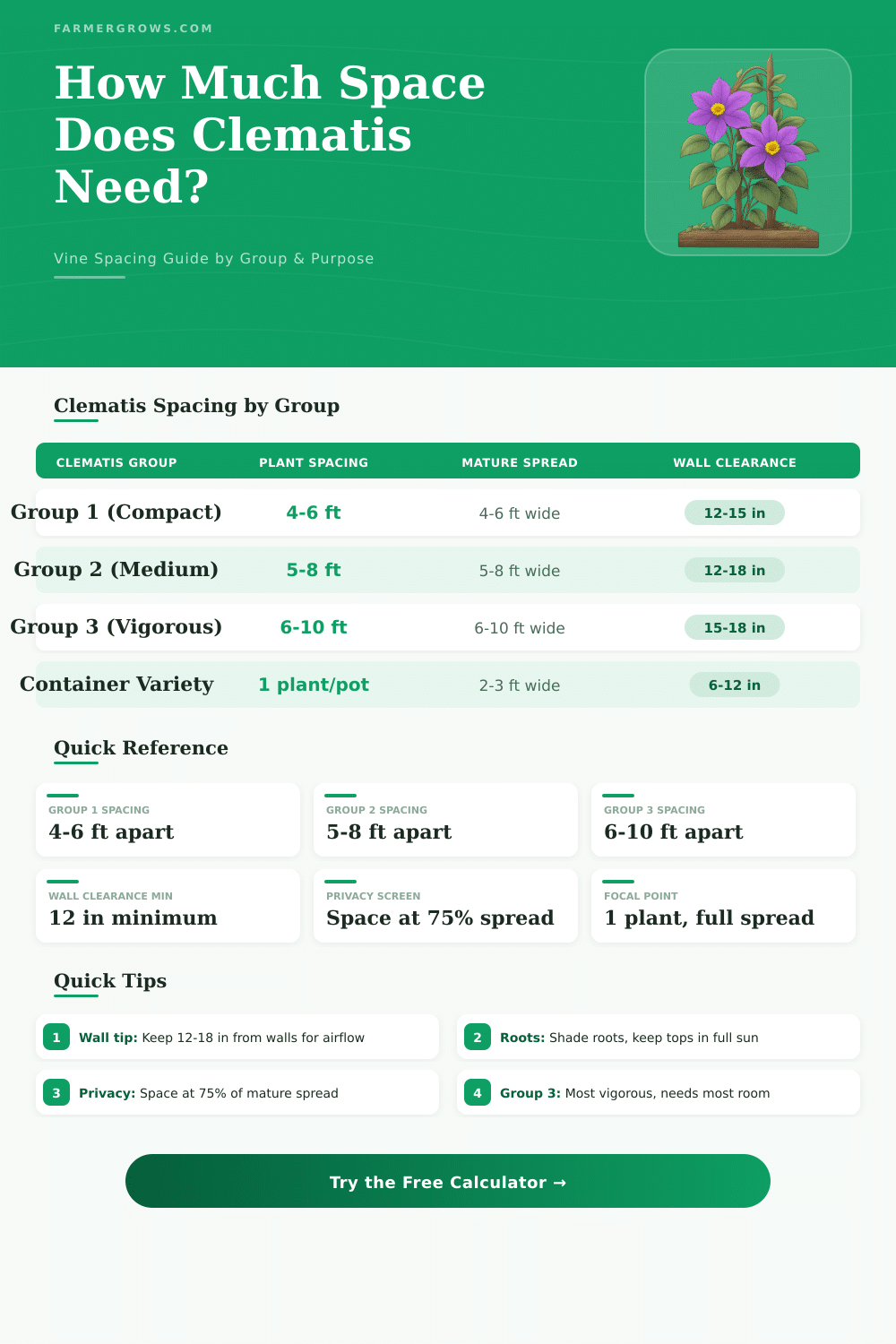
| Clematis Group | Mature Height | Mature Spread | Recommended Spacing |
|---|---|---|---|
| Group 1 – Compact (e.g. alpina, macropetala) | 8–12 ft | 4–6 ft | 4–6 ft apart |
| Group 2 – Medium (e.g. large-flowered hybrids) | 6–12 ft | 5–8 ft | 5–8 ft apart |
| Group 3 – Vigorous (e.g. viticella, tangutica) | 10–20 ft | 6–10 ft | 6–10 ft apart |
| Container / Compact Variety | 3–6 ft | 2–3 ft | 1 plant per large pot |
| Purpose | Spacing Rule | Effect | Best For |
|---|---|---|---|
| Privacy Screen | 75% of mature spread | Dense, overlapping cover | Fences, boundaries |
| Decorative / Focal Point | 100% of mature spread | Full, open display | Trellises, arbors |
| Mass Planting | 70% of mature spread | Solid coverage fastest | Large borders, walls |
| Container Planting | 1 plant per pot | Contained, manageable | Patios, balconies |
| Clematis Group | Min Support Width | Min Support Height | Clearance from Wall |
|---|---|---|---|
| Group 1 (Compact) | 4 ft wide | 8 ft tall | 12–15 in |
| Group 2 (Medium) | 5 ft wide | 10 ft tall | 12–18 in |
| Group 3 (Vigorous) | 6 ft wide | 12+ ft tall | 15–18 in |
| Container Variety | 2–3 ft wide | 4–6 ft tall | 6–12 in |
clematis plants require the right amount of space to grow well and stay healthy. One usually spaces them 24 to 36 inches from one another. Although some books mention that planting 1 to 3 feet apart works, everything depends on the specific type.
Little species can be placed more close but big ones like clematis montana require more space to spread and climb upward.
How Far to Plant Clematis and How to Care for Them
For strong types, growers must give more space than for compact bush forms. During planting, one digs quite a big hole to bury the plant from the jar up to the first leaves. Some folks leave even 6 feet between plants when one places clematis along a fence or wall.
Even so, most clematis one grows on their own.
One can also space clematis at least 3 feet, measuring from center to center. Like this the plants receive enough room to spread out. Because they cover a wide surface, creating a group from different types one beside the other commonly works well.
If one chooses form various groups, one gets a nice sight of flowers through the whole year.
Here some useful facts about the different groups. Each of them has its own needs for pruning. Spacing clematis from different groups helps to stop the plants from tangling, especially if the garden is in a region where clematis die repeatedly in winter and require hard pruning.
Climbing clematis need to keep there roots fresh and moist. Place the base in light shade or protect by means of other plants or a layer of stones. Also matters to leave enough space so that the plant reaches its full size.
Some species climb strong and can soon become a problem in too narrow an area. Clematis become heavy, so everything that backs them against walls must be firmly bound.
clematis integrifolia is a compact, leafy species with hanging blue or purple bell flowers. It grows straight upward and requires little or any support. Such forms work well for borders, jars or covering rocks.
They simply want good soil, sunshine and a bit of space to spread.
The ground plays a role also. In places with bitter soil, adding lime now and then helps to balance the pH-level. Clematis tend to grow, so while the soil must stay moist, it really must drain well.
If the roots get dry, right away transplant them in well drained ground, enriched with organic materials, that is thebest step.
A famous remark about clematis: in the first year it sleeps, in the second it creeps and in the third it jumps. So patience truly matters with this plant.