🌿 Hosta Spacing Calculator
Calculate exactly how much space your hostas need based on size category, planting style, and garden dimensions
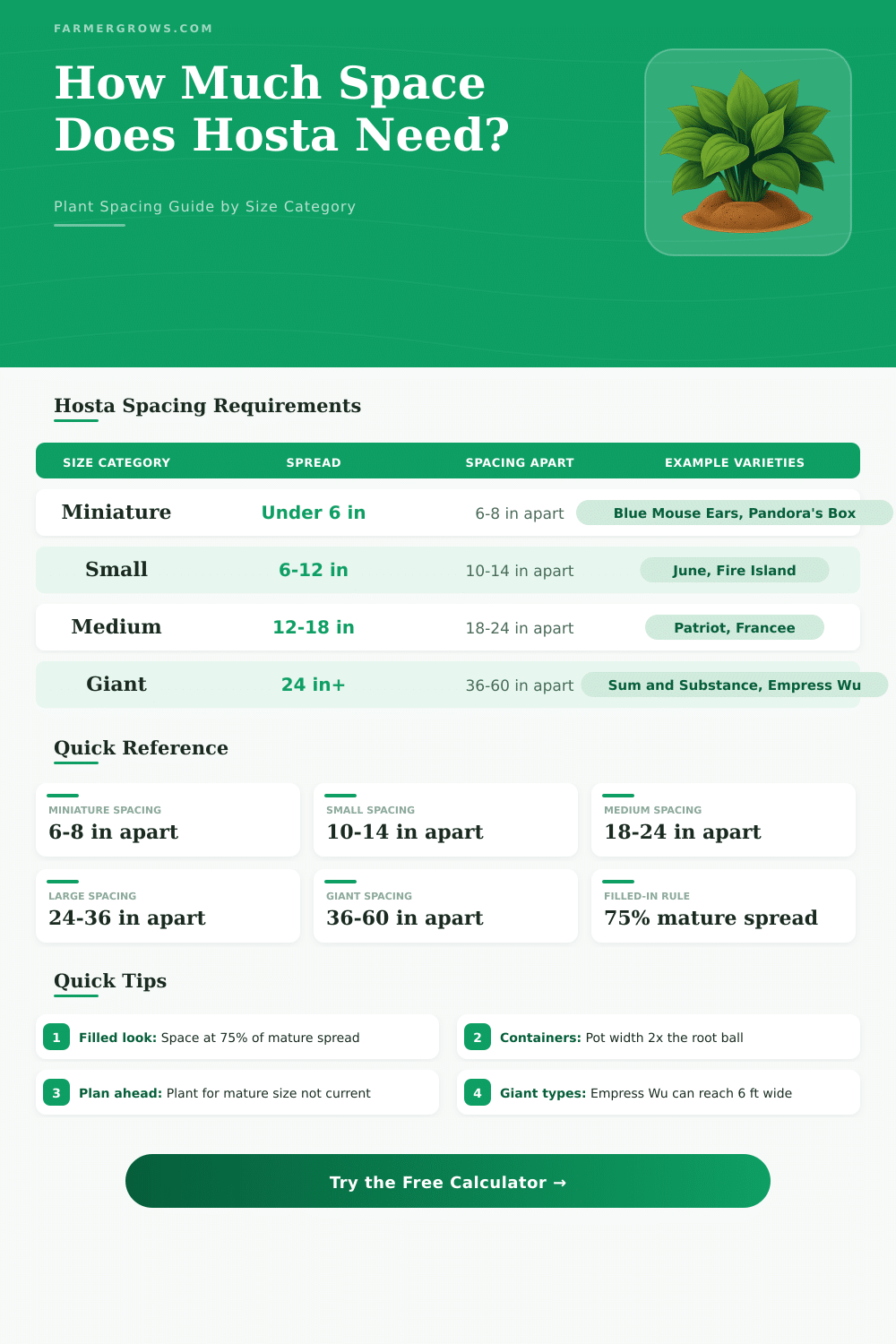
| Size Category | Mature Spread | Spacing Apart | Filled-In Spacing (75%) | Example Varieties |
|---|---|---|---|---|
| Miniature | Under 6 in (15 cm) | 6–8 in (15–20 cm) | 5–6 in (12–15 cm) | Blue Mouse Ears, Pandora's Box |
| Small | 6–12 in (15–30 cm) | 10–14 in (25–36 cm) | 8–11 in (19–27 cm) | June, Fire Island |
| Medium | 12–18 in (30–46 cm) | 18–24 in (46–61 cm) | 14–18 in (34–46 cm) | Patriot, Francee |
| Large | 18–24 in (46–61 cm) | 24–36 in (61–91 cm) | 18–27 in (46–69 cm) | Frances Williams, Sagae |
| Giant | 24–72 in (61–183 cm) | 36–60 in (91–152 cm) | 27–45 in (69–114 cm) | Sum and Substance, Empress Wu |
| Variety | Size Category | Mature Spread | Mature Height | Growth Rate |
|---|---|---|---|---|
| Blue Mouse Ears | Miniature | 5 in (12 cm) | 5 in (12 cm) | Slow |
| Pandora's Box | Miniature | 6 in (15 cm) | 4 in (10 cm) | Slow |
| June | Small | 12 in (30 cm) | 10 in (25 cm) | Moderate |
| Fire Island | Small | 10 in (25 cm) | 10 in (25 cm) | Moderate |
| Patriot | Medium | 18 in (46 cm) | 15 in (38 cm) | Moderate |
| Francee | Medium | 18 in (46 cm) | 16 in (41 cm) | Moderate |
| Frances Williams | Large | 24 in (61 cm) | 22 in (56 cm) | Moderate |
| Sagae | Large | 24 in (61 cm) | 24 in (61 cm) | Moderate |
| Sum and Substance | Giant | 60 in (152 cm) | 30 in (76 cm) | Fast |
| Empress Wu | Giant | 72 in (183 cm) | 36 in (91 cm) | Fast |
| Planting Style | Spacing Multiplier | Best For | Notes |
|---|---|---|---|
| Specimen | Full spacing (100%) | Showcasing a single hosta | Maximum air flow and display |
| Mass Planting | 75% of spacing | Filling large shaded areas | Plants grow together for impact |
| Border / Edging | 85% of spacing | Lining paths and beds | Single row along edges |
| Groundcover | 70% of spacing | Covering bare ground quickly | Tightest spacing for fast fill |
| Container | 1 plant per pot | Patios, porches, entryways | Pot width 2x root ball |
| Hosta Size | Minimum Pot Width | Recommended Pot Depth | Soil Volume |
|---|---|---|---|
| Miniature | 6 in (15 cm) | 6 in (15 cm) | 0.5 gal |
| Small | 10 in (25 cm) | 8 in (20 cm) | 1–2 gal |
| Medium | 14 in (36 cm) | 12 in (30 cm) | 3–5 gal |
| Large | 18 in (46 cm) | 14 in (36 cm) | 7–10 gal |
| Giant | 24 in (61 cm) | 18 in (46 cm) | 15–25 gal |
| Size Category | Year 1 | Year 3 | Year 5 | Years to Mature |
|---|---|---|---|---|
| Miniature | 40% of mature size | 70% of mature size | 90% of mature size | 4–6 years |
| Small | 35% of mature size | 65% of mature size | 85% of mature size | 4–6 years |
| Medium | 30% of mature size | 60% of mature size | 85% of mature size | 5–7 years |
| Large | 25% of mature size | 55% of mature size | 80% of mature size | 6–8 years |
| Giant | 20% of mature size | 50% of mature size | 75% of mature size | 7–10 years |
The distance between hosta plants depends much on the kind of plant. Different types require different amounts of space. According to the type, one should plant them 1 to 4 feet from one another.
When the type is not known leaving around 3 feet between the plants is a safe choice.
How Far Apart Should You Plant Hosta?
Big hosta plants tend to spread in 3 feet or even more wide. These big types require at least 4 feet of space so that they can freely grow. Rather, small types like Etela Fire reach maturity at 1 to 2 feet wide.
If you want to quickly cover the ground without risking the health of the plants, plant them at about 1 foot from one another.
For medium plants a distance of 32 to 36 inches from center to center works well. The 36-inch space commonly is the best choice. When the leaves almost only touch each other, the group looks clean and well shaped.
In new hosta gardens with small plants, that has only some leaves, one can start planting them at 24 to 30 inches aprat.
During planting, the hole should have depth equal to that of the root ball and be at least double in the width. This way the roots receive enough space to expand freely, without being pressed or bent. A whole 6 to 8 inches deep and twice that much wide works well.
Add organic material to the ground is also useful, because hosta plants like rich, moist soil full of organic matter.
One commonly feels temptation to plant hosta plants heavily to reach a full, mature look. Even so too much crowding slows their growth and tight air flow can cause diseases in the leaves. Hosta plants slowly grow their clumps over time, and so proper space is very important.
Always try to check the notes on the labels of the plants before you put them in the ground.
hosta plants spread from roots in clumps, and those clumps can grow quite a lot over time. Usually what limits more growth is crowding with other hosta in the same bed. Then the plants start to compete for light and space.
When a hosta bed is too heavily planted, you need to split the hosta plants more often, when they fill it. Some gardeners like the dense look, where clumps overlap one another and form easy ground cover. Others like to split them so they stay sorted in their limits.
Splitting hosta plants is a fairly simple task. The best time is in early spring, when they just start coming from the ground. Dig them out and then cut like cake in three parts is the usual way.
Even big old hosta plants can be split in eighths or even twelfths, if one wants many new plants. Splitting or buying of new types, that grow to the same size as theexisting ones, helps to keep the bed nice.