🍓 Raspberry Sunlight Calculator
Find out exactly how much sun your raspberry plants need based on type, climate, and garden conditions
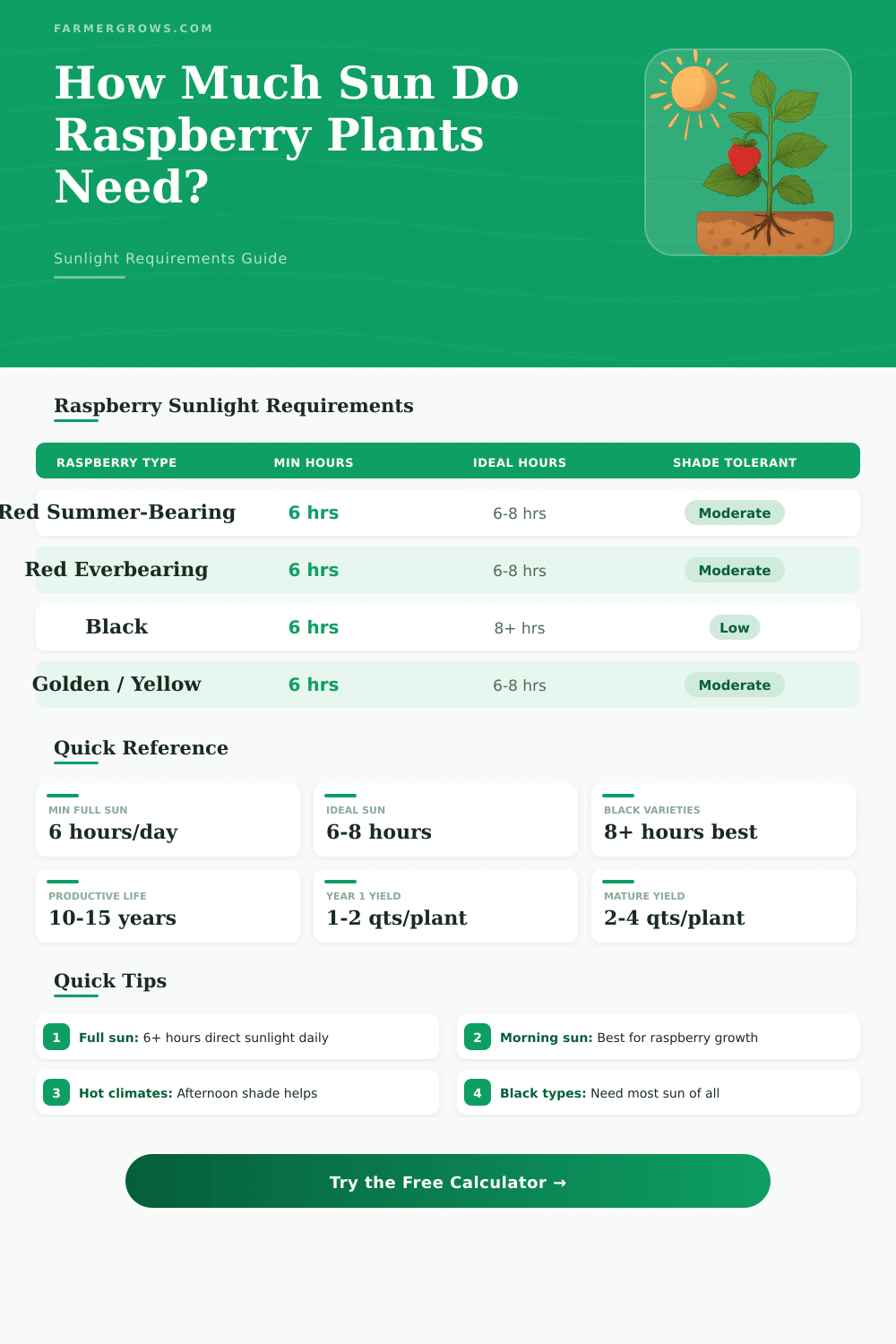
| Raspberry Type | Category | Min Sun (hrs) | Ideal Sun (hrs) |
|---|---|---|---|
| Red Summer-Bearing | Floricane | 6 | 6–8 |
| Red Everbearing | Primocane | 6 | 6–8 |
| Black | Floricane | 6 | 8+ |
| Golden / Yellow | Primocane | 6 | 6–8 |
| Purple | Hybrid | 6 | 6–8 |
| Climate Zone | Avg Summer Temp | Sun Adjustment | Notes |
|---|---|---|---|
| Hot (USDA 9–13) | 90°F+ / 32°C+ | Afternoon shade essential | Provide 40–50% shade cloth after 1pm to prevent sunscald |
| Warm (USDA 7–8) | 80–90°F / 27–32°C | Light afternoon shade | Morning sun preferred, light shade after 3pm helpful |
| Moderate (USDA 5–6) | 70–80°F / 21–27°C | Full sun ideal | No adjustment needed, peak raspberry growing zone |
| Cool (USDA 3–4) | 60–70°F / 16–21°C | Full sun essential | South-facing slopes best, maximize every sun hour |
| Raspberry Type | In-Row Spacing (ft) | Row Spacing (ft) | In-Row Spacing (cm) |
|---|---|---|---|
| Red Summer-Bearing | 2–3 | 6–8 | 60–90 |
| Red Everbearing | 2–3 | 6–8 | 60–90 |
| Black | 3–4 | 8–10 | 90–120 |
| Golden / Yellow | 2–3 | 6–8 | 60–90 |
| Purple | 3–4 | 8 | 90–120 |
| Plant Age | Yield Per Plant | Productive Life | Notes |
|---|---|---|---|
| Year 1 | 1–2 quarts | Establishing | Limited harvest, focus on root development |
| Year 2–3 | 2–4 quarts | Maturing | Production increasing each year |
| Year 4–8 | 3–5 quarts | Peak production | Highest yields with proper sun and care |
| Year 9–15 | 2–4 quarts | Declining | Yields taper, consider replacing canes |
Raspberries really benefit from rich sunshine, best around 6 to 8 hours of direct Sun daily. Here the key point however: do not leave that everything hits them at once. If you break the Sun during the day, that really helps you because it will stop the fruits getting sunburn all along.
Soil is also important as light. Those plants really need well drained and rich ground. When you mix plenty of Sun with good soil, then come good fruit yields.
Growing Raspberries: Sun, Soil and Space
Plant so, pushing the canes in the ground until the crown, like this, as they sat in the old jar. Space them around 30 to 45 centimetres apart, and everything will be well.
Black raspberries have same need in light as their red relatives, that need 6 to 8 hours of direct Sun to give juicy berries. Black types can cope with less than 6 hours, but really, the amount of fruit drops clearly. Those thorns are quite cruel also.
The bottom of the point is: any Raspberry Plant that regularly receives 6 hours of daily Sun, should give good result.
Things get harder in very warm climates with endless Sun. The tips of the canes can burn during the strong heat with full exposure. In such cases shady cover becomes your friend.
Keep the pH of the soil between 5.5 and 6.5 for healthy plants. One trap to escape is too much crowding, that hurts many growers.
In bad warm waves with strong direct Sun, the raspberry leaves sometimes brown at the edges and curl upward. That shows sunburn or marks that the plants do not receive enough water. Hot weather causes such problems.
Like this you plant them very carefully. You want good airflow for fighting against diseases, but not so strong that it creates problems. Raspberry canes dry quickly, if they catch wind.
A sheltered place, that yet takes enough Sun, is the ideal. Point your rows from north too south, so that the plants receive most light, and that also reduces risk more below.
For fully grown canes, plant them around 30 centimetres apart during winter works well. Space your rows about 150 centimetres apart. Test different types, because some adapt to certain climates more well than others.
The Mysore-raspberry, for instance, does not need winter cold to flower and fruit, ideal for gardening in south areas.
Partial shade from nearby trees commonly gives too little of what those plants want. A place on the south side of a house with a bit of morning and evening light could leave them hungry for more. Full open sky always is better, if you can control it.
Protective metal fence driven around 13 centimetres in the ground helps to keep the plants, while it leavesthem in sunny, open surroundings.