🏗️ Crushed Concrete Calculator
Calculate cubic yards, bags, and weight for crushed concrete & recycled aggregate projects
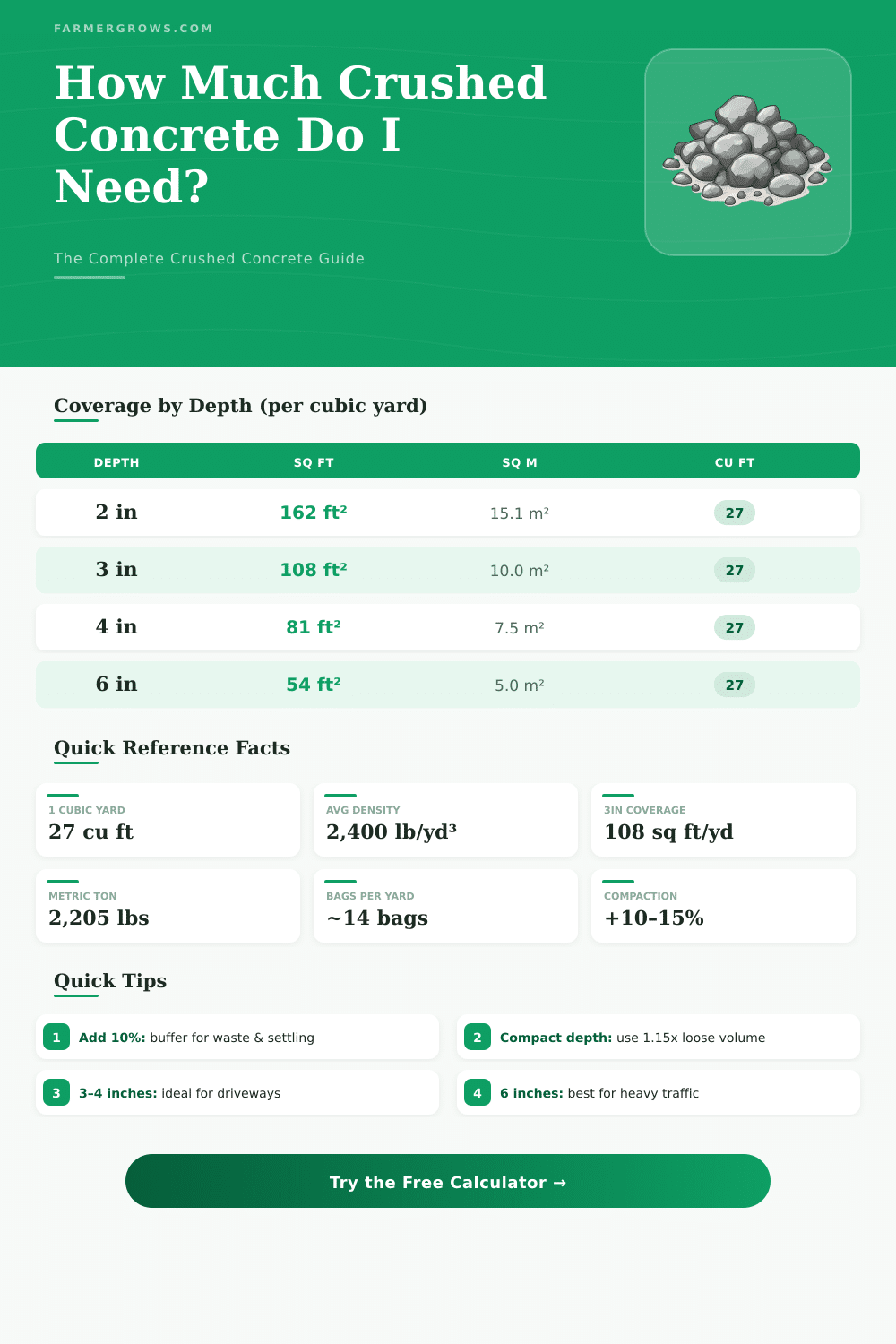
| Depth (in) | Depth (cm) | Coverage (sq ft) | Coverage (m²) | Cubic Feet |
|---|---|---|---|---|
| 1 in | 2.5 cm | 324 sq ft | 30.1 m² | 27 cu ft |
| 2 in | 5.1 cm | 162 sq ft | 15.1 m² | 27 cu ft |
| 3 in | 7.6 cm | 108 sq ft | 10.0 m² | 27 cu ft |
| 4 in | 10.2 cm | 81 sq ft | 7.5 m² | 27 cu ft |
| 6 in | 15.2 cm | 54 sq ft | 5.0 m² | 27 cu ft |
| 8 in | 20.3 cm | 40.5 sq ft | 3.8 m² | 27 cu ft |
| 12 in | 30.5 cm | 27 sq ft | 2.5 m² | 27 cu ft |
| Bag Size | Volume / Bag | Bags per Cu Yd | Coverage @ 3 in | Coverage @ 4 in |
|---|---|---|---|---|
| 0.5 cu ft bag | 0.5 cu ft | 54 bags | 2 sq ft | 1.5 sq ft |
| 2 cu ft bag | 2 cu ft | 13.5 bags | 8 sq ft | 6 sq ft |
| 3 cu ft bag | 3 cu ft | 9 bags | 12 sq ft | 9 sq ft |
| 50 lb bag (~0.5 cu ft) | ~0.5 cu ft | ~54 bags | 2 sq ft | 1.5 sq ft |
| Bulk – 1 ton | ~0.74 yd³ | N/A | ~80 sq ft | ~60 sq ft |
| Project | Area (sq ft) | Cu Yds @ 3 in | Cu Yds @ 4 in | Cu Yds @ 6 in |
|---|---|---|---|---|
| Small Path 4x10 | 40 sq ft | 0.37 yd³ | 0.49 yd³ | 0.74 yd³ |
| Patio 10x12 | 120 sq ft | 1.11 yd³ | 1.48 yd³ | 2.22 yd³ |
| Driveway 12x20 | 240 sq ft | 2.22 yd³ | 2.96 yd³ | 4.44 yd³ |
| Driveway 12x50 | 600 sq ft | 5.56 yd³ | 7.41 yd³ | 11.11 yd³ |
| Parking Pad 20x20 | 400 sq ft | 3.70 yd³ | 4.94 yd³ | 7.41 yd³ |
| Large Pad 30x50 | 1,500 sq ft | 13.89 yd³ | 18.52 yd³ | 27.78 yd³ |
Finding the right amount of crushed concrete for your work does not require great experience, just one basic math step. Multiply the length by the width then by the depth or thickness, that you intend to use for the material. This way you get the total volume, that you will work with.
The volume measures in cubic yards, which is the usual unit in construction. Here is the conversion: because one cubic yard equals 27 cubic feet, divide the total amount of cubic feet by 27. But the thickness of the layer matters a lot.
How Much Crushed Concrete Do You Need
For example, a 150-foot driveway with 12 feet of width will require very different amounts of crushed concrete, depending on whether you lay something low or a bit heavy.
The math itself is pretty easy. Length times width times depth in inches, then divide by 12 to pass to feet. Then divide by 27 to raech cubic yards.
For the weight, multiply the cubic feet by the density (in pounds per cubic foot), then divide by 2,000 to get tons. Always use the same formula.
Here density plays a lead role. Most kinds of crushed concrete weigh around 120 pounds per cubic foot, which gives between 2,400 and 2,410 pounds per cubic yard, say around 1.21 tons per yard, or almost 0.8 cubic yards per ton. One ton equals around 0.714 cubic yards.
Type 2 crushed concrete in the small size (from zero to 80 millimeters) weighs more, around 1.50 tons per cubic metre.
So hear it gets complex. Bigger bits of concrete act differently. If you have blocks of four to six inches, they usually are chunky and angled, which changes how they fill the space.
The real density, when it is installed, depends strongly on the size and shape of those small parts. Also the moisture matters, when you buy by weight, the moisture of the material can change the numbers quite a lot.
Recycled Concrete Aggregate, or RCA, is the official name for crushed concrete. Industrial machines for breaking and sifting crush it to the wanted size. It works well as base under new concrete, pavings or driveways.
You can use it also in drainage holes, dry spots or French drains, if that fits with your plan. Some use it for landscape berms, building mounds and covering them with soil. One warning though: it does not compact as well as natural grit or gravel.
Online calculators help to quickly finish all this math. Enter the length, width and depth, and they will give the needed cubic yards, cubic feet and tons. The secret is knowing the exact density of your material, sothat the numbers truly match what you buy.