🐴 Horse Grain Feed Calculator
Calculate daily and weekly grain requirements for your horse based on weight, activity, and feed type
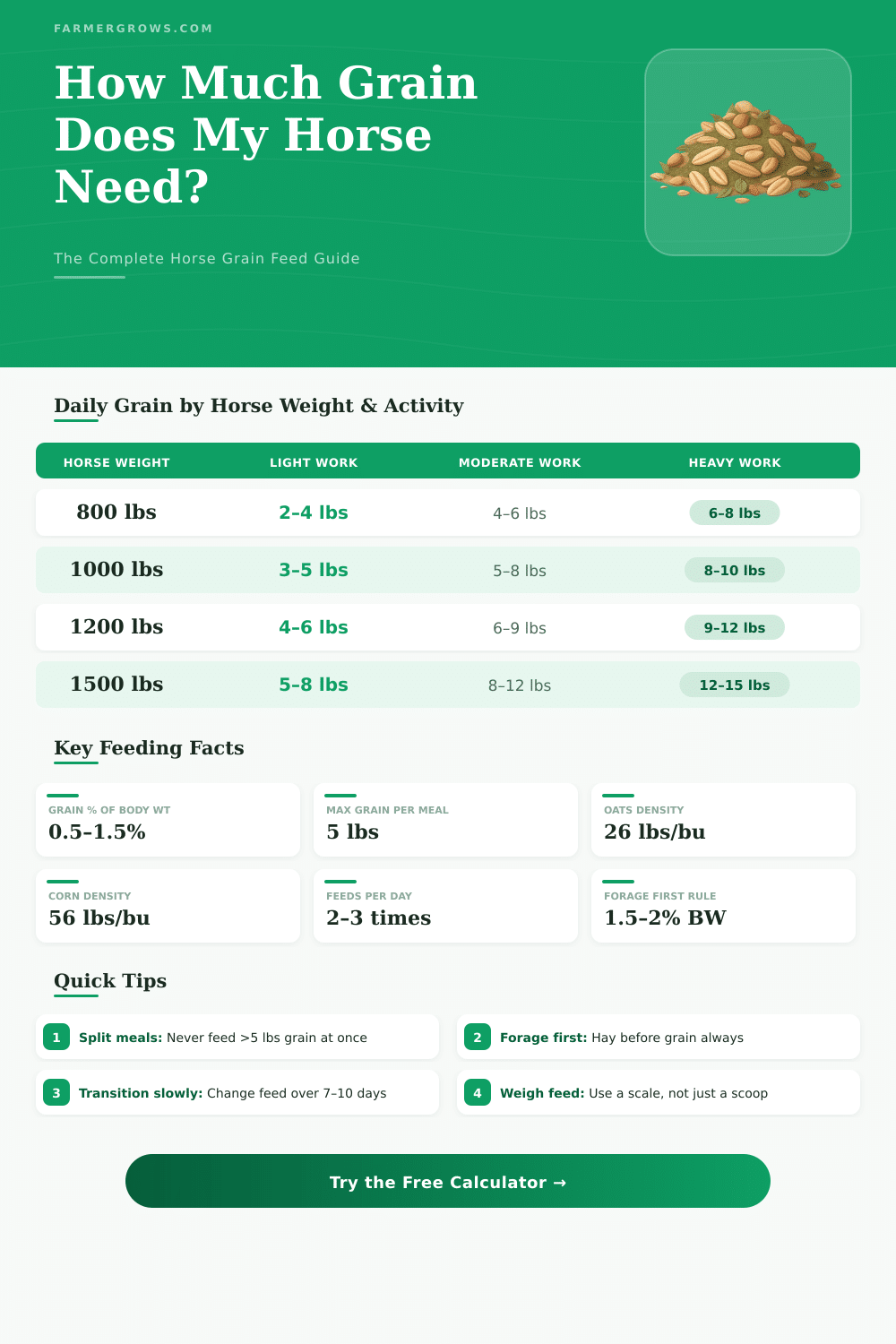
| Horse Weight | Maintenance | Light Work | Moderate Work | Heavy Work | Performance |
|---|---|---|---|---|---|
| 500 lbs (227 kg) | 0–1.5 lbs | 1–2.5 lbs | 2–4 lbs | 3–5 lbs | 4–6 lbs |
| 800 lbs (363 kg) | 0–2 lbs | 2–4 lbs | 3–5 lbs | 5–7 lbs | 6–9 lbs |
| 1000 lbs (454 kg) | 0–2.5 lbs | 3–5 lbs | 4–7 lbs | 6–9 lbs | 8–11 lbs |
| 1100 lbs (499 kg) | 0–3 lbs | 3–5.5 lbs | 5–8 lbs | 7–10 lbs | 9–12 lbs |
| 1200 lbs (544 kg) | 0–3 lbs | 4–6 lbs | 5–9 lbs | 8–11 lbs | 10–14 lbs |
| 1500 lbs (680 kg) | 0–4 lbs | 5–7.5 lbs | 7–11 lbs | 10–14 lbs | 12–17 lbs |
| Bag Size | Daily Use (5 lbs/day) | Days Per Bag | Bags Per Month | Bags Per Year |
|---|---|---|---|---|
| 50 lbs | 5 lbs/day | 10 days | 3 bags | 36.5 bags |
| 50 lbs | 8 lbs/day | 6.25 days | 4.8 bags | 58.4 bags |
| 50 lbs | 10 lbs/day | 5 days | 6 bags | 73 bags |
| 40 lbs | 5 lbs/day | 8 days | 3.75 bags | 45.6 bags |
| 40 lbs | 8 lbs/day | 5 days | 6 bags | 73 bags |
| 25 lbs | 5 lbs/day | 5 days | 6 bags | 73 bags |
| Activity Level | Grain % of Body Wt | Example: 1000 lb Horse | Example: 1200 lb Horse | Max Grain Per Meal |
|---|---|---|---|---|
| Maintenance | 0–0.5% | 0–5 lbs/day | 0–6 lbs/day | 3 lbs |
| Light Work | 0.5–1.0% | 5–10 lbs/day | 6–12 lbs/day | 4 lbs |
| Moderate Work | 0.75–1.25% | 7.5–12.5 lbs/day | 9–15 lbs/day | 5 lbs |
| Heavy Work | 1.0–1.5% | 10–15 lbs/day | 12–18 lbs/day | 5 lbs |
| Performance | 1.25–2.0% | 12.5–20 lbs/day | 15–24 lbs/day | 5 lbs |
Horse grain feed help a lot so that horses stay healthy, even so it not always needed for each of them. The basic part of the food for any horse must be made up of hay. So hay and feed comes first.
One adds extras, as grains or pellets, for filling gaps of nutrients in that hay.
Hay and Grain for Horses
Horses need carbohydrates as main source of energy, together with fats for extra force, proteins for building the body, minerals, vitamins and water. Usual types of feed include hay, pasture and extras as oats. The main grains, that one gives to horses, are oats, barley and corn.
One uses also wheat and milo, but less commonly. Oats stay the favourite and most relibale grain for feed horses.
Oats form bigger grain, so that horses chew them well to break the bark of the seed, without need of extra work. Oat flour digests much more easily than corn or barley flour in raw state. So one can give oats whole and raw.
Even so, the decision about giving raw oats must depend on every horse especially. It is useful to watch the dung of the horse closely when one starts too feed them.
Grain delivers extra fats and energy, what helps to quickly reach good shape. Even so not every horse needs grain. Horse, that walks on good pasture during summer, commonly does not need other feed, although a salt block and sometimes a vitamin-mineral supplement is still useful.
Especially light work horses must not get grain. They receive calories mostly from pasture, and extra feed serves only to fill lacking minerals.
Things that affect the food needs of a horse are breed, weight, physical state, age, growing phase, breeding situation and level of training. There is not one right feed, because each horse can live well or have troubles on different diets. For one horse the ideal could be without grain entirely.
When a horse does need extra feed, the form of that feed depends on several things.
One never gives big amounts of grain during one meal. Horses are mostly fiber digesters, so access to hay through the day is the most important. Too much oats or grain can cause excess of buildup in the belly, what can lead to colic and founder.
Processed feeds have the plus that they are precooked, so they escape risk of buildup.
Some feeds are made for separate goals. Mixed feeds can meet energy needs for pregnant mares and active sport horses. There are also organic types, with items as organic corn, organic oats and organic roasted soy flakes.
When a horse gets good pasture and the right amount of the right feed, extra supplements usually are not needed. Sensibleswing can help well for horses in light work, that do not need many extra calories.