🌿 Garden Bed Size Calculator
Calculate exactly how much soil, mulch, or compost your garden bed needs
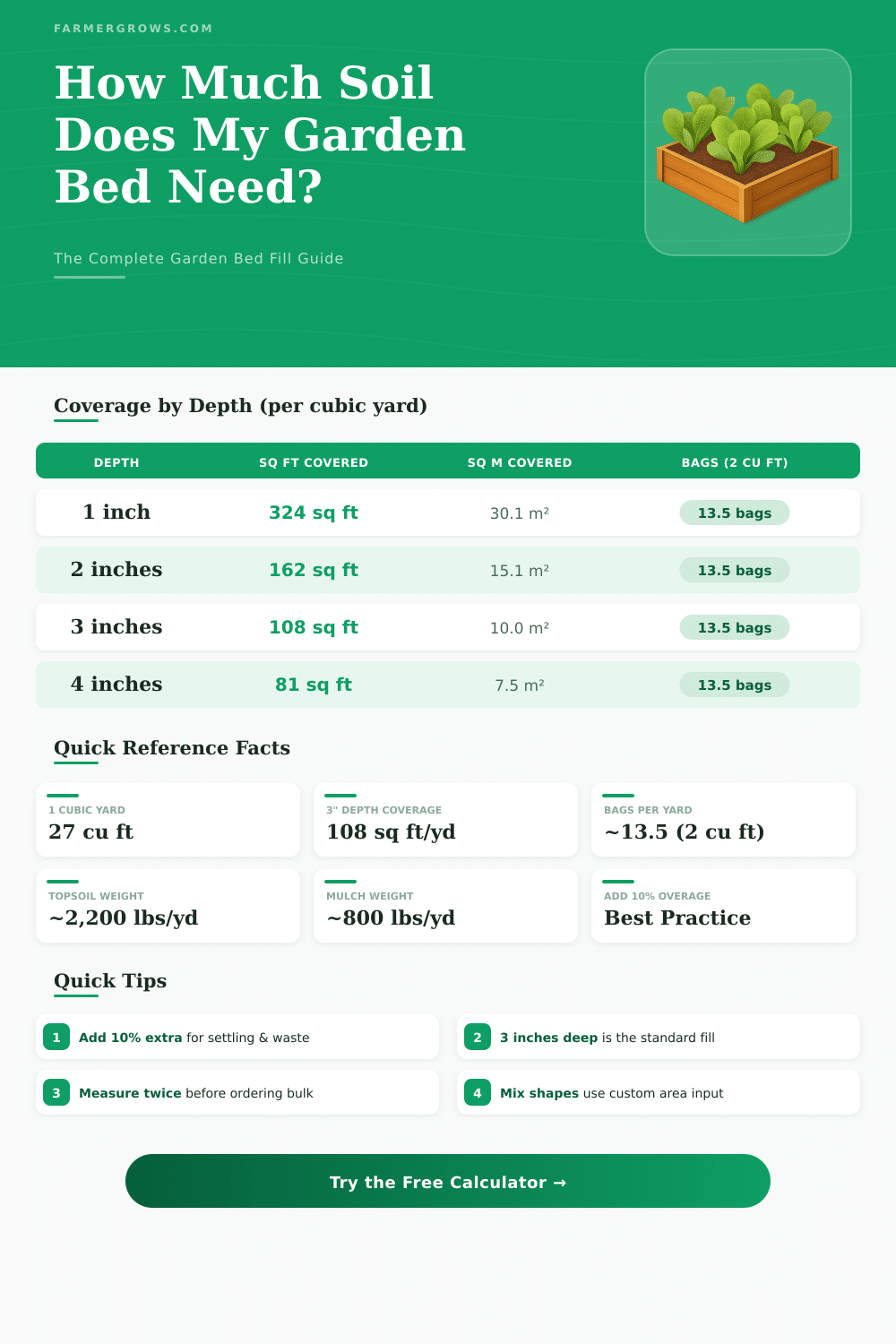
| Depth | Sq Ft / Cu Yd | Sq M / Cu M | 2 Cu Ft Bags / Yd | 3 Cu Ft Bags / Yd |
|---|---|---|---|---|
| 1 inch (2.5 cm) | 324 sq ft | 30.1 m² | 13.5 bags | 9 bags |
| 2 inches (5 cm) | 162 sq ft | 15.1 m² | 13.5 bags | 9 bags |
| 3 inches (7.6 cm) | 108 sq ft | 10.0 m² | 13.5 bags | 9 bags |
| 4 inches (10 cm) | 81 sq ft | 7.5 m² | 13.5 bags | 9 bags |
| 6 inches (15.2 cm) | 54 sq ft | 5.0 m² | 13.5 bags | 9 bags |
| 12 inches (30.5 cm) | 27 sq ft | 2.5 m² | 13.5 bags | 9 bags |
| Bag Size | Cu Ft / Bag | Bags per Cu Yd | Coverage @ 2" | Coverage @ 3" |
|---|---|---|---|---|
| Small bag | 1 cu ft | 27 bags | 6 sq ft | 4 sq ft |
| Standard bag | 2 cu ft | 13.5 bags | 12 sq ft | 8 sq ft |
| Large bag | 3 cu ft | 9 bags | 18 sq ft | 12 sq ft |
| Half yard | 13.5 cu ft | 0.5 yd³ | 81 sq ft | 54 sq ft |
| Full yard (bulk) | 27 cu ft | 1 yd³ | 162 sq ft | 108 sq ft |
| Project | Dimensions | Area | Cu Yards | Bags (2 cu ft) |
|---|---|---|---|---|
| Small raised bed | 4 x 8 ft | 32 sq ft | 0.30 yd³ | ~4 bags |
| Border bed | 3 x 20 ft | 60 sq ft | 0.56 yd³ | ~8 bags |
| Veggie garden | 10 x 12 ft | 120 sq ft | 1.11 yd³ | ~15 bags |
| Tree ring (8ft dia) | 8 ft dia | 50 sq ft | 0.46 yd³ | ~7 bags |
| Large flower bed | 15 x 20 ft | 300 sq ft | 2.78 yd³ | ~38 bags |
| Full backyard bed | 30 x 40 ft | 1200 sq ft | 11.11 yd³ | ~150 bags |
Choosing the right size for your raised garden bed size can really change everything. That affects the comfort of your gardening life and the amount of harvest that you actually get. For the width, the ideal usually sits around four feet.
Such sizes work well, because adults can easily reach past the centre from any side, without needing to walk in the bed itself. Avoiding steps on the ground is key. It stops packing that destroys the soil.
How to Choose the Right Size for a Raised Garden Bed
If you plan to garden with children, choose a bit narrower option. Three-foot width works for them much better. When the bed stands against a wall or fence and only one side is available, do it between two and two-half feet wide.
Like this everything stays inside reaching distance for the arms, without needing paths.
The layout 4×4 is very popular for good reason. It perfectly fits with square foot garden systems, splitting into 16 separate squares. Because you can walk fully around it, nothing is more than two feet away from your hands.
Some folks get creative and build the upper edges quite a lot broad for seating, that makes it really practical.
There is also the format 4×8, that is another big favorite. Because the most common wooden boards come in eight-foot lengths, building a 4×8 bed saves material and time. 4×10 or 4×12 also work well, if you have the long space.
Combiantions like two feet high with 4×4, 4×8 or 4×12 help to cut the waste of materials.
The depth is a separate thing to think about. Garden beds need at least eight inches of soil depth. For the most common vegetables though, twelve inches work for their needs.
If your ground drains poorly or you grow plants that like dryness, go more deep and fill with really draining growth mix, that helps a lot. Eight-to-twelve-inch high beds of 4×8 can hold around two to three cubic bags of soil, which quickly becomes costly.
Beds narrower then around 33 inches risk leaving out too much space. Turning to broader beds brings other troubles. Reaching the centre across a broad bed almost forces you into the ground.
Such outside reaching causes trouble, if you have problems with weight.
Commercial growers like 30-inch broad beds with a foot of space between them. Such narrowness allows heavily planting vegetables. The most common folks end with raised beds between three and four feet broad and six to ten feet long.
If you must choose one standard, four feet broad, eight feet long and two feet deep hits the target. Raised beds look better grouped in pairs or thirds than alone, although a single cedar bed still has its charm. Pressure-treated wood or cedar helps bedslast well past five years.