🌱 Plant Age Calculator
Estimate how old your tree, shrub, or plant is using height, trunk size, or growth rate
/yr
/yr
/yr
/yr
/yr
/yr
/yr
/yr
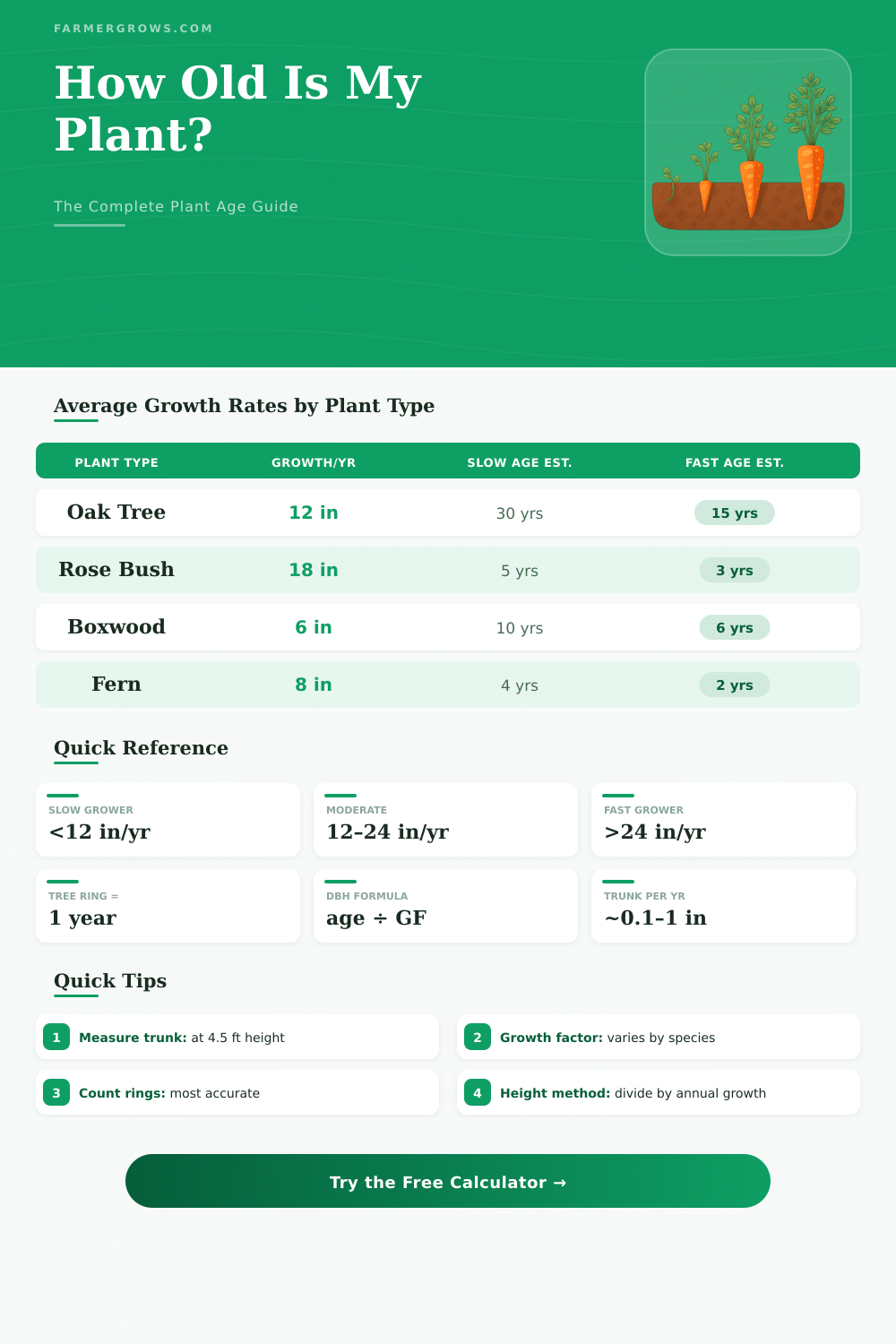
| Tree Species | Growth Factor | Formula | Accuracy |
|---|---|---|---|
| Oak (Red, White) | 4.0 – 5.0 | DBH (in) × 4.5 | ±10% |
| Maple (Sugar) | 5.0 | DBH (in) × 5.0 | ±10% |
| Pine (Eastern White) | 5.0 | DBH (in) × 5.0 | ±15% |
| Cedar (Eastern Red) | 7.0 | DBH (in) × 7.0 | ±15% |
| Birch | 5.0 | DBH (in) × 5.0 | ±12% |
| Willow | 2.0 | DBH (in) × 2.0 | ±20% |
| Arborvitae | 5.5 | DBH (in) × 5.5 | ±15% |
| Rose Bush | — | Use height method | Height-based |
| Height (ft) | Oak (yrs) | Pine (yrs) | Rose Bush (yrs) | Boxwood (yrs) |
|---|---|---|---|---|
| 1 ft (0.3 m) | 1–2 | 1 | 1 | 2–4 |
| 3 ft (0.9 m) | 2–3 | 1–2 | 2 | 6–12 |
| 6 ft (1.8 m) | 4–6 | 2–3 | 3–4 | 12–24 |
| 10 ft (3.0 m) | 7–10 | 4–5 | 5–7 | 20–40 |
| 20 ft (6.1 m) | 13–20 | 7–10 | 10+ | 40+ |
| 40 ft (12.2 m) | 26–40 | 14–20 | — | — |
| 60 ft (18.3 m) | 40–60 | 20–30 | — | — |
| DBH (in) | DBH (cm) | Oak Age (yrs) | Pine Age (yrs) | Willow Age (yrs) |
|---|---|---|---|---|
| 2 in | 5 cm | 9 | 10 | 4 |
| 4 in | 10 cm | 18 | 20 | 8 |
| 6 in | 15 cm | 27 | 30 | 12 |
| 10 in | 25 cm | 45 | 50 | 20 |
| 14 in | 36 cm | 63 | 70 | 28 |
| 20 in | 51 cm | 90 | 100 | 40 |
| 30 in | 76 cm | 135 | 150 | 60 |
Plants do not age according to the same way as creatures. Rather than animals, they do not have a fixed age or size, when one considers them mature or old. They have something called indefinite growth.
When the conditions allow, they simply keep growing with almost no limit. That marks quite a dramatic difference compared to human bodies.
How Plants Age and How We Tell Their Age
Plants do not age like folks, because there are basic differences in the way their tissues die and regrow. Although the Plant Age similarly to each other living creature, they evolved to escape death during thousands of years and maybe forever. That sounds dramatic, but some cases truly prove it.
One can estimate roughly how old a plant is. For dead trees and fossils one commonly uses carbon dating. It counts the amount of carbon-14 that stays in the fossil.
For living trees the growth rings in the wood help a lot. Those rings from wood one calls annual rings, and they help estimate the Plant Age. Growth rings show mostly in plants form mild regions.
Some plants live surprisingly long times. Methuselah, a bristlecone pine in California, is around 4 800 years old. Its precise place stays secret to protect it.
There also exist cloned plants, where separate trunks share the same DNA. Every trunk can last only around 130 years, but the root system will persist during thousands of years, always regrowing by means of new shoots. Those roots form the oldest known plant sample.
Some cloned plants, like quaking aspen and box huckleberry, are said to pass 10 000 years of age, but the older parts always die and rot, so there is no one single continuous structure.
Even so not all plants reach such ages. Most flowering plants last less than one year. Most trees live under 40 years.
Cottonwood trees usually do not pass 100 years. Plants can be annual, biennial or ongoing. Annual plants grow and finish their life cycle in one single season.
Some fruit trees also age and stop making fruits. For instance, buffalo plum trees have a lifetime of around 25 years.
The Plant Age also affects other parts. Younger and strong plants commonly are more open to attacks from plant eaters than more old and mature ones. A hormone system controls that age-based balance between growth and defence.
Also the age of leaves matters. The rate of making food and use of nitrogen sink, when leaves age. Like the age of the whole plant, they can put more defensive material and grow leaves with traits that save resources.
After sprouting, the first stage is the young phase, in that theplant does not fit to flower even in ideal conditions. If the root stays unchanged, the plant can last destruction, stay alive and regrow.