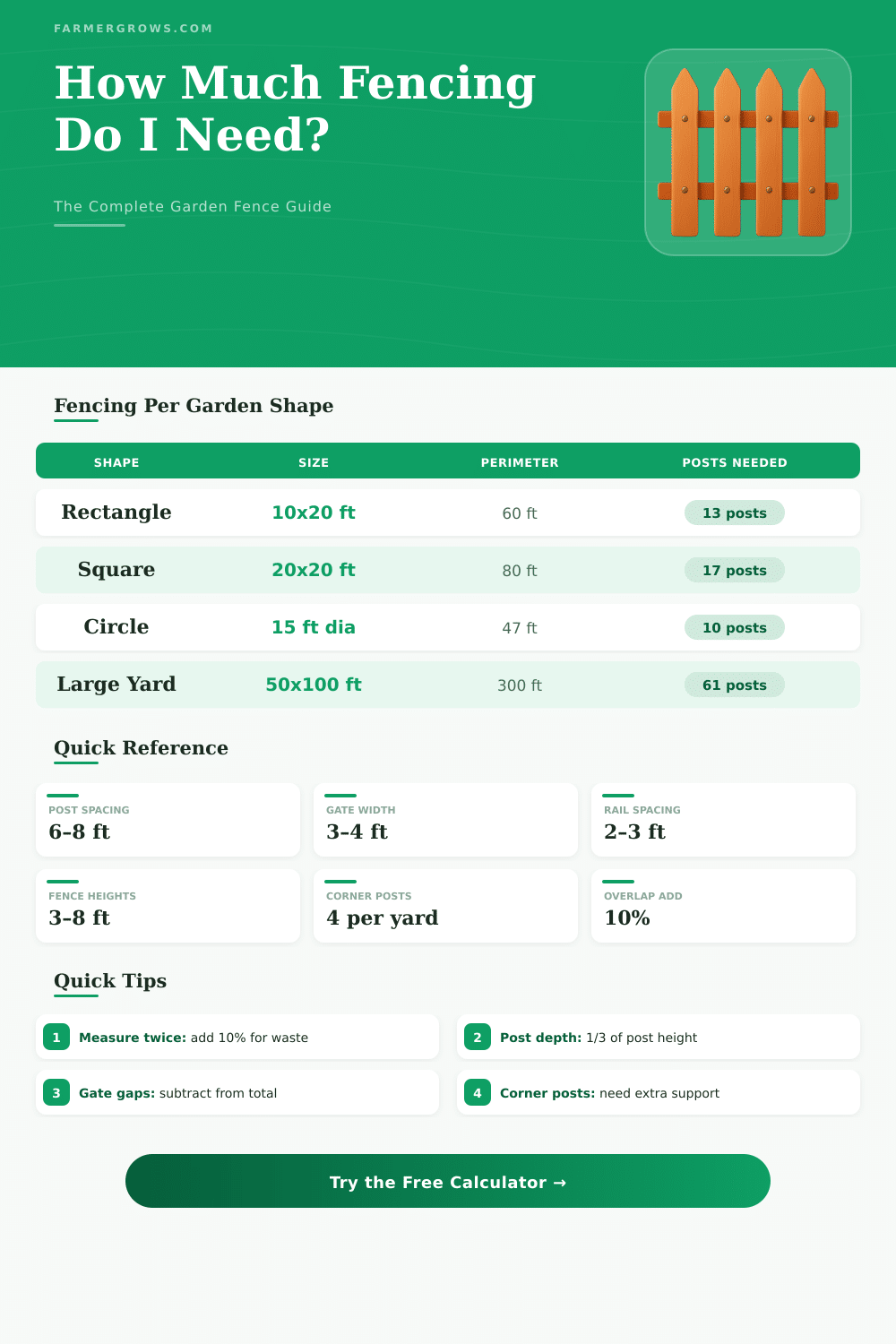
🌿 Garden Fence Calculator
Calculate fencing length, posts, rails & gates needed for any garden shape
| Post Spacing | Posts per 100 ft | Posts per 50 m | Sections per 100 ft |
|---|---|---|---|
| 4 ft (1.2 m) | 26 posts | 42 posts | 25 sections |
| 6 ft (1.8 m) | 18 posts | 28 posts | 17 sections |
| 8 ft (2.4 m) | 14 posts | 21 posts | 13 sections |
| 10 ft (3.0 m) | 11 posts | 17 posts | 10 sections |
| 12 ft (3.7 m) | 9 posts | 14 posts | 9 sections |
| Project | Approx. Area | Perimeter | Posts (6 ft spacing) |
|---|---|---|---|
| Small Herb Bed | 40 sq ft | 26 ft | 6 posts |
| Raised Veg Bed 8x12 | 96 sq ft | 40 ft | 8 posts |
| Small Garden 10x20 | 200 sq ft | 60 ft | 11 posts |
| Square Garden 20x20 | 400 sq ft | 80 ft | 15 posts |
| Backyard 30x50 | 1,500 sq ft | 160 ft | 28 posts |
| Large Yard 50x100 | 5,000 sq ft | 300 ft | 51 posts |
| Estate 100x150 | 15,000 sq ft | 500 ft | 85 posts |
| Material | Lifespan | Typical Height | Post Spacing |
|---|---|---|---|
| Wood Picket | 10–15 yrs | 3–6 ft | 6–8 ft |
| Chain-Link | 15–20 yrs | 3–12 ft | 6–10 ft |
| Vinyl / PVC | 20–30 yrs | 4–6 ft | 6–8 ft |
| Split Rail Wood | 10–20 yrs | 3–5 ft | 8–10 ft |
| Wire Mesh | 10–15 yrs | 2–6 ft | 4–8 ft |
| Bamboo | 5–10 yrs | 3–8 ft | 4–6 ft |
| Aluminum | 30–50 yrs | 3–6 ft | 6–8 ft |
| Wrought Iron | 50+ yrs | 3–8 ft | 4–6 ft |
| Feet | Meters | Inches | Yards |
|---|---|---|---|
| 10 ft | 3.05 m | 120 in | 3.33 yd |
| 25 ft | 7.62 m | 300 in | 8.33 yd |
| 50 ft | 15.24 m | 600 in | 16.67 yd |
| 100 ft | 30.48 m | 1,200 in | 33.33 yd |
| 150 ft | 45.72 m | 1,800 in | 50.00 yd |
| 200 ft | 60.96 m | 2,400 in | 66.67 yd |
| 300 ft | 91.44 m | 3,600 in | 100.00 yd |
Garden fences do a very important task. They form the most reliable way to stop wild or domestic creatures from the damage of the garden. Deer, rabbits, groundhogs and raccoons rank between the common thieves, that a good Garden fence successfully stops.
Farming of a garden requires a lot of work and it is painful to spend months on it only so that creatures destroy everything.
Garden Fences to Keep Animals Out
Various materials are available to choose during building of a Garden fence. Wood, vinyl, chain link and synthetic wood all deserve attention. Recycled steel vines or similar garden piles offer easy and green solutions, that add an attractive rustic style.
Such elements fit themselves naturally in the surrounding ground and help to control children together with pets. If you want more privacy, a solid fence with dark vertical boards can convert the yard into a separate retreat.
Plastic fencing for gardens and multi-use nets are useful in many cases. They work as limiting fences, supports for plants or markers for terraces and pools. Beyond that, they help to create play areas for children and pets.
Flexible and lightweight options of fences adapt to any form of garden, and one can move them as needed without creating dangerous slices, that would risk children or pets.
To keep animals away from the garden, galvanised wire net with T-shaped posts works as a strong solution. It resists well against upper attack and adding electrical wire at the top together with the bottom edge makes it even more effective. An efficient Garden fence protects against predators while it keeps the creatures inside, like this doing a double role.
Page wire forms another reliable option to stop predators. Sack materials slightly buried at the base, combined with wire cutting until six feet high, prove efficient against soil diggers. Chicken wire along posts with one foot sticking out on the ground helps too stop creatures from too much digging.
Building a fence according to the right methods matters. Use square posts, set under the frost line by means of gravel and cement, to ensure a strong base. Creation of a rectangular frame between posts with tight chicken wire from top to bottom results in a reliable system.
Fence cutting at four feet high is a typical design.
Deer can be hard to fight. Add a second series of higher electrical fence posts with rubber string zigzagging between the main fence and the extra posts to trick them. Such deer do not manage to estimate the distance to jump and will escape the risk.
Complete Garden fence kits are available, as well as extension kits for already existing fences. There are also special kits for groundhogs, rabbits and dogs. Decorative garden fences come in several sizes and help to nicely mark limits while they improve the look of outdoor areas.
A fully closed garden with good fencing and at least one gate for easy access forms a nice solution, especially if it includes raised beds together with paths from highquality stone.