🌱 Compost Mix Calculator
Calculate exactly how much compost you need by area, depth & material type
lbs/yd³
lbs/yd³
lbs/yd³
lbs/yd³
lbs/yd³
lbs/yd³
lbs/yd³
lbs/yd³
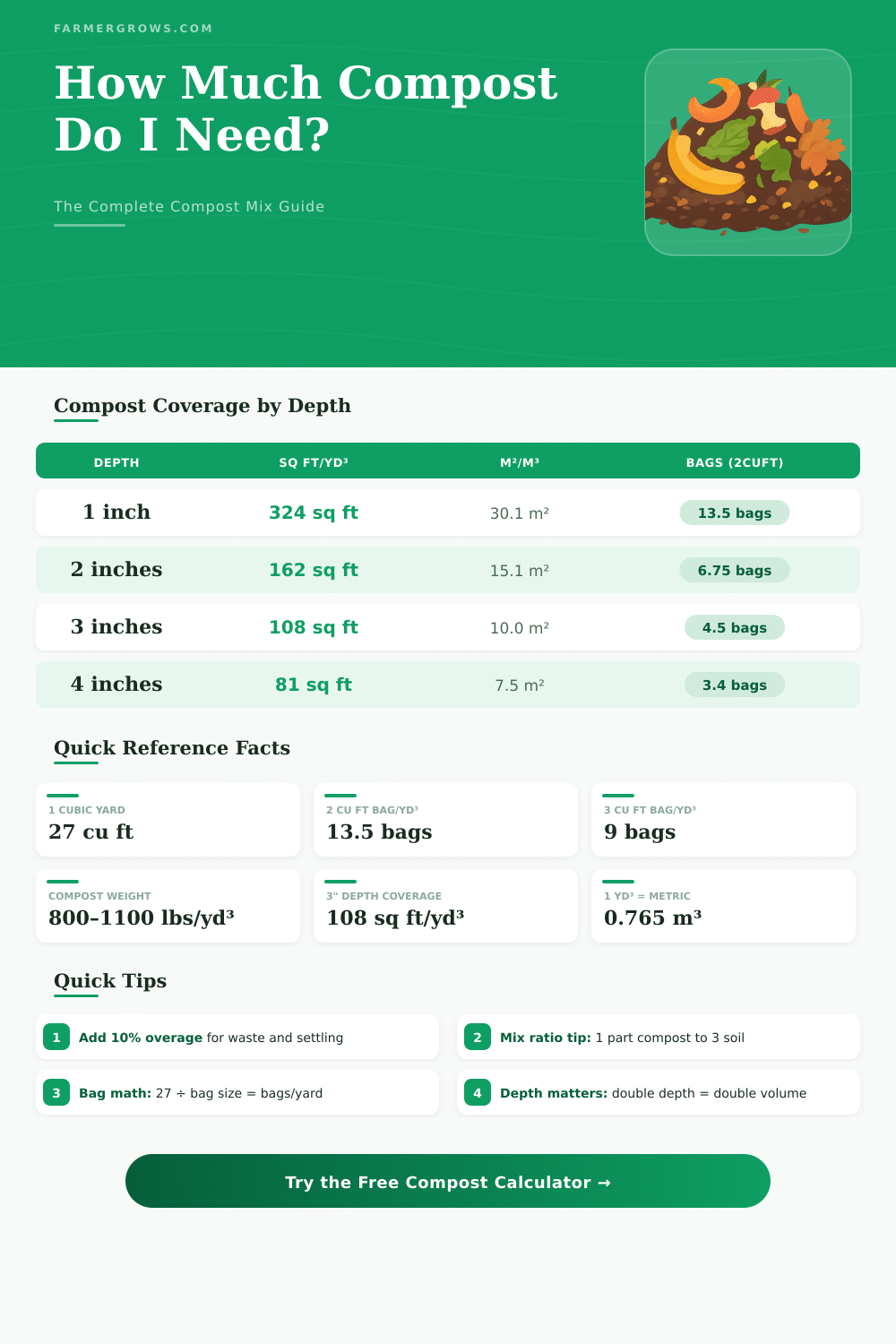
| Depth | Sq Ft per Yd³ | M² per M³ | Cubic Ft per Yd³ | Notes |
|---|---|---|---|---|
| 1 inch (2.5 cm) | 324 sq ft | 30.1 m² | 27 cu ft | Light top-dressing |
| 2 inches (5 cm) | 162 sq ft | 15.1 m² | 27 cu ft | Annual amendment |
| 3 inches (7.5 cm) | 108 sq ft | 10.0 m² | 27 cu ft | Standard bed prep |
| 4 inches (10 cm) | 81 sq ft | 7.5 m² | 27 cu ft | Heavy amendment |
| 6 inches (15 cm) | 54 sq ft | 5.0 m² | 27 cu ft | New bed fill |
| Bag Size | Volume per Bag | Bags per Yd³ | Coverage at 3" | Coverage at 2" |
|---|---|---|---|---|
| Small bag | 1 cu ft | 27 bags | 4 sq ft | 6 sq ft |
| Standard bag | 2 cu ft | 13.5 bags | 8 sq ft | 12 sq ft |
| Large bag | 3 cu ft | 9 bags | 12 sq ft | 18 sq ft |
| Half yard bulk | 13.5 cu ft | 2 bags | 54 sq ft | 81 sq ft |
| Full yard bulk | 27 cu ft | 1 unit | 108 sq ft | 162 sq ft |
| Project | Area | Yd³ at 3" | 2 cu ft Bags | 3 cu ft Bags |
|---|---|---|---|---|
| Small flower bed | 40 sq ft | 0.37 yd³ | 5 bags | 4 bags |
| Medium veggie patch | 100 sq ft | 0.93 yd³ | 13 bags | 9 bags |
| Standard garden bed | 200 sq ft | 1.85 yd³ | 25 bags | 17 bags |
| Large raised bed | 320 sq ft | 2.96 yd³ | 40 bags | 27 bags |
| Small lawn top-dress | 500 sq ft | 4.63 yd³ | 63 bags | 42 bags |
| Large lawn area | 2500 sq ft | 23.1 yd³ | 312 bags | 208 bags |
Plants need food to stay healthy, and here enters the role of Compost mix. That helps to give your garden just what it needs to grow. In the middle of the 1990s, brands of organic soil and Compost mix improved these mixes to fit various growing needs, because not every garden is the same.
Among the most popular choices is the Compost mix of 50/50 from compost and garden soil. It is easy: half soil, half compost. When you want the most plant growth and plenty of crops, that mix works well.
Compost Mixes for Gardens and Pots
For general tasks in gardening, the 50/50 soil-compost Compost mix hits the ideal balance. Some gardeners truly believe in blending soil and leaf compost in the same amount, when one fills raised beds.
For pots and bags for growing the case is totally different. Garden soil does not always work well in them. Really you want something that lets water drain quickly.
One recipe that I found is a mix of fines, peat or coconut fibers, and pumice or perlite. Add about half to one scoop of compost per batch, and you bring in those useful tiny organisms. One otehr opportunity is two parts of coconut fibers mixed with one part each of perlite or vermiculite and compost.
That mix works well, whether for starting seeds, potting up young plants or setting up house plants.
A Compost mix of 75/25 sits in that nice middle way. It balances drainage with support for growth, keeping food and moisture in sandy soils, while it still blends well in current beds or brakes up heavy clay.
How to make compost at home? Aim for about a 30-to-1 ratio of carbon to nitrogen, give or take. Layering green stuff and brown stuff helps you have a clear guide to keep everything in balance.
Variety is key, a mix from different organic materials is the goal. Too much of won kind, like grass clippings, can mess everything up. Really you need kitchen scraps, dried leaves, water, air and time.
The easiest way? Layer your kitchen scraps and dried leaves in a bin or in corner piles and let nature take care of the rest.
Warm composting goes faster. Germs work on that mix of green and brown stuff, making heat that breaks the organic matter into rich, nice compost. Turn the pile every few days with a fork to mix everything evenly and speeds up the whole thing.
When you reach steady temperatures above 131 degrees, you really kill bad germs and seeds of unwanted weeds.
But here is the main point. Compost alone is not always the answer. It simply does not give enough support to hold up the plants that they need.
Plants grown only in pure compost can lean during storms or easily uproot. Also, too much compost makes the soil too soft, easily packing down and likely to hold too much moisture. For plants in pots on a porch or deck, mix between 20 and 50 percent of compost works best, because potsdry out faster.
When dealing with house plants, worm compost is widely seen as one of the richest additions to soil that you can mix.