💧 Irrigation Pump Sizing Calculator
Calculate the correct pump size for your irrigation system — flow rate, total dynamic head & horsepower
| Pipe Size | 5 GPM | 10 GPM | 15 GPM | 20 GPM | 30 GPM | 50 GPM |
|---|---|---|---|---|---|---|
| 1/2" PVC | 2.6 | 9.2 | 19.4 | 33.0 | — | — |
| 3/4" PVC | 0.8 | 2.8 | 5.9 | 9.9 | 21.2 | — |
| 1" PVC | 0.3 | 1.0 | 2.2 | 3.7 | 7.9 | 20.8 |
| 1-1/4" PVC | 0.1 | 0.4 | 0.8 | 1.4 | 2.9 | 7.5 |
| 1-1/2" PVC | 0.06 | 0.22 | 0.46 | 0.78 | 1.65 | 4.3 |
| 2" PVC | 0.02 | 0.07 | 0.15 | 0.25 | 0.53 | 1.4 |
| 3" PVC | — | 0.01 | 0.03 | 0.05 | 0.10 | 0.26 |
| TDH (ft) | Flow (GPM) | Min HP | Pump Type | Typical Use |
|---|---|---|---|---|
| 20–40 ft | 5–15 | 0.25 HP | Centrifugal | Small drip / garden |
| 40–80 ft | 10–25 | 0.5 HP | Centrifugal | Residential lawn |
| 60–100 ft | 15–40 | 0.75 HP | Centrifugal | Medium sprinkler system |
| 80–120 ft | 20–50 | 1 HP | Centrifugal / Turbine | Large residential/light commercial |
| 100–150 ft | 30–80 | 1.5 HP | Turbine / Submersible | Commercial / sports field |
| 140–200 ft | 50–120 | 2–3 HP | Multi-stage turbine | Agricultural / large field |
| 180–300 ft | 80–200 | 5+ HP | Submersible / Turbine | Large agricultural / golf course |
| Project Type | Typical GPM | TDH (ft) | Rec. HP | Metric (LPM) |
|---|---|---|---|---|
| Small garden drip (10 emitters) | 5 | 30–50 | 0.25–0.5 | 19 |
| Residential lawn (20 heads) | 20–30 | 50–80 | 0.75–1 | 76–114 |
| Greenhouse drip (50 emitters) | 15–25 | 40–70 | 0.5–0.75 | 57–95 |
| Sports field (40 rotors) | 80–120 | 80–120 | 2–3 | 303–454 |
| Orchard micro spray (100 heads) | 50–80 | 60–100 | 1.5–2 | 189–303 |
| Agricultural field (200 emitters) | 100–200 | 100–180 | 3–5 | 379–757 |
| Golf fairway (60 rotors) | 120–180 | 120–200 | 5+ | 454–681 |
| From | To | Multiply By | Notes |
|---|---|---|---|
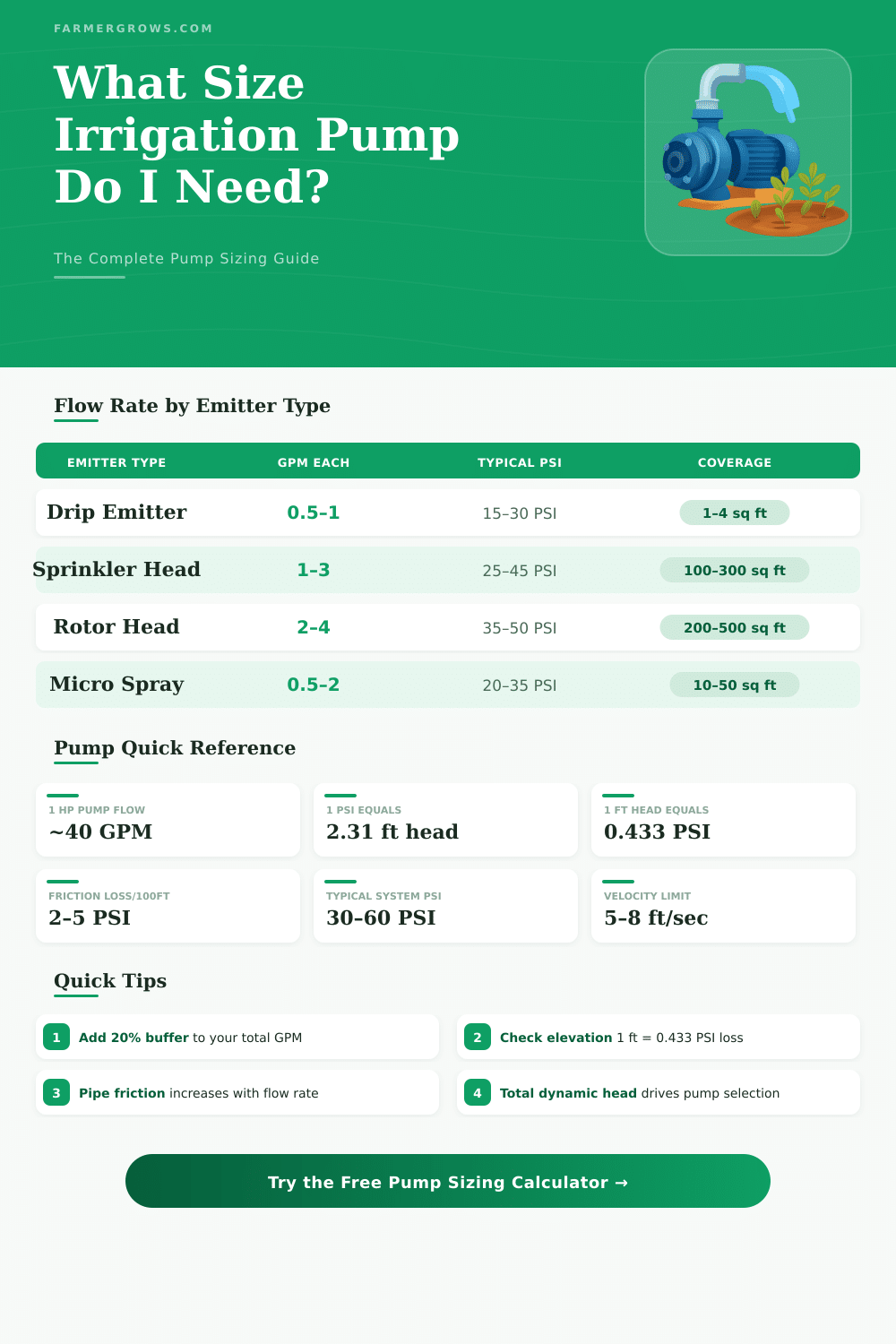
| PSI | Feet of Head | × 2.3077 | 1 PSI = 2.31 ft head |
| Feet of Head | PSI | × 0.4335 | 1 ft = 0.433 PSI |
| PSI | kPa | × 6.895 | 1 PSI = 6.895 kPa |
| kPa | PSI | × 0.1450 | 1 kPa = 0.145 PSI |
| GPM | LPM | × 3.7854 | 1 GPM = 3.785 L/min |
| LPM | GPM | × 0.2642 | 1 L/min = 0.264 GPM |
| Feet | Meters | × 0.3048 | 1 ft = 0.3048 m |
| Meters | Feet | × 3.2808 | 1 m = 3.281 ft |
The sizing of pumps is made up of the calculation of the right pump for each job. In the process, the main element is the combination of precise and whole information about every project. Lacking reliable data, the choice of the right pump turns into a gamble.
Between the first elements for estimate are the flow rate. It points the amount of liquid, that needs to move through the setup. For instance, for pump water at 20 gallons in minute at room temperature the curve of the pump are useful for setting the desired size according to any pressure situation in the range of the device.
How to Size a Pump
When the flow rate already are clear, the next stage is the computation of the head or the pressure needs.
For determine the lowest outlet head, estimate the pressure loss according to the long flow path. Also must consider the minimum inlet suction head. The amount of both, together with the whole minimum flow and the density of the liquid, mean proper Irrigation pump sizing of the pump.
The power of the pump itself match to flow rate times total head difference times density of the liquid times boost of gravity, everything divided buy the efficiency of the pump.
When one receives the involved hydraulic power in watts, share it by means of the efficiency of the pump for reach the motor power. For instance, 100 000 watts shared by means of 80 percent efficiency gives 125 000 watts. Later, add 25 percent to that value for be the estimated power, that here would be 156 250 watts.
Extra parts have gravity. The back pressure, the unlike pressure, the temperature of the liquid and its thickness all affect the sizing. For a pump, that delivers at least 6 gallons in minute, the device maybe requires to beat 40 pounds in square inches of back pressure for reach 60 pounds in square inches of target pressure for water.
Various uses require different methods. At pool pumps, the whole amount in gallons matters. A setup, that circulates the whole volume one time during one or two hours, operate well for tiny pools.
In irrigation, the main cause is understand, how much water requires the landscape and how much time last the water delivery. From that, one can size the pump according to flow and pressure. Centrifugal pumps answer for wells with surface water or shallow, during turbine pumps more well serve for deep wells.
Pumps for deep wells can confuse because of the various choices of horses of power and gallons in minute for the ratings. Those devices usually are sized according to the total lift, what is the vertical distance of the spot, where the pump touches the water in the well pipe until the surface.
Pumps for pools with filters require to consider the layout, changes of height and the Total Dynamic Head. Gallons in minute and TDH together chart to the curved performance chart of thepump maker for find the nearest match. Different websites with tools help to compile the head difference, the brake power and the NPSH for free.