💧 Irrigation Schedule Calculator
Calculate exact water volume, runtime, and watering frequency for any irrigation zone
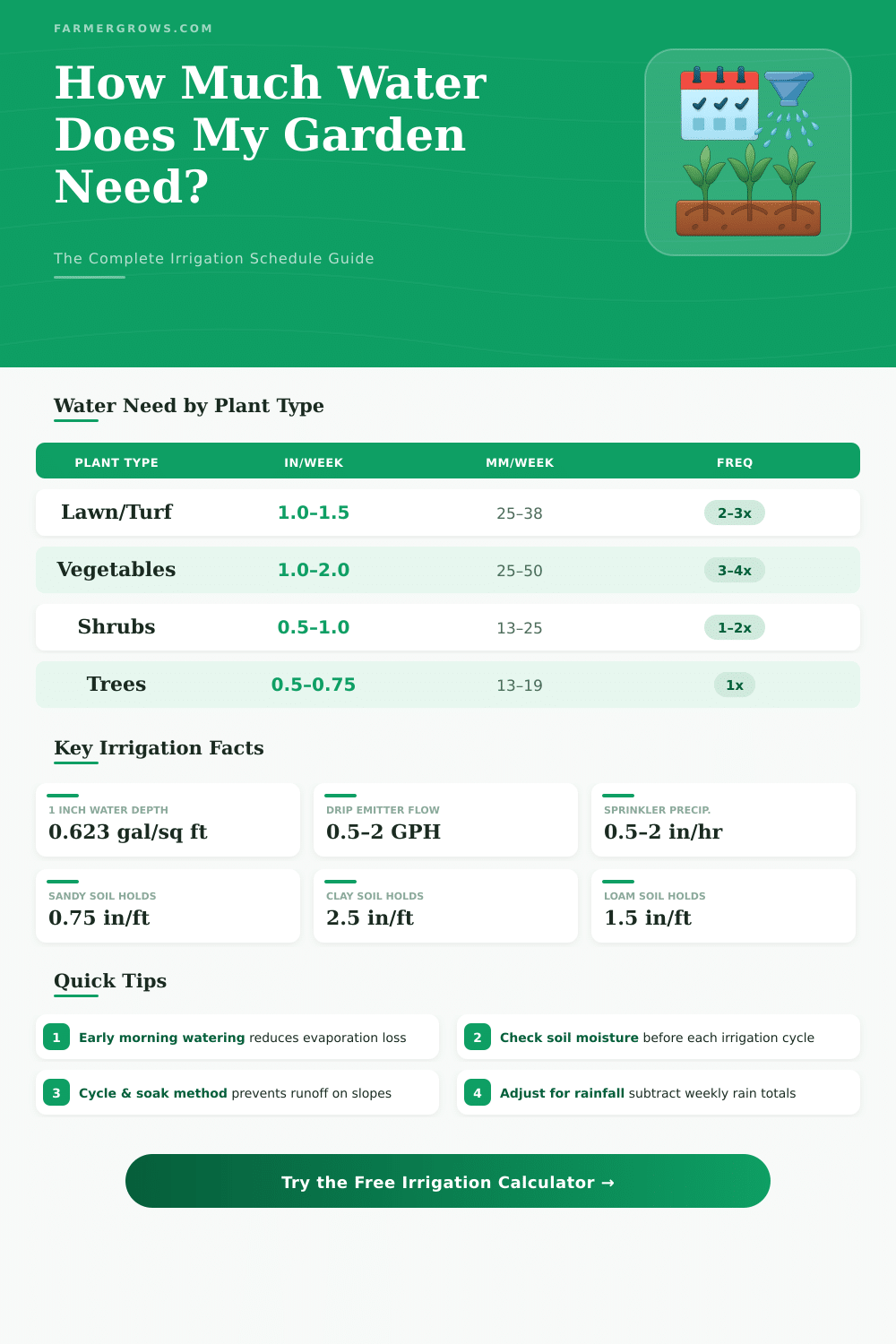
| Plant Type | Water Need (in/week) | Water Need (mm/week) | Recommended Frequency | Root Depth (in) |
|---|---|---|---|---|
| Lawn / Turf Grass | 1.0 – 1.5 | 25 – 38 | 2–3x per week | 4–6 |
| Vegetables | 1.0 – 2.0 | 25 – 50 | 3–4x per week | 12–18 |
| Shrubs & Hedges | 0.5 – 1.0 | 13 – 25 | 1–2x per week | 18–24 |
| Trees | 0.5 – 0.75 | 13 – 19 | Once per week | 24–36 |
| Annual Flowers | 1.0 – 1.5 | 25 – 38 | 2–3x per week | 6–12 |
| Ground Cover | 0.75 – 1.0 | 19 – 25 | 1–2x per week | 6–12 |
| Succulents / Xeric | 0.1 – 0.25 | 3 – 6 | 1x per 2 weeks | 6–12 |
| System Type | Typical Rate (in/hr) | Typical Rate (mm/hr) | Efficiency | Best For |
|---|---|---|---|---|
| Rotor Sprinkler | 0.4 – 0.8 | 10 – 20 | 75–85% | Large lawns |
| Pop-up Spray | 1.0 – 2.0 | 25 – 50 | 70–80% | Small lawns, beds |
| Oscillating Sprinkler | 1.0 – 2.5 | 25 – 63 | 65–75% | Rectangular areas |
| Drip Emitters | 0.1 – 0.5 | 3 – 13 | 88–95% | Trees, shrubs, veggies |
| Soaker Hose | 0.25 – 1.0 | 6 – 25 | 80–90% | Garden rows |
| Micro-Spray | 0.5 – 1.5 | 13 – 38 | 80–90% | Shrubs, ground cover |
| Manual / Hand | Variable | Variable | 60–70% | Container plants |
| Water Depth | Gallons per 1,000 sq ft | Liters per 100 m² | Runtime at 1 in/hr |
|---|---|---|---|
| 0.25 in (6 mm) | 156 | 590 | 15 min |
| 0.5 in (13 mm) | 312 | 1,180 | 30 min |
| 0.75 in (19 mm) | 467 | 1,767 | 45 min |
| 1.0 in (25 mm) | 623 | 2,357 | 60 min |
| 1.25 in (32 mm) | 779 | 2,947 | 75 min |
| 1.5 in (38 mm) | 935 | 3,537 | 90 min |
| 2.0 in (51 mm) | 1,246 | 4,714 | 120 min |
| Zone / Project | Area (sq ft) | Gal per Session (1") | Runtime at 1 in/hr | Gal per Week (3x) |
|---|---|---|---|---|
| Patio Planter Bed | 50 | 31 | 60 min | 94 |
| Small Front Lawn | 200 | 125 | 60 min | 374 |
| Vegetable Garden | 400 | 249 | 60 min | 748 |
| Medium Backyard | 1,000 | 623 | 60 min | 1,869 |
| Large Lawn | 5,000 | 3,115 | 60 min | 9,345 |
| Sports Field Zone | 10,000 | 6,230 | 60 min | 18,690 |
The planning of irrigation is made up of the calculation of that, as far as how often and how much time one must water the plants. It aims to give the right amount of water to fully wet the root zone, while one avoids overwatering and ensures efficient use of the water. Reaching the right frequency and amount are essential because the quality of the crops and the amount of the product depends strongly on both.
The needs of water of crop drive the Irrigation schedule, not vice versa. Various crops require different levels of water. For instance, rice requires irrigation during most of his growing period.
How to Make an Irrigation Schedule
Also the season affects the cause. In dry periods irrigation becomes needed, but only for certain species.
Key principle in the planning of irrigation is the control of the allowed water use. When the deficit of water matches or passes that limit, one should start the irrigation. One drives the crop, when the real use of water gets close to that value.
The final amount of water to apply one counts by means of division of the real use by means of the efficiency of the application. For methods of rough irrigaiton on slope, efficiency between 75 and 85 percent are reachable. Methods of borders can reach 65 to 80 percent.
Local advisers about farms can help estimate the efficiency of the application.
For lasting crops the Irrigation schedule ranges according to the increase of the crop during the season. Plants like the stable ones, that mention the samples alfalfa, grasses, trees and bushes, have almost permanent depth of the root zone, hence their schedules stay relatively stable.
Also the weather affects strongly. The needed amount of water for plants changes according too the weather and the length of the days. Commonly updating the Irrigation schedule is necessary for healthy landscapes.
Some tools for planning of irrigation take data from local weather stations daily, what gives precise rating of the whole water use, that the plants require weekly. Those tools consider the type of soil, the skill to keep water and rates of water loss. The water loss is a basic measure to form irrigation plans, that adapts to the needs of the plants.
Typical controls of irrigation allow programming the run for any chosen day of the week. Adding or removing days is the usual way to adapt to the seasonal changes in needs of water. Run the system one or two days weekly and only when needed, is a good method.
Also it matters to check local restrictions about water to know, what days are allowed.
The schedules assume, that it does not rain. When rain comes, one can turn the control off for some days or even weeks. In regions like mountain towns, the amounts of rain and snow can pass the needs of water for the whole year, but most of the rainfall happens in winter.
Hence maybe still require a bit of irrigation in summer, especially for non-native plants. Seasonal changes, preparations for winter to escape damages to tubes during cold and spring restart services to fix after winter period, everything helps topreserve a good Irrigation schedule.
In regions with limited irrigation, choosing stages of growth, that feel moisture or handle dryness, help to improve the use of the given water. A wise Irrigation schedule preserves the resources of water and preserves the health of the soil.