🐄 Cattle Stocking Rate Calculator
Calculate how many animal units your pasture can sustainably support
(AUM/acre)
(AUM/acre)
(AUM/acre)
(AUM/acre)
(AUM/acre)
(AUM/acre)
(AUM/acre)
(AUM/acre)
| Animal Type | Avg Weight (lbs) | AU Equivalent | Daily DM Need (lbs) |
|---|---|---|---|
| Beef Cow-Calf Pair | 1,000 + 250 | 1.00 | 26 |
| Beef Yearling Stocker | 700 | 0.70 | 18 |
| Beef Bull | 1,500 | 1.35 | 35 |
| Dairy Cow | 1,400 | 1.40 | 36 |
| Dairy Heifer | 900 | 0.90 | 23 |
| Horse | 1,100 | 1.25 | 27 |
| Sheep (ewe + lamb) | 130 | 0.20 | 5 |
| Goat (doe + kid) | 100 | 0.17 | 4 |
| Forage Type | AUM/Acre (low) | AUM/Acre (high) | Dry Matter (lbs/ac/yr) | Best Season |
|---|---|---|---|---|
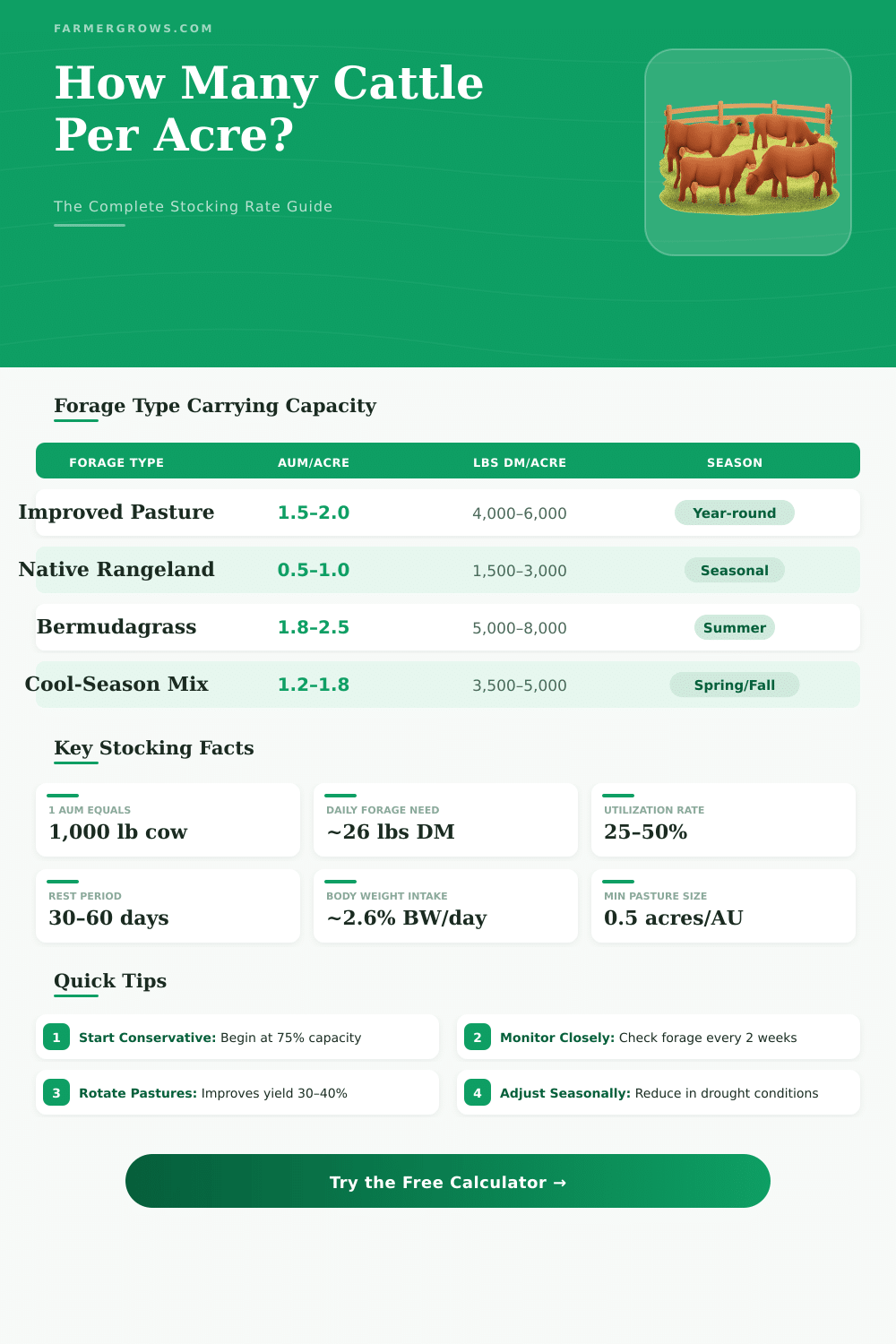
| Improved Pasture | 1.5 | 2.0 | 4,000–6,000 | Year-round |
| Native Rangeland | 0.5 | 1.0 | 1,500–3,000 | Summer/Fall |
| Pure Bermudagrass | 1.8 | 2.5 | 5,000–8,000 | Summer |
| Cool-Season Mix | 1.2 | 1.8 | 3,500–5,000 | Spring/Fall |
| Hay Meadow | 1.0 | 1.5 | 3,000–4,500 | Late Spring |
| Semi-Arid Rangeland | 0.3 | 0.6 | 800–1,800 | Summer |
| Irrigated Pasture | 2.0 | 4.0 | 8,000–15,000 | Year-round |
| Stockpiled Fescue | 0.8 | 1.2 | 2,500–3,500 | Fall/Winter |
| Forage Type | Acres / AU (min) | Acres / AU (avg) | Acres / AU (max) | Ha / AU (avg) |
|---|---|---|---|---|
| Improved Pasture | 0.5 | 0.7 | 1.0 | 0.28 |
| Pure Bermudagrass | 0.4 | 0.6 | 0.8 | 0.24 |
| Cool-Season Mix | 0.6 | 0.9 | 1.2 | 0.36 |
| Native Rangeland | 1.0 | 2.0 | 3.0 | 0.81 |
| Hay Meadow | 0.7 | 1.0 | 1.5 | 0.40 |
| Semi-Arid Rangeland | 2.0 | 4.0 | 8.0 | 1.62 |
| Irrigated Pasture | 0.25 | 0.4 | 0.6 | 0.16 |
| Stockpiled Fescue | 0.9 | 1.3 | 2.0 | 0.53 |
| Operation Type | Pasture Area | Forage Type | AU Supported | Cattle Head (approx) |
|---|---|---|---|---|
| Hobby Farm | 10 acres | Improved Pasture | 8–12 AU | 6–10 head |
| Small Ranch | 50 acres | Improved Pasture | 40–60 AU | 30–50 head |
| Mid-Size Ranch | 200 acres | Native Rangeland | 60–120 AU | 50–100 head |
| Large Ranch | 640 acres | Native Rangeland | 190–380 AU | 160–320 head |
| Stocker Operation | 100 acres | Bermudagrass | 120–180 AU | 170–260 yearlings |
| Irrigated Dairy | 40 acres | Irrigated Pasture | 50–100 AU | 35–72 cows |
The Cattle stocking rate relates to the relation between the amount of animals and the size of the pasture that they use. It helps to determine how many animal units of livestock use the ground during a set time. One should not mix it with the stocking density, that points the number of animals that has access to a particular area in one precise moment.
The Cattle stocking rate is a decision of the manager. It depends on how many livestock one puts on the pasture. On average, one cow requires between 1 and 10 or even more acres, according to the quality of the feed, the amount of rain and the ways of management.
What Is Cattle Stocking Rate
Good Cattle stocking rate balances the eating of animals with the regrowth of the pasture. The highest Cattle stocking rate depends on the kind of available feed and whether it receives watering or not.
Many pastures have around 2 acres for one animal unit. That gives enough feed, which is about 2.5% of the body weight daily. In some places one cow does well on 2 acres with good grass.
In otehr parts of the world, one requires 7 acres, to give hay almost during the whole year. Some farms work with 12 to 15 acres for animal unit, after years of basic management and rotating use.
Because livestock and other feeding animals do not have same size, one must convert them to equivalent animal units. A cow of 1 200 pounds, that eats 2.6% of its body weight, requires 31 pounds of feed a day. Multiplying the daily need of the animal buy the number of used days, one receives the whole need for feed during that time.
To estimate the Cattle stocking rate, one multiplies the whole number of equivalent animal units by the length of the grazing season, then divides by the whole area of the ground. For instance, 20 acres of average pasture can support ten cows each 1 000 pounds with Cattle stocking rate of 0.5. Splitting those 20 acres in four pastures each 5 acres, with rotation and good care, one could keep more than 10 cows on same soil.
Here is a cause that one easily misses. Keeping the same number of cows on same ground can hide overload. If 100 heads use 1 000 acres today same as 20 years ago, now there can be bigger pressure, because those cows probably weigh 1 400 pounds each instead of 1 200 pounds then.
The amount of rain also matters. More rain usually allows higher Cattle stocking rate. Local differences in types of grasses and seasonal growth play a role.
In some regions, half to two thirds of the feed happen during spring. Adding grain, one can make up for high stocking density or lower quality of feed. With careful management of Cattle stocking rate, producers reach more grazing days yearly, reduce the need of rested pastures and improve the possible profit of any livestock business.
Although the pure income per work was bigger at light Cattle stocking rate, when one removes theland cost, the pure income per acre actually grew at heavy Cattle stocking rate.