🌱 Spider Plant Water Calculator
Calculate exactly how much water your spider plant needs based on pot size, season & environment
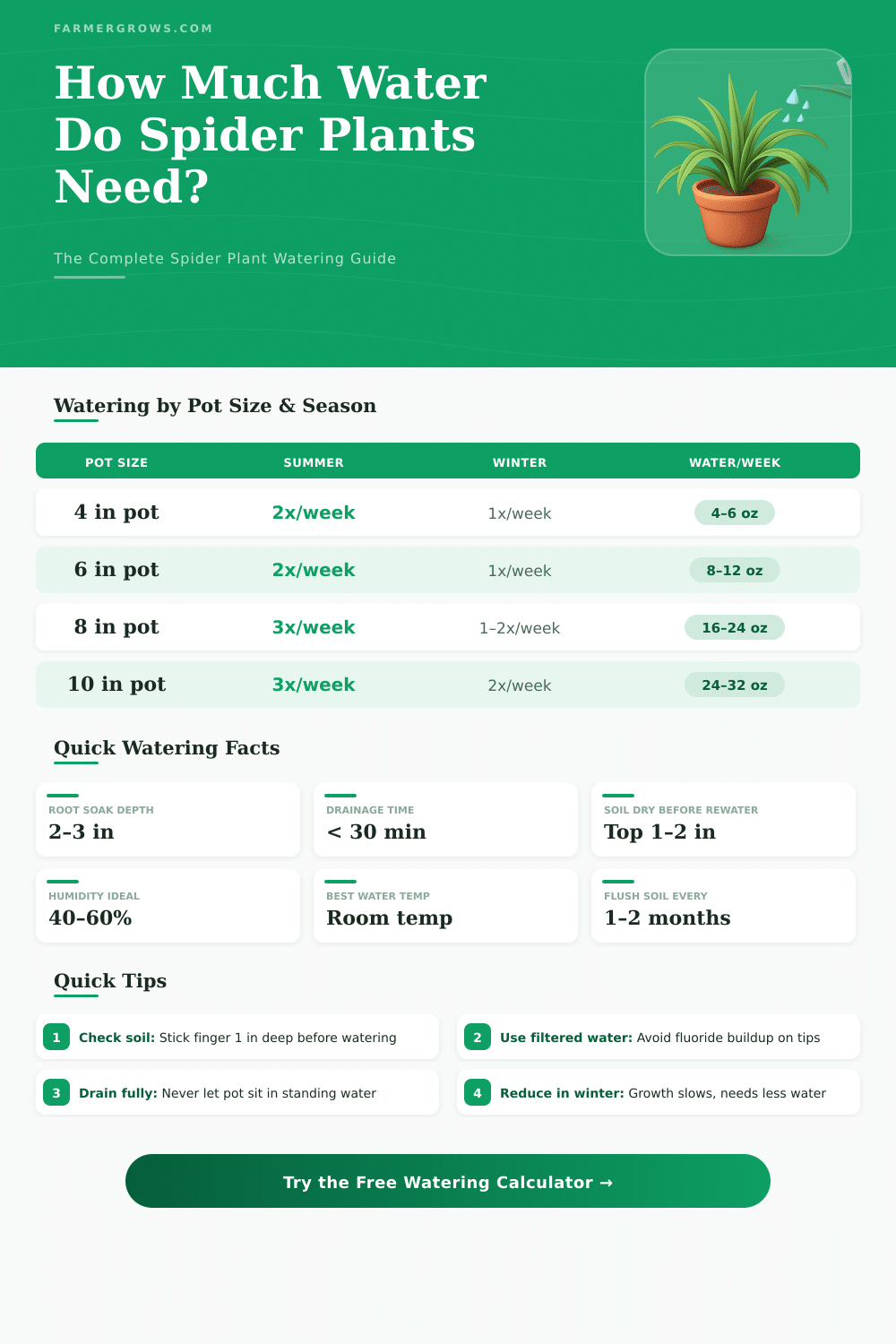
| Pot Size | Spring | Summer | Fall | Winter |
|---|---|---|---|---|
| 4 in (10 cm) | 3–4 fl oz / 90–120 mL | 4–6 fl oz / 120–177 mL | 2–3 fl oz / 60–90 mL | 1–2 fl oz / 30–60 mL |
| 6 in (15 cm) | 6–8 fl oz / 177–237 mL | 8–12 fl oz / 237–355 mL | 4–6 fl oz / 120–177 mL | 2–4 fl oz / 60–120 mL |
| 8 in (20 cm) | 10–14 fl oz / 296–414 mL | 14–20 fl oz / 414–591 mL | 6–10 fl oz / 177–296 mL | 4–6 fl oz / 120–177 mL |
| 10 in (25 cm) | 14–18 fl oz / 414–532 mL | 18–26 fl oz / 532–769 mL | 10–14 fl oz / 296–414 mL | 6–8 fl oz / 177–237 mL |
| 12 in (30 cm) | 18–24 fl oz / 532–710 mL | 24–34 fl oz / 710–1006 mL | 14–18 fl oz / 414–532 mL | 8–12 fl oz / 237–355 mL |
| 14 in (35 cm) | 24–30 fl oz / 710–887 mL | 30–42 fl oz / 887–1242 mL | 18–24 fl oz / 532–710 mL | 10–16 fl oz / 296–473 mL |
| Season | Frequency | Soil Check | Notes |
|---|---|---|---|
| Spring | Every 5–7 days | Top 1 in dry | Increase as growth picks up |
| Summer | Every 3–5 days | Top 1 in dry | Peak demand, check often |
| Fall | Every 7–10 days | Top 1–2 in dry | Gradually reduce amount |
| Winter | Every 10–14 days | Top 2 in dry | Overwatering risk highest |
| Factor | Condition | Water Adjustment | Frequency Change |
|---|---|---|---|
| Humidity | Low (<30%) | +15–20% | 1–2 days sooner |
| Humidity | High (>60%) | –10–15% | 1–2 days later |
| Light | Direct sun | +20–25% | 1–2 days sooner |
| Light | Low / shade | –15–20% | 2–3 days later |
| Basket type | Hanging basket | +20–30% | 1–2 days sooner |
| Plant age | Seedling | –25–35% | Check daily |
spider plants, known by the scientific name Chlorophytum comosum, rank among the most spread house plants around the world. They also bear some other names like airplane plant, ribbon plant, spider ivy and hen-and-chickens. That species comes from the jungles in South Africa and West Africa.
Among newcomers it enjoys big favor because one can easily grow it and it handles enough neglect.
How to Grow and Care for Spider Plants
spider plants fit in almost any place in the house. For generations they stayed liked and stay until now. They have long, green leaves, that can be plain green or striped with white marks.
In some forms white strips cover the edges of the leaves, what reverses the usual look. Actually the purely green type is the most ancient, because spider plants did not have such markings originally.
Thanks to their long leaves and even longer shoots, spider plants work well for hanging baskets or high shelves. The little baby plants swing down, what gives fresh sight. They grow at the tips of the shoots and root, when they touch the ground.
For spreading, one cuts the babies, when they are big enough, and plants them in soil. Planting them directly in ground commonly gives more strong roots then starting in water. Another way is to set a baby in a little jar with soil, while it is yet tied, and later separate it from the parent plant, after it has rooted.
Cutting the shoots does not injure the main plant. Rather, that helps to focus energy on the parent instead of spreading it on new babies.
spider plants own bulky root systems, that store water, so one does not need to water them as often as many other species. It is well to keep the soil a bit damp. One must mind burns, where the leaf tips become brown.
That can come from too dry soil, low moisture or chemicals in the water from the tap. Fluoride is a famous problem for them, and it does not go away even if one leaves the water stand. Using water without fluoride or chlorine helps to escape that.
If brown tips appear, simply cut them.
spider plants are not seen as toxic for people or pets. Even so they carry stuff close to opioids, that could cause belly pain and vomiting, so do not eat them. They help to remove a bit of dirt from the air, although one plant cleans only very little.
Spider plants bear dual flowers, so one cannot call them male or female. After flowering greenmodules with seeds can show up.