
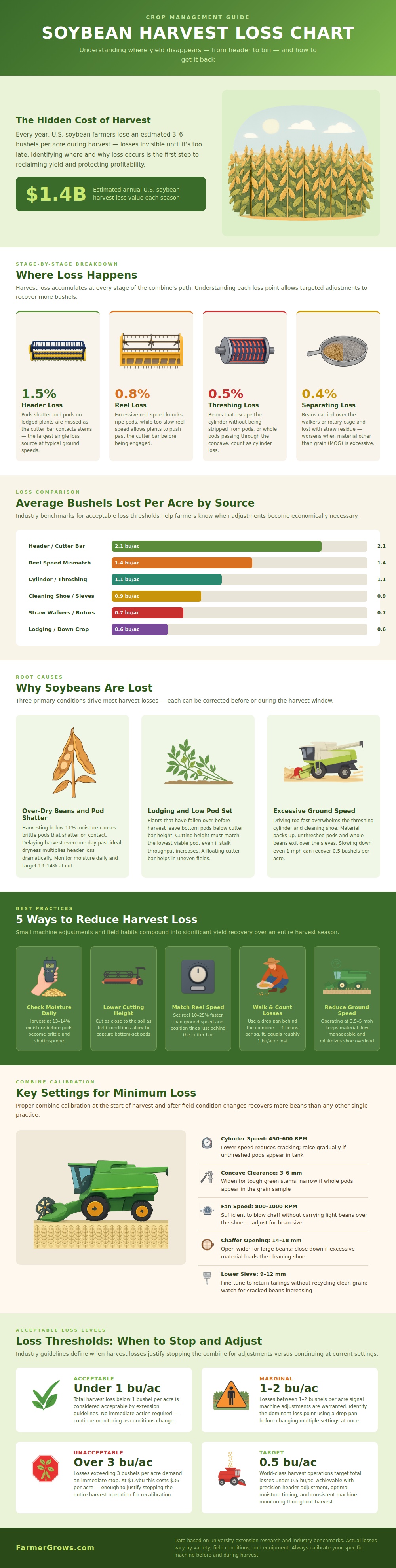
Soybean harvest are a process in which the total soybean grain that is harvested is depend upon the amount of soybean grain that enters the combine’s tank. The total amount of soybean grain that may be harvested may differ from the total soybean grain that is measured at the elevator in which the soybeans is processed. The difference between these two measurement is referred to as harvest loss.
Charts that depict potential cause of harvest loss can help a person to understand where such loss occur during the soybean harvest. Harvest loss can occur at several differently stages in the soybean harvest. For instance, the header may sever the soybean plants, but the header can also cause soybean pod to shatter prior to the reel pulling the plants into the combine.
How to Reduce Soybean Harvest Loss
The reel can be set to be too aggressive in relation to the ripeness of the soybean pods, or too slow in relation to severing the soybean plant. Furthermore, the cylinder that remove the soybeans from the pods may be too likely to crack the soybeans, or the shoe that removes the soybean grain from the chaff can be set such that the soybean grain is blown out of the combine. If any part of the combine is out of balance, a pattern in the loss of soybean grain can be expected.
Such pattern can help a person understand how to adjust the combine machine. Even small amount of soybean harvest loss result in significant monetary loss for the farmer. The loss of a few bushel of soybean grain per acre in the soybean fields result in a significant loss of income for that farm if applied to many acre.
Because harvest loss tends to occur in the same area of the fields every year, the farmers can make adjustments to the combine to minimize such losses. Many experienced soybean farmers use the first few pass of the combine through the field to ensure that the combine isnt losing any soybean grain. By making such a “diagnostic” pass, the farmer can make adjustment to the combine prior to continuing to harvest that field.
The moisture level of the soybean crop can impact the amount of soybean grain that is lost during the harvest. If the moisture level of the soybean beans drop to below 13%, the soybean pods become brittle and often shatter when the header cuts them. Because of this, if the soybean fields are allowed to dry more, the amount of soybean loss due to brittleness and shattering can increase.
Furthermore, if the moisture level of the soybean crop are too high, whole soybean pods can pass through the threshing section of the combine and end up in the residue rather than in the combine tank. Thus, the farmer should adjust the settings of the combine according to the moisture level of the soybean fields. If the soybean fields are experiencing lodging, in which the plants begin to lean and fall over, the combine experience a problem.
If the header is raised to avoid picking up soil in the fields, the lowest soybean pods will be left behind in the fields. If the header is lowered to ensure that those lowest soybean pods are picked up, the combine will have to process more soybean plant, which can overload the combine’s systems if the ground speed is not adjusted. Thus, the farmer must decide between loss at the header and loss at the cleaning shoe.
Ground speed is another setting for the combine that may impact harvest loss, but which the farmers often overlook. If the ground speed is increased, the threshing and cleaning system of the combine may be overloaded with soybean plants to be processed. As a result, unthreshed soybean pods and soybean beans may be carried over the sieves and become lost in the return of the combine.
If the ground speed is decreased, the amount of soybean grain that is lost can be reduced. Thus, a small reduction of ground speed will result in savings in the amount of soybean grain that is left behind in the fields. By looking at the ground behind the soybean combine, a person is often able to recognize where soybean losses are occurring.
By using a frame or drop pan to observe the soybean fields, a farmer can determine if the combine’s setting are correct. For instance, if clusters of soybean beans are found in the wheel track of the combine, the farmer knows that that section of the combine need to be adjusted. If soybean beans are even in the field, the problem is likely with the ground speed of the combine.
The goal for soybean harvest loss is to maintain the total loss within a narrow band. A narrow band loss can be achieved through the continual correction of the combine machine. Although there may not be an immediate payoff for adjusting the combine according to the soybean losses, such adjustment will pay off over time in soybean harvest fields of any size.
Thus, a combine that is often inspected will experience less loss in soybean grain than a combine that is continuously running at high rate and which is not often inspected.