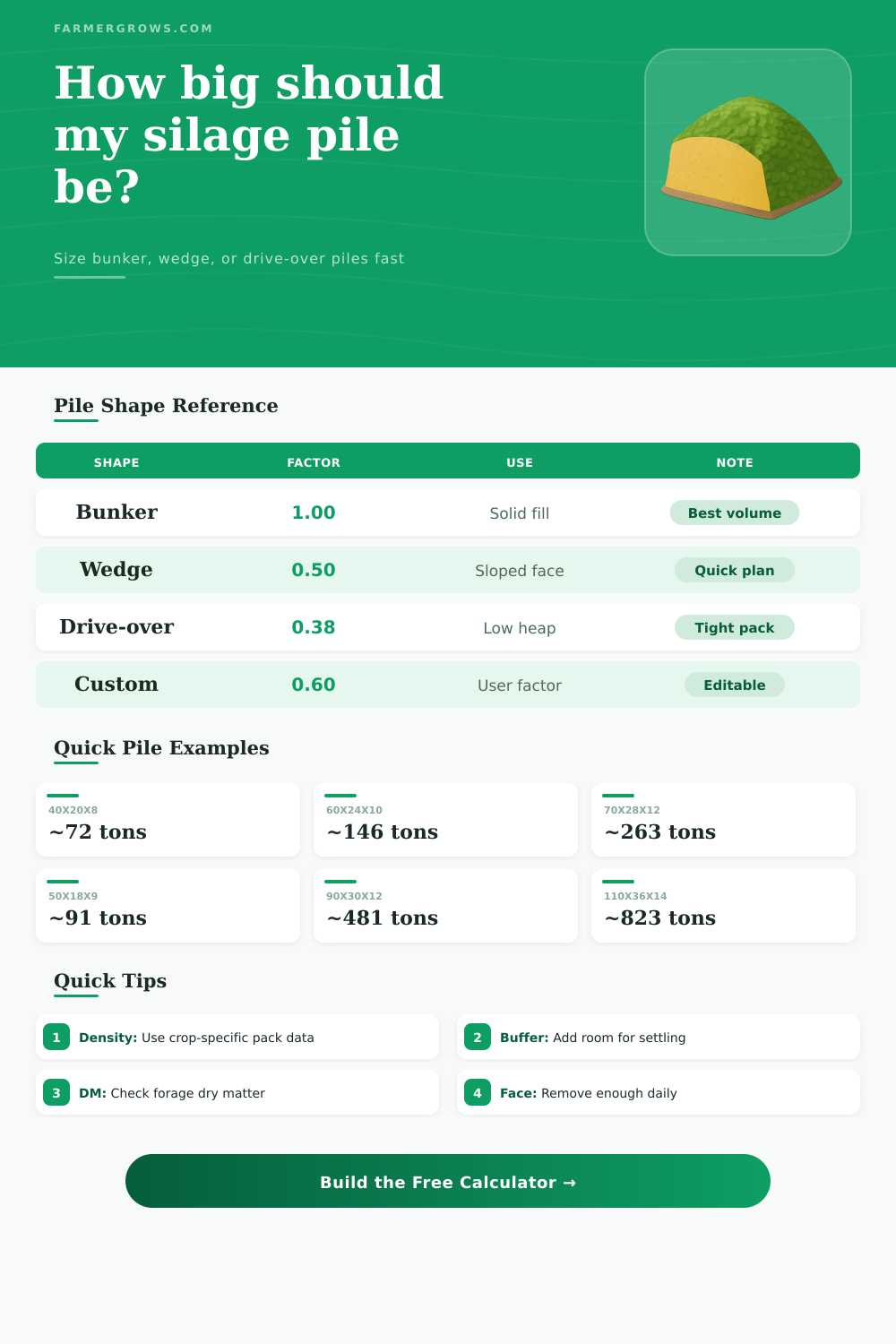
🌾 Silage Pile Sizing Calculator
Size bunker, wedge, and drive-over piles by dimensions, density, and dry matter
| Silage Type | Typical Density (lbs/cu ft) | Typical DM% | Tons per 1,000 cu ft |
|---|---|---|---|
| Corn silage | 40-45 | 28-35% | 20-22.5 tons |
| Grass / haylage | 35-42 | 35-50% | 17.5-21 tons |
| Alfalfa silage | 38-45 | 35-45% | 19-22.5 tons |
| Sorghum silage | 38-44 | 28-35% | 19-22 tons |
| Small grain silage | 35-42 | 30-40% | 17.5-21 tons |
| Scenario | Size | Capacity | Feed Days |
|---|---|---|---|
| Small dairy | 32x16x7 | ~31 tons | ~8 days |
| Mid bunker | 60x24x10 | ~146 tons | ~19 days |
| Grass stack | 50x18x9 | ~91 tons | ~14 days |
| Large reserve | 110x36x14 | ~823 tons | ~51 days |
| Corn wedge | 70x28x12 | ~263 tons | ~27 days |
| Earlage pack | 55x22x9 | ~125 tons | ~16 days |
Getting the right size of the silage pile is a big deal for any farm It affects how much feed stays fresh and how much goes to waste. The basic rule is to size the pile so that at least six inches of silage go from the face daily. Twelve inches a day is even better.
That helps to lower the damage because of air. You can remove less if the silage pile feeds only during winter months.
How to size a silage pile
To size the pile right, follow step by step. Start by counting how many pounds of silage the pile delivers daily. That amount determines all other choices about width, height and length.
Drive-over piles shoud have sides with a slope of 1:3, so one foot high for three feet long. The height stay safe and easy. Typical height is twelve to fourteen feet for such piles, but never more than the unloading machine reaches.
Length depends on the tonnage target. With the advised pitch of around 1:3, a pile 20 feet wide has about 66 cubic feet of feed for one foot length. So a 20 by 100 foot silage pile has a volume of around 6600 cubic feet.
Future expansion of feed pile you do simply by adding to the existing concrete base.
Because it stores around 2400 tons of corn silage, a pile of 150 feet by 150 feet up to 20 feet high on a 150 by 200 foot concrete floor is a good option. Longer and narrower piles help to keep a small face. If space and feeding speed suffices, a long pile, not too wide and not too high on a concrete floor works well.
Although quality is most important, you must also prioritize a pile safe for access. The ideal moisture for corn silage is 60 to 70 percent, and particle size should be half to three-quarters of an inch for good packing. After opening the pile requires fast feeding, otherwise it starts to rot.
Around many farms the pile size depends on how quickly you feed from its face.
Silage piles usually do not have straight sides or ends, so compared to other storage methods piles are the most difficult to measure during stock calculations. Plan ahead to size the pile right and build it on a well chosen and ready place, that helps to maximize the profit from feed investment, lower waste and give prime feed to the livestock. For smaller herds, silage bags in 8 to 9 foot height under 200 feet long can be a good alternative, with better feed quality and fewer damage offsetting the extracost.