🐑 Sheep Feed Ration Calculator
Calculate daily DMI, energy, protein & as-fed ration amounts by sheep weight and production stage
📋 Ration Breakdown
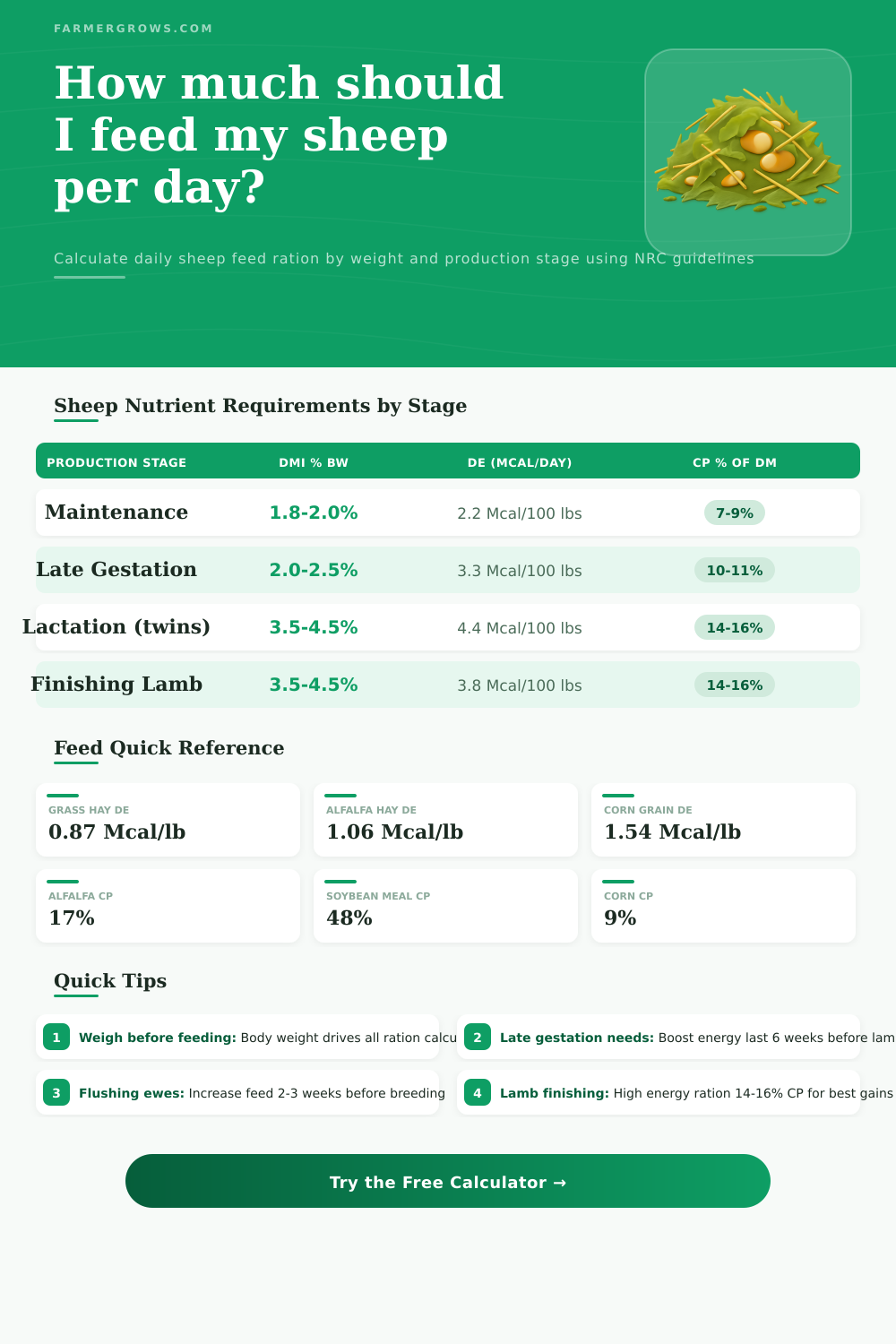
📊 Sheep Nutrient Requirements by Production Stage
| Production Stage | DMI % of BW | DE Mcal/day (150 lb ewe) | CP % of DM |
|---|---|---|---|
| Maintenance | 1.8-2.0% | ~3.3 Mcal | 7-9% |
| Early Gestation | 1.8-2.0% | ~3.5 Mcal | 9-10% |
| Late Gestation (last 6 wks) | 2.0-2.5% | ~5.0 Mcal | 10-11% |
| Lactation — Single | 3.0-3.5% | ~6.0 Mcal | 12-14% |
| Lactation — Twins | 3.5-4.5% | ~6.6 Mcal | 14-16% |
| Growing Lamb | 2.5-3.5% | ~2.5 Mcal | 14-16% |
| Finishing Lamb | 3.5-4.5% | ~3.5 Mcal | 14-16% |
📋 Feed Ingredient Nutritional Values
| Feed | DM % | DE Mcal/lb | CP % | Best Use |
|---|---|---|---|---|
| Grass Hay | 88% | 0.87 | 10% | Maintenance, gestation base |
| Alfalfa Hay | 88% | 1.06 | 17% | Lactation, growing lambs |
| Corn Grain | 89% | 1.54 | 9% | Energy supplement, finishing |
| Barley | 89% | 1.38 | 12% | Energy + moderate protein |
| Oats | 89% | 1.26 | 12% | Mild energy, good fiber |
| Soybean Meal | 90% | 1.48 | 48% | Protein supplement |
| Corn Silage | 35% | 0.43 | 8% | Energy, high moisture |
| Pasture Grass | 25% | 0.35 | 18% | Grazing, spring/summer |
| Lamb Creep Pellet | 90% | 1.40 | 18% | Pre-weaning lambs |
Getting your sheep’s feed right genuinely helps keep the sheep energetic. The amount and kind of feed depend on the type of sheep you care for, their body weight and stage of life. When you know whether you deal with adult ewes, ewe lambs, ram lambs or growing lambs then consider their weight and whether they are pregnant or lactating.
That will show what nutrients they genuinely require. Later compare that with your hay and grains and dose the supplies until everything coincides with the needs of the sheep
How to Feed Your Sheep
When the meadow becomes unavailable because of thick snow or other weather problems, sheep fare well with a mix of alfalfa hay and grains. We talk about around 450 to 1,350 grams of hay a day, with 90 to 150 grams of low-protein pellet mix or cracked corn. Commercial feed, as those ready complete mixes…
Point the protein percentage on the lbael. All those amounts give the everyday nutrition.
Here is the cause: hay full of unknown grasses and weeds do not answer for the diet of your sheep. Recall that well.
Adult breeding rams perform best if they graze during the season when it is possible. If your rams are in good shape before the breeding season and your ewes eat from quality flushing pasture, you commonly do not require to add grains while the rams are with them. What is serious is that the rams stay in proper body condition, around 3 to 3.5 on a five-point scale, before the breeding season starts.
The real state of every sheep, the quality and amount of forage they have access to, and how the weather affects them, everything decides whether and how many extra feeds are needed.
Add grains to sheep that until then only ate meadow, which requires patience. For ewes before the lambing do it step by step, for example quarter-kilogram rations over a week or more. Like this they will digest well and have fewer stomach issues.
Around 250 grams of soya per ewe a day or finely ground beans answer during two to three weeks before the lambing, if she bears twins or triplets. For singles 100 to 150 grams while around ten days does the job.
Only sweet feed, mix of grains, molasses and little fiber, would kill sheep in some days. Sheep are creatures made to live from meadow and roughage, that should form the biggest part of their food. On the other hand, they lack some things from grasses, especially sodium and selenium.
Salt licks help to compensate that when you cannot add feed directly, and ranchers commonly use them because of that.
For lambs stay with their mates on creep feed for a smooth transition after weaning. Ram lambs separate from ewe lambs a week after weaning and get a grower ration. The growing phase lasts around 60 days.
Do not forget rotate the pasture, in North America between warm and cool season pastures with different grasses for different temperatures, it genuinely pays off.