🌱 Seed Spacing Calculator
Calculate exact plant spacing, seeds per row, and total seeds needed for any garden bed
| Spacing (in) | Row Method (seeds/sq ft) | Sq Ft Method (plants/sq ft) | Hex Method (seeds/sq ft) |
|---|---|---|---|
| 2 in | 36 | 36 | 41 |
| 3 in | 16 | 16 | 18 |
| 4 in | 9 | 9 | 10 |
| 6 in | 4 | 4 | 5 |
| 8 in | 2.25 | 2.25 | 2.6 |
| 12 in | 1 | 1 | 1.15 |
| 18 in | 0.44 | 0.44 | 0.51 |
| 24 in | 0.25 | 0.25 | 0.29 |
| Bed Width | 12 in Row Spacing | 18 in Row Spacing | 24 in Row Spacing | 36 in Row Spacing |
|---|---|---|---|---|
| 2 ft (61 cm) | 2 rows | 1 row | 1 row | 1 row |
| 3 ft (91 cm) | 3 rows | 2 rows | 1 row | 1 row |
| 4 ft (122 cm) | 4 rows | 2 rows | 2 rows | 1 row |
| 6 ft (183 cm) | 6 rows | 4 rows | 3 rows | 2 rows |
| 8 ft (244 cm) | 8 rows | 5 rows | 4 rows | 2 rows |
| 10 ft (305 cm) | 10 rows | 6 rows | 5 rows | 3 rows |
| Project | Bed Area | Crop | Plants Needed | Seeds Needed (80% germ) |
|---|---|---|---|---|
| Small Raised Bed | 4 x 4 ft (1.2 x 1.2 m) | Lettuce (6 in) | 16 | 20 |
| Standard Raised Bed | 4 x 8 ft (1.2 x 2.4 m) | Carrots (2 in) | 288 | 360 |
| Row Garden Strip | 3 x 20 ft (0.9 x 6.1 m) | Beans (4 in) | 90 | 113 |
| Salad Garden | 4 x 6 ft (1.2 x 1.8 m) | Spinach (3 in) | 96 | 120 |
| Tomato Bed | 6 x 10 ft (1.8 x 3.0 m) | Tomato (24 in) | 15 | 19 |
| Large Market Garden | 20 x 50 ft (6.1 x 15.2 m) | Kale (12 in) | 1000 | 1250 |
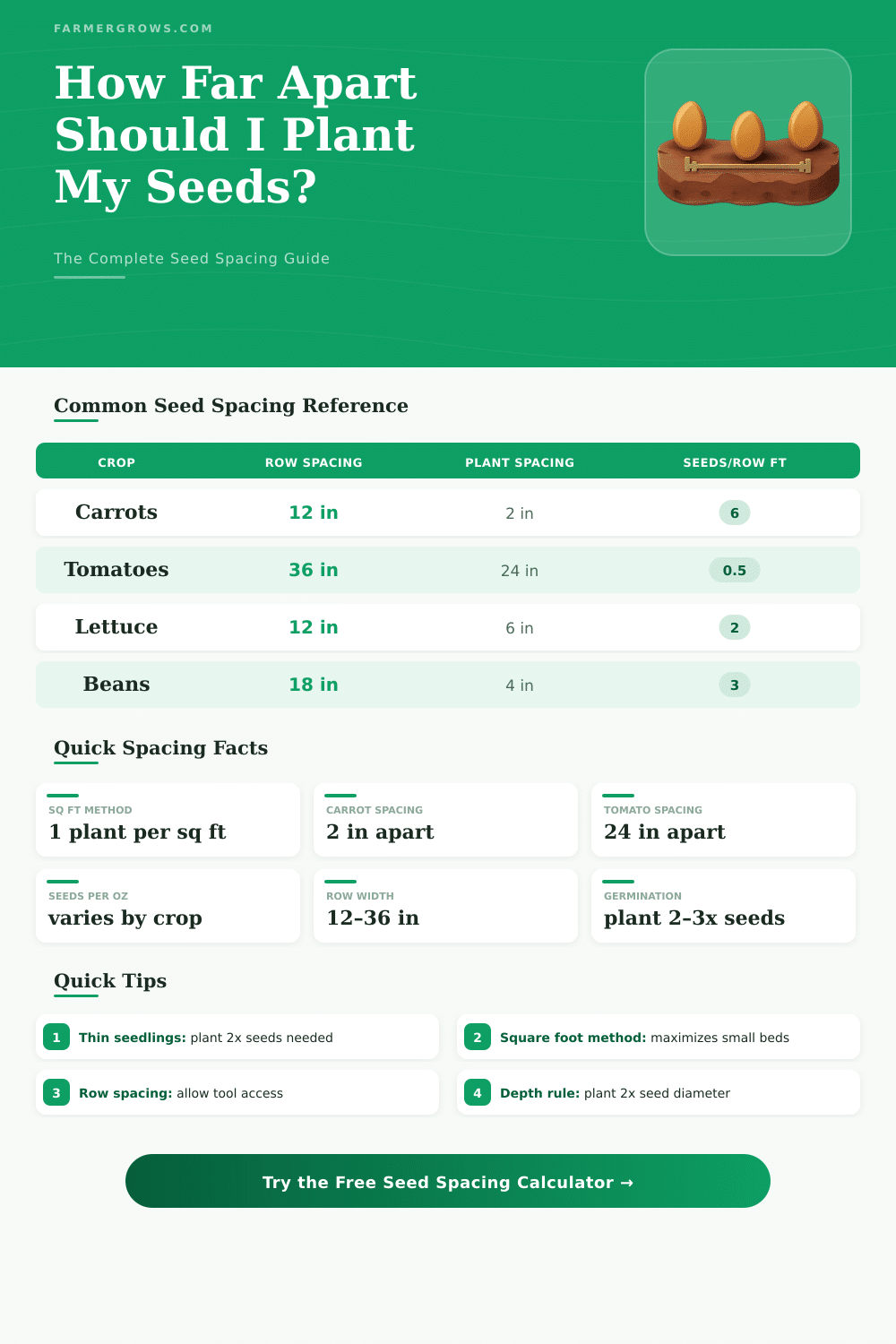
The distance between seeds during planting is called Seed spacing. That is important because each plant needs enough space for roots underground and to expand up. If one gets the right spaces, one escapes too dense growth, that otherwise would compete for food and water.
Packets of seeds usually say, how broadly to plant, how far to deeply bury and when in the year is best. Although seed is little and the packet mentions six inches for Seed spacing, one should still follow that. Plants do need space, when they reach their full size.
How Far Apart to Plant Seeds
Useful info about spacing: six inches means three inches on every side of the seed, not six on both sides.
Also the depth of planting matters. One should bury seeds in depth equal to their own thickness. If planted more deeply, the seed must spend more energy to push upward.
Some seeds, planted too shallow, simply can not grow. For example root vegetables, like carrots, one plants with seeds in quarter to third of inch depth, in rows spaced at twelve to twenty-four inches.
Commonly the spacing on seed packets assumes, that the gardener will walk between rows for weeding or harvesting. In raised beds, where none walks on the ground, you can leave that broad row spacing and plant equal distance in all directions. Even so rows ease the weeding.
Too dense planting slows the use of a hoe. Rows also help to identify babies of seeds of unwanted grasses, because something not growing along a line is probably unwanted grass.
Good spacing allows good air flow, that stops pests and diseases. This gentle flow is more important for some crops then for others. The advice about spacing on seed packets is meant to produce the biggest single copies of every plant, not necessarily the maximum whole amount.
Some gardeners lay two or three seeds in one place, because not all sprout. Even with good seed from a reliable company, the sprouting does not reach hundred percent. For little vegetables like radishes and carrots, sixteen plants can come from a square foot, arranged in four rows each four, with two inches between every plant.
It is possible to plant more closely than the advice says, but like this the soil tires more quickly. Space between plants lets sunlight reach them also from the sides. There are simple tools for help with spacing.
A wooden box pressed in the ground makes equal holes. A square template with marks is useful for placing seeds at the right distance. A simple wooden board with holes drilled in regular gaps works well for straight sowing.
Egg cartons with holes cut in the bottom can space peas well along a row.
Plants truly adapt to a broad range of spacings. There is a sweet spot, where the amount of product stays almost the same, although the Seed spacing adjusts a bit. Methods like vertical gardening and repeated planting also help to useconfined garden area most effectively.