🪴 Potting Soil Calculator
Calculate exactly how much potting soil you need for any garden bed, container, or planting area
lbs / cu yd
lbs / cu yd
lbs / cu yd
lbs / cu yd
lbs / cu yd
lbs / cu yd
lbs / cu yd
lbs / cu yd
| Depth (in) | Depth (cm) | Coverage (sq ft) | Coverage (m²) |
|---|---|---|---|
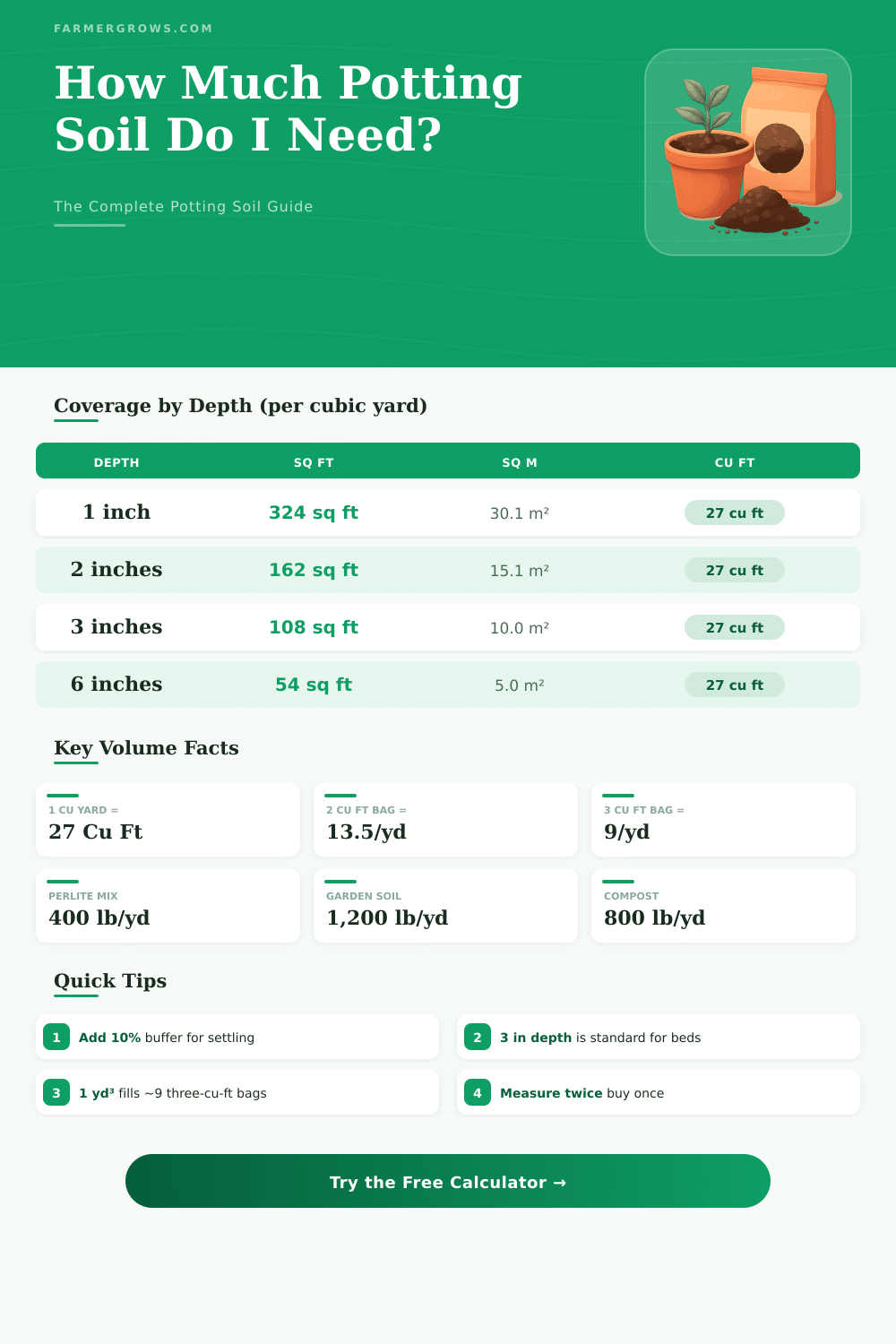
| 1 inch | 2.5 cm | 324 sq ft | 30.1 m² |
| 2 inches | 5 cm | 162 sq ft | 15.1 m² |
| 3 inches | 7.6 cm | 108 sq ft | 10.0 m² |
| 4 inches | 10 cm | 81 sq ft | 7.5 m² |
| 6 inches | 15 cm | 54 sq ft | 5.0 m² |
| 8 inches | 20 cm | 40.5 sq ft | 3.8 m² |
| 12 inches | 30 cm | 27 sq ft | 2.5 m² |
| Bag Size | Volume per Bag | Bags per Cu Yd | Coverage at 3 in |
|---|---|---|---|
| 1 cu ft bag | 1.0 cu ft | 27 bags | 4 sq ft |
| 1.5 cu ft bag | 1.5 cu ft | 18 bags | 6 sq ft |
| 2 cu ft bag | 2.0 cu ft | 13.5 bags | 8 sq ft |
| 3 cu ft bag | 3.0 cu ft | 9 bags | 12 sq ft |
| Bulk (1 yd³) | 27 cu ft | 1 unit | 108 sq ft |
| Project | Area | Cu Yards | 2 cu ft Bags |
|---|---|---|---|
| Window Box 2×1 ft | 2 sq ft | 0.02 yd³ | 1 bag |
| Raised Bed 4×4 ft | 16 sq ft | 0.15 yd³ | 3 bags |
| Raised Bed 4×8 ft | 32 sq ft | 0.30 yd³ | 5–6 bags |
| Small Garden 10×10 ft | 100 sq ft | 0.93 yd³ | 14 bags |
| Medium Bed 10×20 ft | 200 sq ft | 1.85 yd³ | 27 bags |
| Large Bed 20×20 ft | 400 sq ft | 3.70 yd³ | 54 bags |
| Full Yard 50×50 ft | 2,500 sq ft | 23.1 yd³ | 340 bags |
Soil settles 10–15% after watering. Add at least 10% overage to avoid running short. For raised beds, consider adding 15–20% since the soil compresses significantly over the first season.
Buying in bulk (by the cubic yard) is more economical for orders over 2 yards. For smaller projects, pre-bagged soil is easier to handle. One cubic yard weighs 400–1,400 lbs depending on material type.
Potting Soil is not really made up of dirt for every use, it is a soil-free mix, created specially for growing plants in pots. One commonly hears the words Potting Soil and potting mix used the same way, and honestly that happens because of a lack of official rules about labeling of packed soils. So pay attention to what is written on the bag.
At the end of the day, Potting Soil simply is the stuff that you put in the pots of your plants.
What Is Potting Soil and How to Use It
What separates Potting Soil from average garden soils is its more lightweight and airy structure. It carries items like vermiculite, perlite and organic materials, for instance bark, that help to ensure good drainage and stop packing down. On the contrary, garden soil easily thickens in pots.
Potting Soil stays lightweight and loose. That lightweight mass matters especially for big pots. The main target is that it works for pots, not for outdoor ground crop.
Good potting mix can include coconut fiber, peat moss, perlite, starter nutrients and limestone, so that plants absorb them more easily. One adds wetting agents to balance humidity, and sometimes mycorrhizae to rush root growth. In the stores you find also organic Potting Soil with sphagnum, humus, worm castings, alfalfa meal, kelp meal and feather meal.
There is another way: mix compost with wooden ash and pine bark chips too create a rich mix, that works for many kinds of plants.
If you choose sterile soil-free mixes, your plants and seeds are protected against bad germs and unwanted grasses… That is a big advantage. It offers more control over the growing space.
What is the disadvantage? Avoid mixes filled with chemical dressings, especially for edible crops. Lime helps to balance the pH-level, germs help the processes, and wetting agents keep the humidity stable.
Cheap products sometimes mix in garden soil or ground, what burdens the structure and impact.
The amount of perlite in the mix depends entirely on your crop. More perlite gives faster water flow and drying. I noticed that for succulents a one-to-one ratio between Potting Soil and perlite avoids too much humidity.
Store bought Potting Soil usually already carries nutrients and perlite mixed in.
Basic home mixes are made up of three parts coconut fiber or peat, two parts compost like worm castings and one part perlite or pumice. Making it yourself, you fully control the ingredients. Regular replanting with fresh soil helps the growth of plants.
Your mixes must allow water flow, while they keep enough humidity for happy roots, without draining too fast. Always use new potting or seed mixes, to avoid diseases later.
Foxfarm Ocean Forest is among the best store-bought all-purpose soils. It helps hold humidity and works well for young clones, that dry out easily. The quality of the soil in pots truly affects how wellplants grow.