Nozzle Reaction Force Calculator
Calculate thrust force from irrigation guns, boom sprayers, and fire suppression nozzles
Nozzle Reaction Force Results
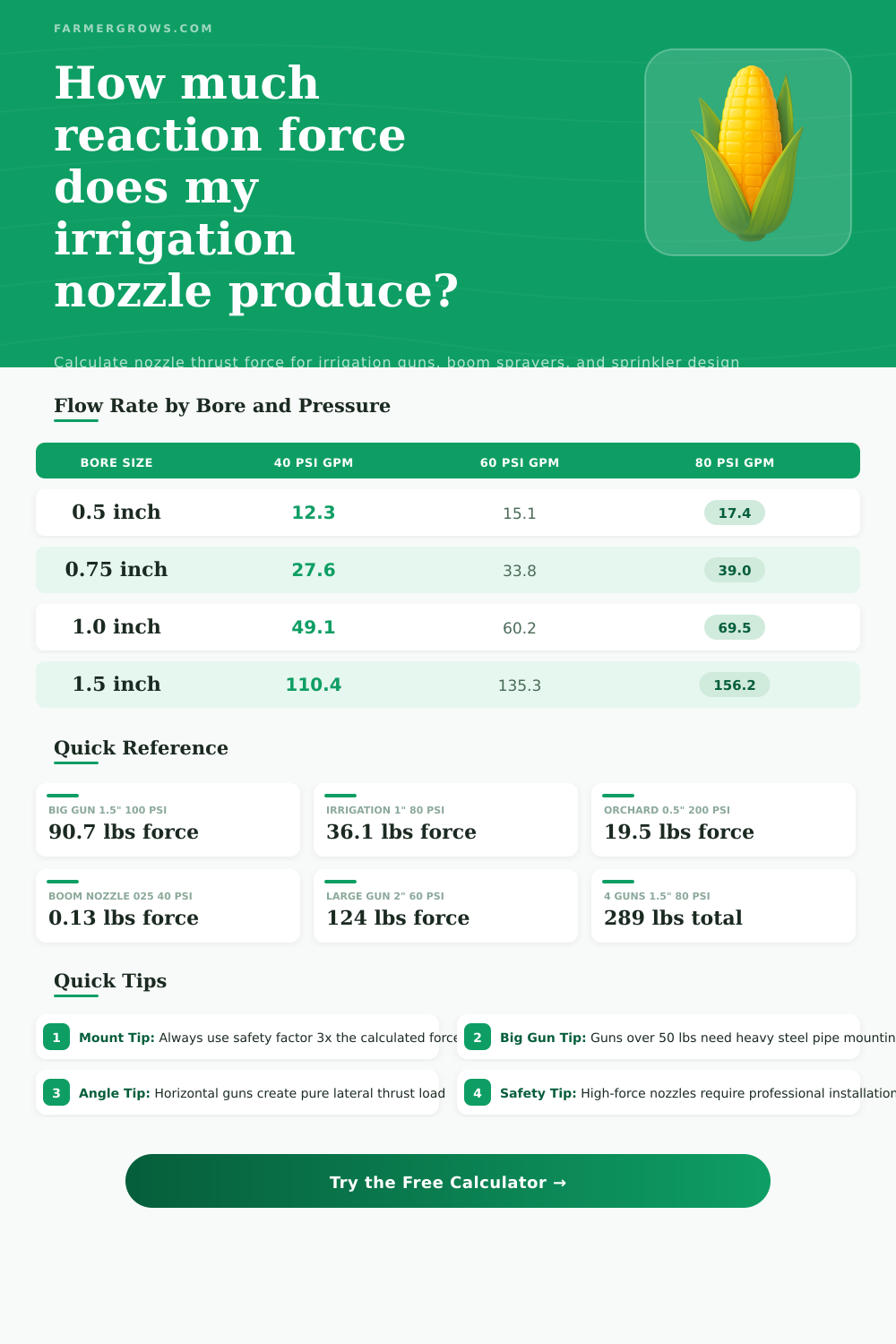
| Bore Size | 40 PSI | 60 PSI | 80 PSI | 100 PSI |
|---|---|---|---|---|
| 0.5 inch | 12.3 | 15.1 | 17.4 | 19.5 |
| 0.75 inch | 27.6 | 33.8 | 39.0 | 43.7 |
| 1.0 inch | 49.1 | 60.2 | 69.5 | 77.7 |
| 1.5 inch | 110.4 | 135.3 | 156.2 | 174.8 |
| 2.0 inch | 196.3 | 240.5 | 277.7 | 310.6 |
| Flow (GPM) | 40 PSI Force | 60 PSI Force | 80 PSI Force | 100 PSI Force |
|---|---|---|---|---|
| 10 GPM | 3.3 | 4.0 | 4.6 | 5.2 |
| 25 GPM | 8.2 | 10.1 | 11.6 | 13.0 |
| 50 GPM | 16.4 | 20.1 | 23.2 | 26.0 |
| 75 GPM | 24.5 | 30.1 | 34.8 | 38.9 |
| 100 GPM | 32.7 | 40.1 | 46.3 | 51.8 |
| 150 GPM | 49.0 | 60.1 | 69.4 | 77.7 |
| 200 GPM | 65.4 | 80.1 | 92.6 | 103.6 |
| Force (lbs) | Mounting Type | Min Bolt Size | Safety Factor |
|---|---|---|---|
| 0–5 lbs | Standard hose clamp | 1/4" bolt | 3x |
| 5–20 lbs | Pipe flange + bolts | 3/8" bolt | 3x |
| 20–50 lbs | Steel bracket welded | 1/2" bolt | 3x |
| 50–100 lbs | Heavy steel pipe mount | 5/8" bolt | 4x |
| 100–200 lbs | Structural steel frame | 3/4" bolt | 5x |
| 200+ lbs | Engineered structure | Engineering required | 5x+ |
Nozzle reaction force are a physical phenomenon that occurs when water exit a nozzle at high speeds. When water exits a nozzle at high speeds, it creates a backward force that pushes against the nozzle and the stands upon which the nozzle is mount. When using an irrigator or a sprayer, it is essential to account for nozzle reaction force since this force can damage the irrigation systems.
The force increase with the flow rate of water exiting the nozzle and with the operating pressure of the system. The magnitude of the nozzle reaction force is determined by several variable in the system. The variables that determine nozzle reaction force are the bore diameter of the nozzle, the operating pressure of the system, and the trajectory angle of the nozzle.
Nozzle Reaction Force and How to Choose Mounts
The bore diameter of the nozzle is the size of an opening through which water exits the nozzle. A larger bore diameter allow more water to exit the nozzle at once, resulting in an increased reaction force. The operating pressure of the nozzle is the amount of pressure acting on the water within the system.
If the operating pressure is higher, the water will have a more higher velocity as it leaves the nozzle. The higher velocity of the water will increase the reaction force at the nozzle. The trajectory angle of the nozzle is the direction to which the nozzle is point.
The nozzle reaction force will be distributed differently based off the trajectory angle of the nozzle. Nozzles that are pointed horizontally create the most significant challenges to the irrigation system. This is because a horizontal nozzle will direct the reaction force of the water against the irrigation systems mounting hardware.
If the nozzle is tilted to a 25 or 30-degree angle from horizontal, the force will shift from a horizontal reaction force to a vertical reaction force. Should the nozzle be tilted to a 45-degree angle from horizontal, the nozzle reaction force will divide equally between the horizontal and vertical components of the nozzle reaction force. By changing the angle to which the nozzle is point, the lateral force acting on the irrigation system can be reduce.
Based on the total nozzle reaction force in the system, the user will need to select the appropriate mounting hardware. If the total nozzle reaction force is under 5 pound, standard hose clamps will do. If the total nozzle reaction force is between 20 and 30 pounds, steel bracket and bolts at least one-half inch in diameter will be required.
For systems where the nozzle reaction force exceed 50 pounds, heavy pipe stand will be required to mount the nozzle since high reaction forces can break lightweight irrigation stands. In these cases, the irrigation system mount should of be able to handle at least three time the reaction force to accommodate surges in the system. Many people make mistake when installing nozzles.
Some of these mistake include not taking into account all the variable related to nozzle reaction force. For example, large nozzle gun are mounted on lightweight PVC pipes. The PVC pipe cannot handle the reaction force of the large nozzle gun.
People also make the mistake of using the flow rate charts made by the nozzle manufacturer. These charts calculate the flow rate without accounting for the drop in water pressure along the irrigation system to the nozzle. The pressure measurement should be taken at the nozzle.
This measurement will determine the nozzle reaction force. For irrigation systems where multiple nozzle are mounted on a single boom or a pivot, the operator must calculate the total nozzle reaction force by calculating the reaction force of each nozzle and adding these force together. Regardless of the direction of the nozzles, each system will contribute to the total nozzle reaction force acting on the boom or pivot.
For instance, a pivot irrigation system equipped with four 1.5-inch guns will create a high reaction force on the pivot. Each 1.5-inch gun will create a reaction force of 72 pounds at 80 PSI. Four gun will create a total nozzle reaction force of nearly 300 pounds.
Nozzle reaction force is a constant in any irrigation system that use nozzles. The three factor to consider when calculating nozzle reaction force are the bore diameter of the nozzle, the operating pressure of the system, and the angle of the nozzles trajectory. Based on this calculation, the correct mounting hardware must be select.
Finally, irrigation system designer who take into account the nozzle reaction force will prevent damage to the irrigation system and the mounting hardware.