🌾 Hay Tarp Size Calculator
Estimate tarp cut size, coverage area, stack volume, and hay weight for rectangular, round, triangular, or custom stacks.
📋 Breakdown
| Overhang | Added span | Best for | Note |
|---|---|---|---|
| 1 ft | +2 ft total | Tight stacks | Least slack |
| 2 ft | +4 ft total | Standard rows | Balanced fit |
| 3 ft | +6 ft total | Windy sites | More lead |
| 4 ft | +8 ft total | Round bales | Loose drape |
| Stock tarp | Coverage | Fits | Note |
|---|---|---|---|
| 20 x 20 | 400 sq ft | Small piles | Fast cover |
| 20 x 30 | 600 sq ft | Low rows | Easy anchor |
| 30 x 40 | 1,200 sq ft | Mid stacks | Common size |
| 40 x 60 | 2,400 sq ft | Big yards | Wide margin |
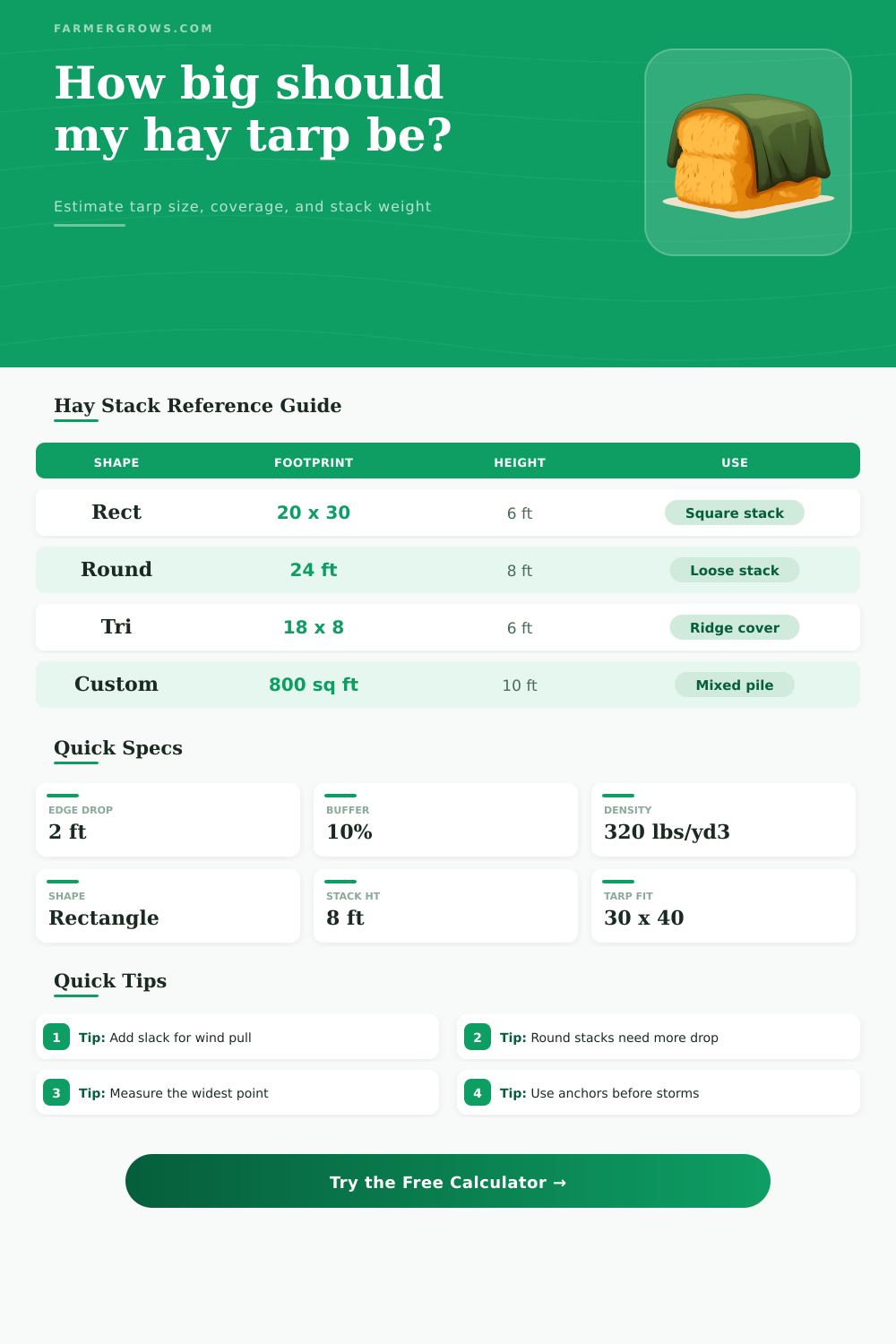
| Project | Footprint | Height | Suggested tarp |
|---|---|---|---|
| Small square stack | 12 x 18 ft | 4-5 ft | 18 x 24 ft |
| Mid field stack | 20 x 30 ft | 6-8 ft | 26 x 36 ft |
| Round bale pile | 24 ft dia | 8 ft | 30 x 30 ft |
| Long hay row | 16 x 42 ft | 5-7 ft | 22 x 48 ft |
Choosing the right size of hay tarp cover matter a lot for protecting bales against rain, snow, wind and sun. The required tarp size depends on the bale size and the used stacking method. Measure your bales to know exactly what specifications are needed.
Do not trust only the directions of the baler because rolls can have different sizes during use Too little tarp leaves the hay without covering.
How to Choose the Right Hay Tarp
Hay tarps are available in various sizes. Good options are 15×54 feet, 18×36 feet and 18×48 feet. For heavy use choose 48×33 feet or 25×33 feet.
Some farmers like smaller ones, as 30×30 feet, after years of problems with enormuos heavy tarps. For round bales 20×20 foot tarps work well. One farmer covered 31 round bales, each weighing around 1,000 pounds, under a giant 50×100 foot tarp.
When bales are stacked doubly with a peak for good drainage, the tarp width must fit both diameters and the overhangs. Always measure the stack before ordering. The main idea is bigger tarps are a better choice.
These tarps do not only block the weather. They sort and set the hay, which eases transfer to indoor storage if needed. Some have dual-sided technology to protect straw, bales and farm tools.
Breathable hay tarps use European polypropylene fabric, that is lightweight, waterproof and almost impossible to tear. The humidity passes freely through the material, but rain slips immediately down, if the pile has a 45-degree slope.
Also the thickness matters. A good range is 12 to 14.5 mil with strengthened edges. Rust-proof grommets, spaced every 2 feet, help against wind.
Some tarps have aluminum grommets every 18 inches, nylon hand grips on the two long sides and the four corners. Commonly present on quality tarps are 2-inch webbing, tabs, and rain flaps to force water away from the pile and upper straps for extra strength on big tarps.
Used vinyl billboard tarps are another option for covering hay. They have 3 to 4 inch tube sleeves around all four sides, ideal for tie-downs. With thickness of around 5 mil, poly hay tarps are lightweight, easy to carry and laid above stored crops.
Cheap tarps from big box stores commonly fall apart after some months in the weather, so it pays to invest in rugged materials.