🌾 Grain Bin Peak Calculator
Estimate bushels, volume & weight stored in round grain bins — including peaked grain above the eave
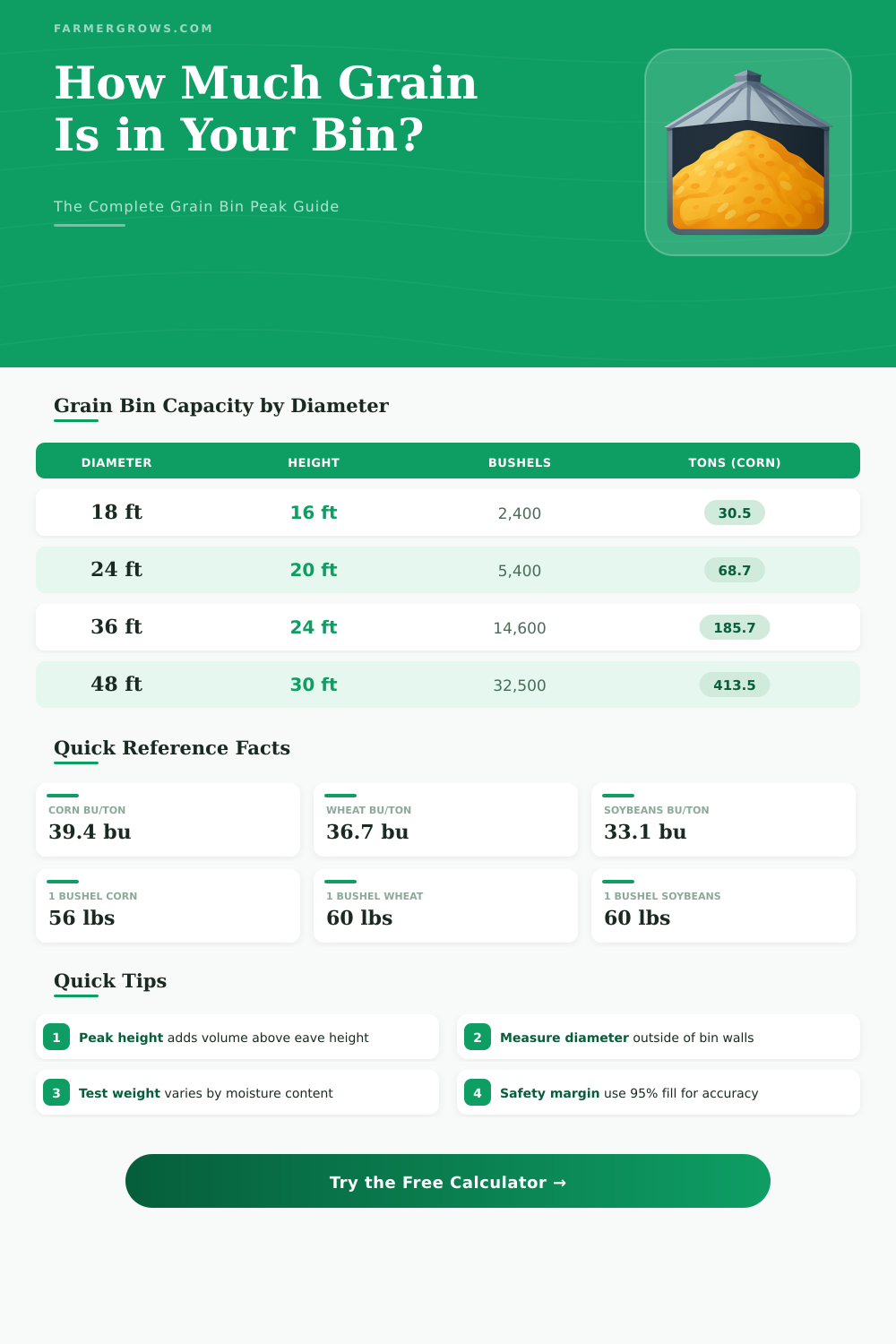
| Diameter | Eave Height | Cylinder Vol (bu) | +3 ft Peak (bu) | Total (bu) |
|---|---|---|---|---|
| 15 ft (4.6 m) | 12 ft | 1,178 | +62 | 1,240 |
| 18 ft (5.5 m) | 14 ft | 1,930 | +90 | 2,020 |
| 21 ft (6.4 m) | 16 ft | 3,150 | +122 | 3,272 |
| 24 ft (7.3 m) | 18 ft | 4,622 | +159 | 4,781 |
| 27 ft (8.2 m) | 20 ft | 6,523 | +201 | 6,724 |
| 30 ft (9.1 m) | 22 ft | 8,891 | +248 | 9,139 |
| 36 ft (11 m) | 24 ft | 13,934 | +357 | 14,291 |
| 48 ft (14.6 m) | 28 ft | 28,917 | +634 | 29,551 |
| Diameter | 1 ft Peak | 2 ft Peak | 3 ft Peak | 4 ft Peak | 5 ft Peak |
|---|---|---|---|---|---|
| 15 ft | 21 bu | 41 bu | 62 bu | 83 bu | 103 bu |
| 18 ft | 30 bu | 60 bu | 90 bu | 120 bu | 150 bu |
| 24 ft | 53 bu | 106 bu | 159 bu | 212 bu | 265 bu |
| 30 ft | 83 bu | 166 bu | 248 bu | 331 bu | 414 bu |
| 36 ft | 119 bu | 238 bu | 357 bu | 476 bu | 595 bu |
| 48 ft | 211 bu | 423 bu | 634 bu | 845 bu | 1,057 bu |
| Grain Type | lbs per bu | bu per ton | kg per bu | bu per tonne |
|---|---|---|---|---|
| Corn (Shelled) | 56 | 35.7 | 25.4 | 39.4 |
| Wheat | 60 | 33.3 | 27.2 | 36.7 |
| Soybeans | 60 | 33.3 | 27.2 | 36.7 |
| Grain Sorghum | 56 | 35.7 | 25.4 | 39.4 |
| Oats | 32 | 62.5 | 14.5 | 68.9 |
| Barley | 48 | 41.7 | 21.8 | 45.9 |
| Sunflower (Oil) | 25 | 80.0 | 11.3 | 88.2 |
| Canola/Rapeseed | 50 | 40.0 | 22.7 | 44.1 |
To determine how much grains is in a bin, you need to take into account the cylindrical and conical portion of the grain bin. Many peoples will look at the bin to try to determine how much grain is in it, but looking at the bin will likely lead to inaccurate numbers regarding the amount of grain in the bin. A grain bin contains both a cylindrical and conical portion of the bin, and you must calculate the volume of each of these portion in order to determine the total volume of the bin.
If you calculate the volume of the cylindrical portion of the bin alone, the amount of grain in the bin will be underestimated, which may lead to problems in determining how much grain should of be purchased for that bin or otherwise manage. The first measurement that you must take to calculate the volume of the grain in the bin is the diameter of the bin. You must measure the diameter from the outside of the walls of the bin to ensure that the measurement of the diameter is accuratey.
How to Measure Grain in a Bin
Because the walls of the bin take up some of the space within the bin, it is important to take into account the thickness of those walls. The diameter of the bin is required to calculate the radius of the bin, which is another of the measurements that is required for the calculation of the volume of both the cylindrical and conical portions of the bin. The height of the sidewalls of the bin is referred to as the eave height, which is a required measurement for calculating the volume of the cylindrical portion of the bin.
The height of the conical portion of the bin is measure from the eave line to the peak of the grain in the bin. This height is referred to as the peak height of the grain in the bin, and this measurement is required to calculate the volume of the conical portion of the bin. You can calculate the volume of the cylindrical portion of the bin using the radius of the bin and the eave height of the bin.
However, the volume of the conical portion of the bin is calculated using the radius of the bin and the peak height of the grain in the bin. The volume of a cone is one-third of the volume of a cylinder with the same radius and height. Thus, the addition of the peak of the grain in the bin adds a significant amount of volume to the total volume of the grain in the bin.
For instance, a grain bin that has a large diameter will have a much larger volume of grain in its conical portion than a grain bin that has a small diameter. This peak of grain in the conical portion of the bin represent a significant amount of grain that can be sold. The type of grain that is within the bin and the moisture content of the grain will change the total amount of that grain within the bin by weight.
For instance, corn has a different test weight than wheat, and wheat has a different test weight than oats. Thus, you must account for each type of grain when calculating the total weight of the grain within the bin. Additionally, the moisture within the grain will also change the weight of the grain within the bin.
High moisture content within the grain will lead to a heavier weight of grain within the bin than if the moisture content within the grain is low. Additionally, high moisture content within the grain can impact the way in which the grain settle within the bin, which can impact the height of the peak of the grain within the bin. It is important to leave a margin of safety within the grain bin in relation to the total capacity of that bin.
For instance, it is common to only fill the grain bin to 95% of its total capacity. It is important to leave a safety margin within the bin for two main reason: because grain may expand within the bin due to changes in the temperature of the grain within the bin, and because grain may settle over time within the bin. If the bin is fill to 100% of its capacity, problems can be created with the movement of air within the bin.
Air movement within the bin is important to regulate the temperature of the grain within the bin, which you can accomplish with the use of aeration fans. These aeration fans may struggle to move air through a conical portion of the bin that is too high in relation to the total height of the bin. The volume of the grain within the bin will need to be converted to either bushel or tons in order to determine how much grain the bin contain.
The bushel is a unit of measure of the volume of grain within the bin, while tons is a unit of measure of the weight of the grain. It is important to know the weight of the grain in each bushel of grain in order to determine the total weight of the grain within the bin. By taking accurate measurements of the diameter, the eave height, and the peak height of the grain within the bin, you can calculate the total volume of grain.
By calculating the total volume of grain within the bin, it is possible to know the exact amount of grain that is within that bin.