Food Plot Lime Calculator
Estimate lime needs for deer, turkey, pollinator, and cover-style wildlife plots from plot acres, crop mix target pH, soil texture, lime ECCE, bag size, ATV spreader capacity, planting date, and split-rate cap.
Use this for food plot logistics before ordering lime or lining up equipment. A local soil test and lab lime recommendation should set the final rate, especially when pH is very low or plots are newly cleared.
Food Plot Lime Plan
Rates are adjusted for pH gap, crop target, texture, incorporation depth, ECCE, ordering buffer, ATV bag handling, and the split cap you selected.
| Wildlife crop mix | Target pH used | Acidity tolerance | Best planting window | Lime priority |
|---|---|---|---|---|
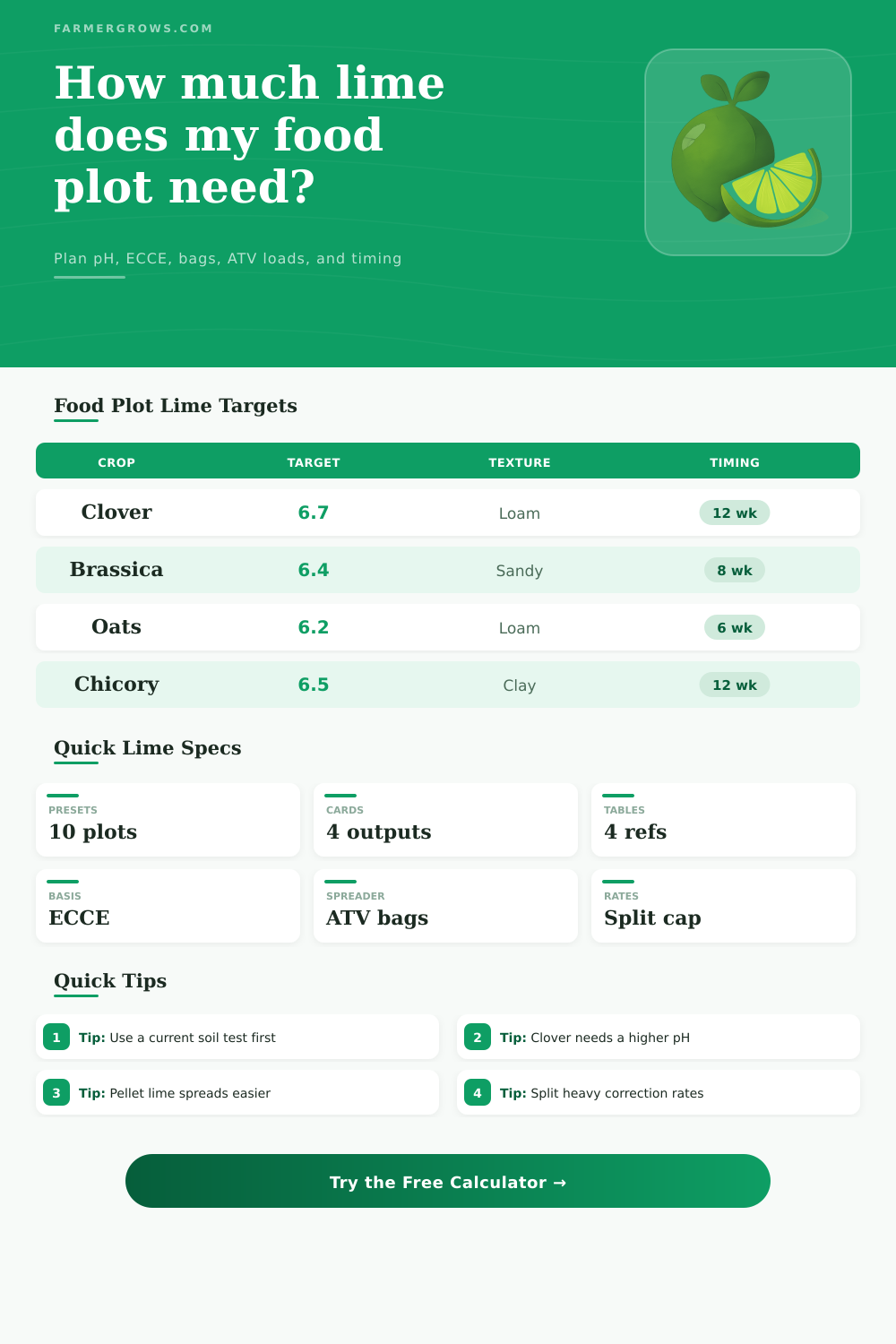
| White or ladino clover | 6.7 | Low tolerance | Spring or late summer | High; lime before seeding if possible |
| Clover and chicory blend | 6.6 | Low to moderate | Spring or late summer | High; supports perennial stand life |
| Brassica blend | 6.4 | Moderate | Late summer | Medium high for leaf and bulb growth |
| Cereal grains | 6.2 | Good tolerance | Late summer or fall | Medium; useful while lime reacts |
| Soybean, cowpea, or pea mix | 6.5 | Moderate | Spring or early summer | High for nodulation and protein forage |
| Sorghum, millet, or screen | 6.0 | Good tolerance | Late spring or summer | Moderate; not as strict as clover |
| Soil texture | Buffer strength | Pure lime tons/ac per 1.0 pH at 6 in | Food plot reaction | Planning note |
|---|---|---|---|---|
| Sand or loamy sand | Low | 1.25 to 1.55 | Faster pH movement | Use smaller passes and retest sooner |
| Sandy loam | Low medium | 1.55 to 1.95 | Moderate response | Common for small woods plots |
| Loam | Medium | 2.05 to 2.45 | Balanced response | Good baseline for clover and brassicas |
| Silt loam | Medium high | 2.35 to 2.85 | Slower than sand | Needs more material for same pH lift |
| Clay loam or clay | High | 2.85 to 3.60 | Slow but stable | Split heavy rates and incorporate well |
| Lime product | Typical ECCE | Spreading fit | Food plot use | Handling note |
|---|---|---|---|---|
| Calcitic ag lime | 55% to 75% | Bulk spreader or buggy | General pH correction where Mg is fine | Best value when delivery and spreading are available |
| Dolomitic ag lime | 50% to 75% | Bulk spreader or buggy | Low magnesium soils | Useful when the soil test calls for Mg |
| Pelletized lime | 75% to 95% | ATV or walk spreader | Small plots and remote access | Easy bags, but total pounds still matter |
| Fine high-cal lime | 85% to 100% | Careful spreader setup | Quicker reaction after moisture | Dust and bridging can affect flow |
| Marl or soft lime | 30% to 60% | Bulk only | Local source where analysis is known | Moisture and purity can change tons needed |
| Rate after ECCE | Split guidance | Timing before planting | ATV practical note | Follow-up |
|---|---|---|---|---|
| Under 1 ton/ac | Usually one pass | 4 to 8 weeks helps | Pellet bags are manageable on small plots | Retest after the first season |
| 1 to 2 tons/ac | One incorporated pass or two surface passes | 8 to 12 weeks is better | Plan several hopper fills per acre | Check pH before reseeding clover |
| 2 to 4 tons/ac | Split strongly preferred | Apply first pass well ahead | Bulk ag lime may beat bag labor | Retest 6 to 12 months later |
| Over 4 tons/ac | Stage correction over time | Start the season before planting | ATV-only spreading becomes slow | Use lab recommendation by zone |
| Surface-only plots | Lower single pass cap | Give extra reaction time | Rainfall moves lime slowly downward | Sample the top 0 to 4 inches |
Before planting: Lime reacts slowly, especially ag lime on no-till or shallow-disked plots. If clover is the goal, correcting pH ahead of planting often matters more than adding extra seed.
Before hauling bags: Compare total bags with your ATV hopper capacity. A small remote plot can be simple, but a multi-ton correction may justify bulk lime or staged applications.
Lime is one of the material that is used to change the pH of the soil in a food plot. Using lime will ensure that the plants that are growing in the food plot will grow correctly. For instance, if the pH of the soil is too acidic, the food plot will fail.
Additionally, if the lime does not have enough time to change the pH of the soil prior to planting the seed, the food plot will also fail. The amount of lime that is required to change the pH of the soil to the desired level is dependent upon the current pH level of the soil, the target pH level that is to be achieved, and the texture of the soil. The pH of the soil will dictate the ability of the plants to grow within that soil.
Using Lime to Change Soil pH in Food Plots
Many of the forage plant that are commonly planted in food plots prefer soil that is not acidic. For instance, clover, a forage plant, needs to have a specific pH in the soil for the nitrogen-fixing bacteria that live within the plant’s roots to survive. Additionally, brassicas, another category of forage plants, can grow in soils that are more acidic than the plants described above, but will produce more of their forage food if the pH of the soil is set to the correct level for their growth.
Furthermore, cereal grain, another group of forage plants, can grow in many different pH levels of soil. For these reasons, many individuals that establish food plots will plant cereal grains while the lime is changing the pH of the soil. The texture of the soil will also impact how easy the acidity can be held within the soil; clay soil will hold acidity more than sand soil.
As a result, more lime will be required to change the pH of clay soil to the same extent as sandy soil. Depending upon the type of lime that is used, it will impact the amount of lime that is required, as well as the length of time that it will take for that lime to perform its job of changing the pH of the soil. For instance, an ATV can easily spread pelletized lime, and pelletized lime contains high levels of neutralizing value.
Bulk ag lime, on the other hand, will cost less for the individual establishing the food plot, but will require different equipment to spread the lime, and will react to the soil over a longer period of time. The effective calcium carbonate equivalent (ECCE) is a number that indicates the neutralizing value of the liming materials. For instance, liming material with a low ECCE will contain less neutralizing power than materials with high ECCE value.
Therefore, more of the material with the lower ECCE will be required to reach the target pH of the soil. The lime calculator will account for these factor to determine the amount of each type of lime that will be required for the food plot. The depth of the lime and the time that passes prior to planting the seeds will also need to be considered when using lime for a food plot.
For instance, lime require moisture and time to move through the root zone of the food plot. If the soil is disked to a depth of only three inches, the rate of lime will need to be changed. Additionally, if the seeds are to be planted in only one month, the lime may not have enough time to change the pH of the soil prior to planting the seeds.
Many individuals will apply lime well in advance of the planting of the seeds, often splitting the amount of lime required to establish the food plot into two separate applications of lime to allow for effectiveness over two growing season. Finally, the logistics of moving the lime will impact the application of lime to the food plot. For instance, the size of the bag of lime will impact the capacity of the ATV’s hopper.
Additionally, the number of tons of lime that can be moved in a pass will factor into the amount of lime that is required to treat the food plot. The reference tables included on the page will indicate the amount of lime that is required for the different types of forage crops with the different types of soil textures. These reference tables can be used to verify the figure that the lime calculator calculates.
Some of the common mistake that occur are mistakes in the treatment of lime. For instance, one common mistake is to treat lime as a one-time treatment for the food plot. Another common mistake is to completely ignore the gap between the soil test results and the need of the plants that are to be grown in the food plot.
For instance, if lime is planted in a clearing that contains alot of clover, the clover will not grow well due to the low pH of the soil. Another common mistake is applying all of the lime at once to heavy clay soil where the lime will remain on the surface of the soil. The lime calculator cannot account for soil tests; however, it can help to convert soil test results into a plan for treating the soil with lime.
The value of using lime is best seen during the second year of applying lime to the food plot, when more forage is produced due to the soil having the proper pH for the plants to maximize their production.