🌿 Foliar Fertilizer Calculator
Calculate exact spray volumes, mix concentrations, and coverage for foliar feeding
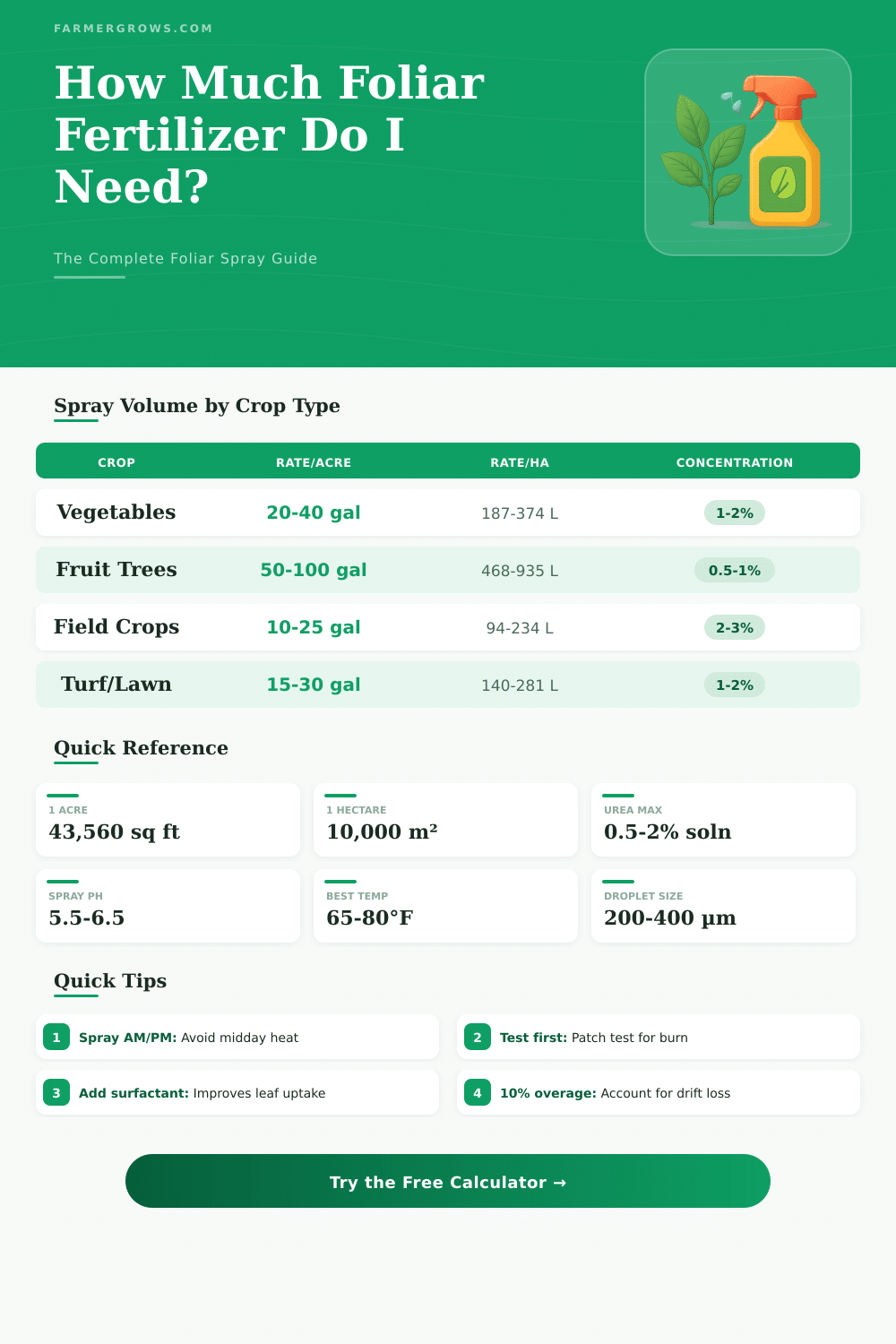
| Crop Type | Spray Rate (gal/acre) | Spray Rate (L/ha) | Typical Concentration |
|---|---|---|---|
| Vegetables (leafy) | 20–40 | 187–374 | 1–2% |
| Vegetables (fruiting) | 25–50 | 234–468 | 0.5–2% |
| Fruit Trees | 50–100 | 468–935 | 0.5–1% |
| Field Crops (wheat, corn) | 10–25 | 94–234 | 2–3% |
| Turf / Lawn | 15–30 | 140–281 | 1–2% |
| Grapes / Vines | 30–60 | 281–561 | 0.5–1.5% |
| Ornamentals | 20–40 | 187–374 | 0.5–1% |
| Berries | 20–40 | 187–374 | 0.5–1.5% |
| Tank Size | At 10 gal/acre | At 20 gal/acre | At 40 gal/acre |
|---|---|---|---|
| 1 gallon (3.8 L) | 4,356 sq ft | 2,178 sq ft | 1,089 sq ft |
| 2 gallons (7.6 L) | 8,712 sq ft | 4,356 sq ft | 2,178 sq ft |
| 4 gallons (15.1 L) | 17,424 sq ft | 8,712 sq ft | 4,356 sq ft |
| 15 gallons (56.8 L) | 1.5 acres | 0.75 acres | 0.38 acres |
| 25 gallons (94.6 L) | 2.5 acres | 1.25 acres | 0.63 acres |
| 50 gallons (189.3 L) | 5.0 acres | 2.5 acres | 1.25 acres |
| Fertilizer | At 0.5% | At 1% | At 2% |
|---|---|---|---|
| Urea (46-0-0) | 0.67 oz/gal | 1.33 oz/gal | 2.67 oz/gal |
| NPK 20-20-20 | 0.67 oz/gal | 1.33 oz/gal | 2.67 oz/gal |
| Calcium Chloride | 0.67 oz/gal | 1.33 oz/gal | 2.67 oz/gal |
| Epsom Salt | 0.67 oz/gal | 1.33 oz/gal | 2.67 oz/gal |
| Fish Emulsion (liquid) | 0.64 fl oz/gal | 1.28 fl oz/gal | 2.56 fl oz/gal |
| Seaweed Extract (liquid) | 0.64 fl oz/gal | 1.28 fl oz/gal | 2.56 fl oz/gal |
| Iron Chelate | 0.67 oz/gal | 1.33 oz/gal | 2.67 oz/gal |
| Zinc Sulfate | 0.67 oz/gal | 1.33 oz/gal | 2.67 oz/gal |
| Project | Area | Spray at 20 gal/acre | Fertilizer at 1% |
|---|---|---|---|
| Raised Bed 4×8 ft | 32 sq ft | 0.015 gal (1.9 fl oz) | 0.025 oz |
| Garden 20×50 ft | 1,000 sq ft | 0.46 gal | 0.61 oz |
| Lawn 50×100 ft | 5,000 sq ft | 2.3 gal | 3.06 oz |
| Half Acre | 21,780 sq ft | 10 gal | 13.3 oz |
| Full Acre | 43,560 sq ft | 20 gal | 26.7 oz (1.67 lbs) |
| 5 Acres | 217,800 sq ft | 100 gal | 8.3 lbs |
Adding a non-ionic surfactant at 0.25% (about 0.3 oz per gallon) improves leaf absorption by 30–50%. Without it, up to 60% of your spray solution can roll off waxy leaves like tomatoes, peppers, and brassicas. Make sure the solution pH is between 5.5 and 6.5 for best nutrient uptake.
Foliar sprays absorb best when stomata are open — typically early morning (6–10 AM) or late afternoon (4–7 PM). Avoid spraying when temperatures exceed 85°F (29°C) as rapid evaporation reduces uptake by 40–60%. Humidity above 70% extends drying time and improves absorption.
A 1% urea solution needs about 1.33 oz per gallon, and at 20 gallons an acre thats roughly 26.7 oz of dry fertilizer for 43,560 square feet. Bumping concentration to 2% doubles that. I found 10% overage covers drift and tank residue pretty well on most backpack sprayer setups.
The information shared below does not come from any calculator or translation program. It is based on real experiences of users, discussions in forums and community experiences, that one finds everywhere on the net.
How to Do Foliar Feeding
Foliar feeding is made up of the application of liquid dressings directly on the leaves of plants. In the last years this became the topic of many discussions. The idea itself is easy: rather than give food by means of the ground, one sends it directly to the greens.
Those foods are liquids that one mixes with extra ingredients, so that a bit from them can soak through the leaves.
Foliar feeding can not replace the ground fertilizer. Truly, the roots take food more well than the leaves. Big nutrients, as nitrogen, phosphorus and potassium, most answer for being in the soil.
Foliar feeding works more well as a boost, that helps to strengthen the impact and care about teh good state of the plant. Only the ground absorption can be quite slow, because sometimes it requires several days, before one sees results.
For small nutrients foliar feeding truly has sense. One can absorb little doses well by means of the leaves. For instance, when a plant has too little iron, the flow of iron on the greens can quickly settle the cause.
Also liquid nitrogen spray helps against nitrogen shortages, and yellowing of more older leaves commonly signals this problem.
In cold northern areas one commonly must use foliar dressing each spring, to deliver nitrogen, phosphorus and other elements, until the soil gets quite warm. Corn, that is sowed in fresh and wet areas, is a good sample, where starter and foliar fertilizer back the start of the plant stage. Modern foliar dressings are focused mixes, that use prime ingredients with NPK.
Time matters. One should apply foliar sprays during the growing period, best in the morning early or evening, away from the direct sunshine. Foliar feeding does not answer, when the heat goes past 75°F. The mix of heat and moisture on the greens can cause leaf burn.
Plant types, that do not handle humidity on leaves, should not receive foliar feeding. Tomatoes are a sample, because they can catch fungal diseases on the leaves.
General advice says, that no more than 25 percent of the whole fertilizer use should come from foliar application. The roots must work with the ground and connect with its ecosystem. The mix ratio for foliar feeding usually is more watered down then that for ground use, to escape lasting burn.
It is also key to not spray just after rain, otherwise the dressing can miss.
The output of foliar dressing is rated at more than 90 percent, while that of ground application stays around 20 to 30 percent. This sounds great, but the total amount of food, that one can give through the leaves, stays limited. Boosters, as kelp and silica, work very well as foliar sprays and show bigger output in vast gardens than watering bymeans of them.
Compost tea and fish fertilizer also are liked for foliar use. Getting enough phosphorus or potassium only by means of leaves is hardly possible, except in cases of emergency.