Firewood Calculator
Convert measured stacks, face cords, full cords, or loose piles into cord equivalents, usable seasoned volume, moisture-adjusted heat, and estimated hauling weight.
●Firewood presets
Pick a common woodpile layout, then fine tune depth, species, moisture, and waste for the actual load.
●Stack, cord, and moisture inputs
This adjusts measured stack volume before converting to cords.
For one row, this is usually the split length. A full cord is 48 in deep.
A face cord is converted using actual split length divided by 48 in.
Thrown firewood often needs about 180 loose ft³ to equal one stacked cord.
Use 0 for already seasoned wood; use a small loss for green splits drying down.
●Species heat and weight grid
Heat values are common seasoned-firewood approximations at about 20% moisture content; actual trees vary by density, bark, rot, and splitting quality.
●Firewood measure comparison
Full cord
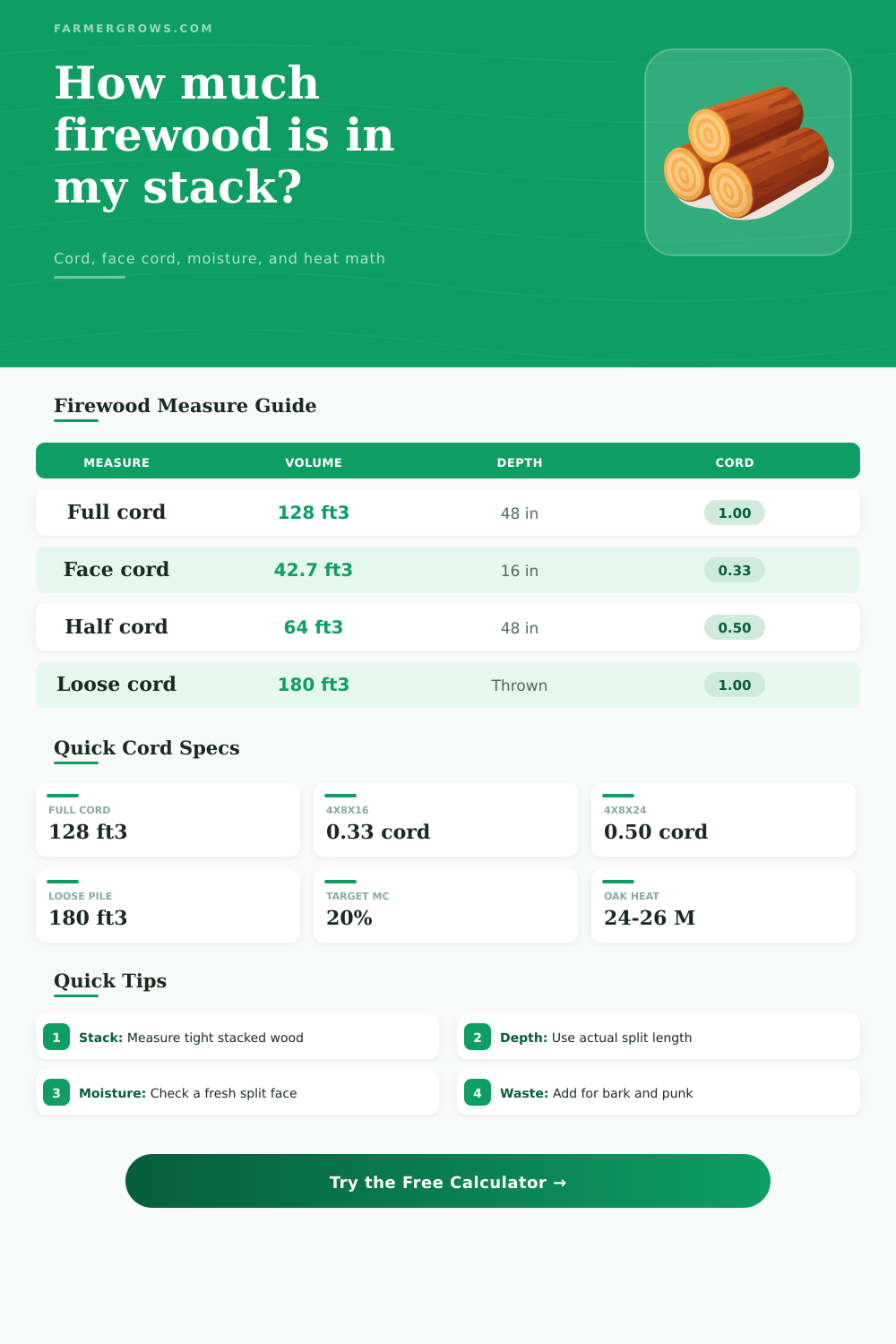
128 ft³ stacked wood and air, commonly arranged 4 ft x 4 ft x 8 ft.
Face cord
One 4 ft x 8 ft face. Cord fraction changes with split length.
Loose tossed cord
About 180 ft³ thrown loose is often used as one stacked cord equivalent.
Usable cord
Raw cord volume after waste, re-stack loss, and moisture heat penalty.
●Cord and stack volume table
| Firewood measure | Nominal dimensions | Stacked volume | Full cord equivalent |
|---|---|---|---|
| Full cord | 4 ft x 4 ft x 8 ft | 128 ft³ | 1.00 cord |
| Half cord | 4 ft x 4 ft x 4 ft | 64 ft³ | 0.50 cord |
| Face cord, 16 in splits | 4 ft x 8 ft x 16 in | 42.7 ft³ | 0.33 cord |
| Face cord, 18 in splits | 4 ft x 8 ft x 18 in | 48 ft³ | 0.375 cord |
| Face cord, 24 in splits | 4 ft x 8 ft x 24 in | 64 ft³ | 0.50 cord |
| Loose thrown pile | Irregular pile or truck bed | 180 loose ft³ | About 1.00 cord stacked |
●Species reference table
| Wood species | Heat per full cord | Weight at 20% MC | Burning note |
|---|---|---|---|
| Hickory | 27.7 MMBtu | 4,320 lb | Very dense heat wood; season thoroughly. |
| White oak | 26.4 MMBtu | 4,200 lb | Long coals, slow to season when split large. |
| Red oak | 24.0 MMBtu | 3,760 lb | Reliable hardwood after a long dry period. |
| Sugar maple | 24.0 MMBtu | 3,750 lb | Good heat with moderate coaling. |
| Ash | 23.6 MMBtu | 3,520 lb | Often starts lower in moisture than oak. |
| Douglas fir | 20.7 MMBtu | 2,970 lb | Good softwood heat with quick ignition. |
| Lodgepole pine | 17.5 MMBtu | 2,410 lb | Fast flame, lighter load weight. |
●Moisture and seasoning adjustment table
| Moisture content | Firewood condition | Heat effect in calculator | Practical reading |
|---|---|---|---|
| 15% to 20% | Seasoned and ready | Uses table heat value | Best measured on a fresh split face. |
| 21% to 25% | Slightly damp | Subtracts extra water boil-off | May hiss or smoke in a cold stove. |
| 26% to 35% | Partly seasoned | Larger heat penalty and more load weight | Stack with sun and airflow before burning. |
| 36% to 50%+ | Green wood | Major delivered heat loss | Plan for seasoning shrink and lower output. |
●Common stack examples
| Stack or storage layout | Measured size | Stack volume | Cord equivalent |
|---|---|---|---|
| One short rack | 4 ft x 4 ft x 16 in | 21.3 ft³ | 0.17 cord |
| Standard face row | 8 ft x 4 ft x 16 in | 42.7 ft³ | 0.33 cord |
| Two shed rows | 8 ft x 4 ft x 16 in x 2 | 85.3 ft³ | 0.67 cord |
| Deep furnace row | 8 ft x 4 ft x 24 in | 64 ft³ | 0.50 cord |
| Full cord bay | 8 ft x 4 ft x 48 in | 128 ft³ | 1.00 cord |
●Firewood calculation notes
A cord of firewood is one of the most common units of measurement for firewood. However, a cord of firewood does not always provide the same amount of heat to a home. Instead, the amount of heat that a cord of firewood can provide depend upon several different factors, including the type of wood that is used, the way that the firewood are stacked, the moisture content of the firewood, and the type of wood splits that is used when measuring firewood in the form of face cords.
Each of these factors will be discussed in more detail in the following paragraphs. The volume of firewood that can be contained within a stack of firewood can be calculated by multiplying the length, the height, and the depth of the stack, and dividing that total volume by 128 to determine the number of cords of firewood that are contained within that firewood stack. However, the actual volume of firewood that can be used for heating is always less than the total volume of the firewood stack due to the gap between the rows of firewood that are stacked within the firewood pile.
What Changes How Much Heat a Cord of Firewood Gives
To account for this lost volume, one can adjust calculations of the total volume of firewood in a stack with the use of a calculator to determine an accurate measurement of the volume of firewood that can be expected from that firewood pile. A face cord of firewood is a different unit of firewood that is often used for firewood measurements. Unlike cords, the depth of a face cord of firewood change according to the length of the firewood splits that are used to create the face cord measurements.
Standard face cords use splits of firewood that is sixteen inches in length, although longer splits is often used for firewood that is to be used in larger fireplaces or stoves. The length of the splits of firewood will indicate whether a face cord will contain a larger or smaller fraction of the total volume of a cord of firewood. In order to calculate the volume of firewood in a face cord, it is essential to know the length of the splits of that firewood.
The efficiency of firewood that is loaded into a truck and transported to a home is often less efficient than the efficiency of firewood that is stacked in piles at the home. When firewood is loaded into a truck bed, the firewood is often thrown into the truck without care for minimizing the amount of space that the firewood occupies. In contrast, firewood that is stacked occupies less space in the truck bed.
Firewood that is thrown into a truck bed often occupies forty percent more space than firewood that is stacked in neatly prepare piles of firewood. Thus, the amount of firewood that is loaded into a truck is often less than the amount of firewood that appear to be loaded based off the size of the truck bed. In addition, firewood that is loaded into a truck often will provide less firewood to a home once the firewood is stacked and measured once it has arrive.
The amount of moisture that is contained within firewood have a significant impact upon the amount of heat that is produced by the firewood when burned. When the moisture content of firewood is high, such as when the moisture content is twenty-five percent, much of the heat that is produced by the firewood will be used to boil the water out of the firewood rather than provide heat to a home. If the moisture content of firewood could be reduced to twenty percent or less, the firewood would produce more heat, and the firewood would weigh less when it is loaded.
The moisture content of firewood can be measured with a moisture meter, which is a more accurate measurement of moisture content than visually inspect the bark of the firewood logs. The species of firewood that is burned is one of the factors that determines the amount of heat that is produced by a cord of firewood. Species of firewood that are dense, such as hickory and white oak, contain more burnable material than species of firewood that are less dense, such as pine or fir trees.
Thus, a cord of firewood made of hickory or white oak will last longer then a cord of pine or fir firewood. Additionally, a cord of firewood that is dense, like hickory, will weigh more than a cord of firewood that is made of light wood, like pine. The amount of firewood that is usable in a pile is also reduced by the amount of waste that is created in the firewood.
Any wood that is discarded due to its bark, its rotten sections, or its length indicates that it can not be stacked with the other firewood logs is waste. Additionally, firewood shrink as it dries, so firewood may be able to pack more tightly together when it has seasoned than when it was initially cut. Thus, the small losses of firewood due to each of these reasons may add up over the life of a firewood pile.
Each of the variables described above will have an impact upon the total amount of heat that can be produced by firewood that is burned in a fireplace or stove. A face cord of red oak wood with twenty-five percent moisture will burn differently from a face cord of ash wood with only twenty percent moisture, for example. Due to the impact of each of these variables upon the amount of heat that is provided by firewood, it is best to use a calculator to account for each of these variables to arrive at the total amount of heat that will be provided by the firewood.
The price of firewood is one of the factors that is often considered when purchasing firewood, but it is not the only such factor. The energy content of firewood can often vary by as much as thirty percent. Thus, two firewood sellers may offer firewood for the same price, but the firewood from one seller may contain so much more energy than firewood from the other seller due to the difference in the moisture content of the firewood or the species of firewood logs that is available from those sellers.
It is therefore a good idea to measure the firewood that is to be purchased prior to stacking it in firewood piles, and to measure the firewood again after it has seasoned in the wood pile. Where firewood is stacked also has an impact upon the moisture content of that firewood. Firewood that is stored in a shaded area that does not allow for the evaporation of moisture from the firewood will season to less moisture content over time than firewood that is stored on pallets in an area that has a roof overhead.
Thus, the way in which firewood is stacked has a significant impact upon the moisture content of the firewood, and, consequently, the amount of heat that will be provided by that firewood when it is burned. Due to the impact of each of the different variables on the amount of heat that will be provided by firewood, it is essential to treat a cord of firewood as a starting point for determining the amount of heat that will be provided by the firewood. It is first important to measure the firewood when the firewood is delivered to the home to determine the total amount of firewood that will be used.
Additionally, the length of the splits of firewood should be measured. Finally, it is also important to measure the moisture content of the firewood. Through measuring each of these variables, an individual will have a realistic idea of the amount of heat that the firewood will provide to the home in which it is to be burned.