Firewood Usage Calculator
Estimate how many full cords, face cords, or custom cord units a home, cabin, shop, or greenhouse will burn from heat load, stove efficiency, burn schedule, wood species, moisture, and backup heat share.
●Named firewood usage presets
Choose a realistic heating pattern, then adjust the load, wood, moisture, backup share, and cord measure to match your place.
●Home heat load and wood inputs
Use a seasonal average load, not the single coldest-hour design load, unless planning for extreme weather.
This gives context for the burn plan and reserve; active wood days can be lower.
Enter the part carried by propane, electric, oil, heat pump, solar gain, or another non-wood source.
Modern wood stoves often land near 65% to 80%; open fireplaces are much lower.
Used when the species menu is set to custom; otherwise the table value is used.
A split-face moisture reading around 15% to 20% is a good stove target.
This adds planning margin after the heat demand calculation.
Species presets update this field; edit it if your local wood is unusually light or dense.
●Species heat quick grid
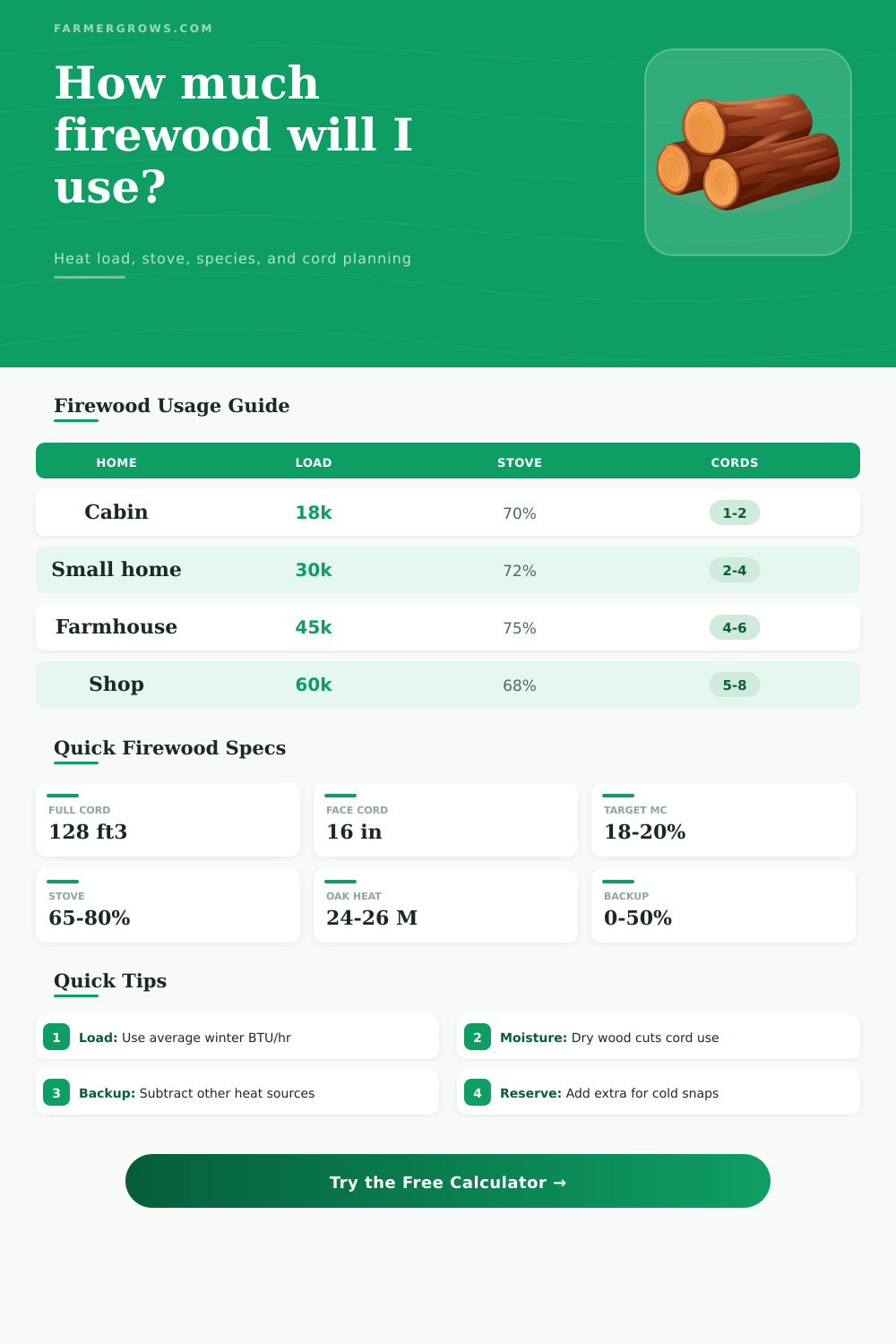
BTU values are practical full-cord planning values near 20% moisture. Real stacks vary with species mix, bark, split size, and how tightly the wood is piled.
●Firewood species reference
| Species or mix | Million BTU per full cord | Approx weight at 20% MC | Usage planning note |
|---|---|---|---|
| Hickory | 27.7 MMBTU | 4,320 lb | High heat and long coals, useful for overnight stove loads. |
| White oak | 26.4 MMBTU | 4,200 lb | Dense winter fuel, but it often needs long seasoning time. |
| Red oak | 24.6 MMBTU | 3,760 lb | Strong heat when dry; wet oak can miss the estimate badly. |
| Sugar maple | 24.0 MMBTU | 3,750 lb | Good all-season hardwood with steady output. |
| White ash | 23.6 MMBTU | 3,520 lb | Reliable medium-density fuel for mixed home heating. |
| Douglas fir | 20.7 MMBTU | 2,970 lb | Strong softwood option where hardwood is scarce. |
| Lodgepole pine | 17.5 MMBTU | 2,410 lb | Fast heat for shoulder season, cabins, and daytime burns. |
| Eastern white pine | 14.3 MMBTU | 2,250 lb | Quick-lighting, lower heat per cord, often needs more volume. |
●Appliance efficiency reference
| Heating appliance | Typical delivered efficiency | Good calculator setting | Usage impact |
|---|---|---|---|
| Open masonry fireplace | 10% to 25% | 15% to 20% | Most cord heat exits the flue, so usage per useful BTU is high. |
| Older airtight stove | 40% to 60% | 50% to 58% | Works for planning, but draft and wet wood can widen the gap. |
| EPA non-catalytic stove | 65% to 75% | 70% to 72% | Common baseline for seasoned cordwood in home heating use. |
| Catalytic stove | 72% to 82% | 76% to 80% | Can reduce cord demand when operated hot enough and with dry wood. |
| Gasification wood boiler | 75% to 85% | 78% to 82% | Best estimate when paired with storage and properly seasoned splits. |
●Moisture and cord-size reference
| Moisture reading | Calculator heat factor | Burn behavior | Planning adjustment |
|---|---|---|---|
| 12% to 15% | About 1.03 | Kiln-dried or very dry | May use slightly fewer cords, but can burn quickly. |
| 16% to 20% | About 1.00 | Seasoned stove target | Best match to published BTU-per-cord values. |
| 21% to 25% | About 0.92 to 0.97 | Slightly damp | Add reserve and expect more smoke on cold starts. |
| 26% to 35% | About 0.75 to 0.90 | Partly seasoned | Usage rises because energy boils off water. |
| 36% to 50%+ | About 0.55 to 0.75 | Green or very wet | Plan on a large cord penalty and season longer. |
●Cord unit conversion table
| Cord unit | Stacked volume | Full-cord factor | Usage meaning |
|---|---|---|---|
| Full cord | 128 ft³ | 1.000 | Standard 4 ft x 4 ft x 8 ft stacked cord. |
| Face cord, 16 in splits | 42.7 ft³ | 0.333 | Three of these equal about one full cord. |
| Face cord, 18 in splits | 48.0 ft³ | 0.375 | Useful for longer stove splits and shed rows. |
| Half cord or 24 in face cord | 64.0 ft³ | 0.500 | Common planning unit for deep furnace wood stacks. |
| Quarter cord rack | 32.0 ft³ | 0.250 | Handy for small sheds, cabins, and porch racks. |
●Usage comparison grid
Part-time cabin
Short evening fires with pine, fir, or mixed hardwood often use less than a cord unless the cabin is leaky or very cold.
Main home stove
A modern stove carrying much of a winter can land around several cords, with climate and insulation driving the result.
Outdoor boiler
Large water loops, older boilers, and long underground runs can raise usage even when the home load looks moderate.
Backup heat mix
Propane, heat pump, oil, or solar gain reduces cord demand only for the hours it actually carries the heating load.
●Planning tips
Many people who use wood as a heating source guess at the numbers of cords of wood that they will need for the heating season before it begins. Most people who attempt to make such a guess base the number on the amount of wood that was used during the previous year, the amount of wood used by a neighbor, or on the suggestion from a wood supplier. Each of these methods of guessing at the amount of firewood that will be needed for the heating season can be inaccurate due to the potential for one season to be colder than another, for instance, or due to the potential for the wood to be wetter than expected.
A firewood usage calculator is a tool that may assist in calculating the amount of wood that will be needed by a household for the heating season, based on several different variable. One of the variables that must be considered in calculating the amount of wood that will be needed is the average heat load for the home. The average heat load is the amount of heat that is required within the home while the stove or boiler is running.
How to Figure Out How Much Firewood You Need
The average heat load is different than what is known as the design heat load, which is the amount of heat that the heating contractor calculates to supply the heating to the home when the home is at an even temperature. If the amount of heat that is entered into the calculator is too high, the calculator will provide a cord count for firewood that is higher than the amount of cords that the house owner will actualy need. Conversely, if the house owner enters an average heat load that is too low, the calculator will show a cord count for firewood that is lower than the amount of cords that will actually be required by the home, which could lead to the homeowner to be without firewood for burning during a particularly cold week within the heating season.
The average heat load can have an impact upon the total number of cords of firewood that is calculated for a heating season; a small change in the average heat load can impact the total cord count by between twenty and thirty percent. Another of the variables that must be considered is the burn schedule for the stove. Each home has its own average heat load, but each home may have a different amount of wood burned within the heating season based upon how long the stove is burned each day.
For instance, two homes that have similar average heat loads may require different amounts of cords of firewood if one home burns wood for twelve hours each day and the other burns wood for twenty hours each day. The firewood calculator that is provided asks for the length of the heating season and the number of days that the wood burning appliance will be burned each day. This allows the calculator to determine how many cords of firewood are necessary for the heating season based upon each of these variables.
Other variables that impact the amount of wood that will be needed for the heating season include the species of wood that will be burned and the moisture content for that wood. For instance, a cord of hickory that has twenty percent moisture will contain more usable heat than a cord of eastern white pine that has twenty percent moisture due to the different densities of each type of wood. Furthermore, if the moisture content within the firewood is higher than twenty-five percent, the firewood will utilize some of the energy in boiling the water that is contained within the firewood.
The firewood usage calculator can calculate the amount of heat that is provided by the species of wood by the moisture content of the firewood. This value is multiplied by the efficiency of the appliance to calculate the total amount of cords of firewood that will be needed to supply the heat load of the home. Thus, each person who purchases and burns the same type and volume of firewood may require a different amount of cords of firewood if each person burns firewood of a different moisture level with a different appliance efficiency.
A third of the variables that the firewood usage calculator considers is the efficiency of the stove. For example, a stove that utilizes catalytic combustion technology may have an efficiency of seventy-eight percent, while an older airtight stove may have an efficiency of only fifty-five percent for the stove. A higher efficiency of the stove indicates that a cord of wood will last for a longer period of time within the home.
Furthermore, with the higher efficiency, the stove will require the homeowner to reload the wood within the stove less frequently. The calculator utilizes these efficiency percentages in determining the amount of cords of firewood that are required to provide the heat that is required by the home. Thus, altering the efficiency setting by only ten percentage points can lead to a significant change in the number of cords of wood of firewood that is calculated to be required for the heating season.
A fourth variable that the firewood usage calculator considers is the amount of heat that is provided by the backup heating systems within the home. For instance, if a household utilizes a heat pump to provide thirty percent of the heat that is required within the home, the wood stove will need to provide seventy percent of the heat that is required by the home. Because the firewood stove will have to provide more than half of the heat that is required of the home, the amount of cords of firewood will be reduced.
Many households find that their backup heat systems that are running alongside the firewood stove provide more heat to the home than many households have previously understood. Thus, if the amount of heat that the backup heating system provides is reduced within the calculator, the total cords of firewood that will be calculated for the heating season will be higher. Another of the variables related to the firewood usage calculator is the unit of measurement for the cords of firewood.
For instance, firewood may be purchased in units in addition to the standard unit of a full cord of wood, such as face cords or quarter racks of firewood. The firewood usage calculator permits the homeowner to select the unit in which firewood will be purchased, and the calculator will convert the amount of cords of firewood that are calculated to the unit that is purchased. Furthermore, an additional percentage can be provided to the amount of cords of firewood that are calculated, which will include provisions for wood that is wasted during the heating season, wood that is burned as kindling, and wood that is lost due to cold weather conditions.
The tables that are provided for the firewood usage calculator provide information regarding each of the different variables that affect firewood needs for the heating season. For instance, the tables can include information regarding the heat value of each species of firewood, the efficiency of different types of stoves, or the effect of moisture within the firewood. Such tables allow the homeowner to understand each of these variables, rather than memorizing each number within the calculator.
Each table may help the user to understand why high efficiency in the stove and the use of dense hardwood will require less cords of firewood than an older stove and wet firewood. Finally, the value of the firewood usage calculator is that it forces the homeowner to consider each of the components of the heating system. For instance, altering the number of hours that the stove is burned can have the same impact upon firewood needs as altering the species of firewood that is burned within the home.
Furthermore, drying firewood from thirty percent moisture to twenty percent moisture will require the homeowner to purchase less firewood than using an inefficient stove. Thus, the firewood usage calculator forces the homeowner to consider each of these components of the heating system, and may be especially valuable for individuals who are changing the type of firewood that is used, the appliance within the home that burns the firewood, or who are making changes to the heating system within the home. While the firewood usage calculator is not a tool that can replace the experience and knowledge of those who have burned firewood in their home for numerous years, the firewood usage calculator may be valuable for allowing the homeowner to make a second calculation of their cords of firewood needs in instances where any of the variables are changed.
Thus, the firewood usage calculator transforms separate observations of the heating system into a plan for the homeowner to use firewood within their home based upon calculation rather than guesswork.