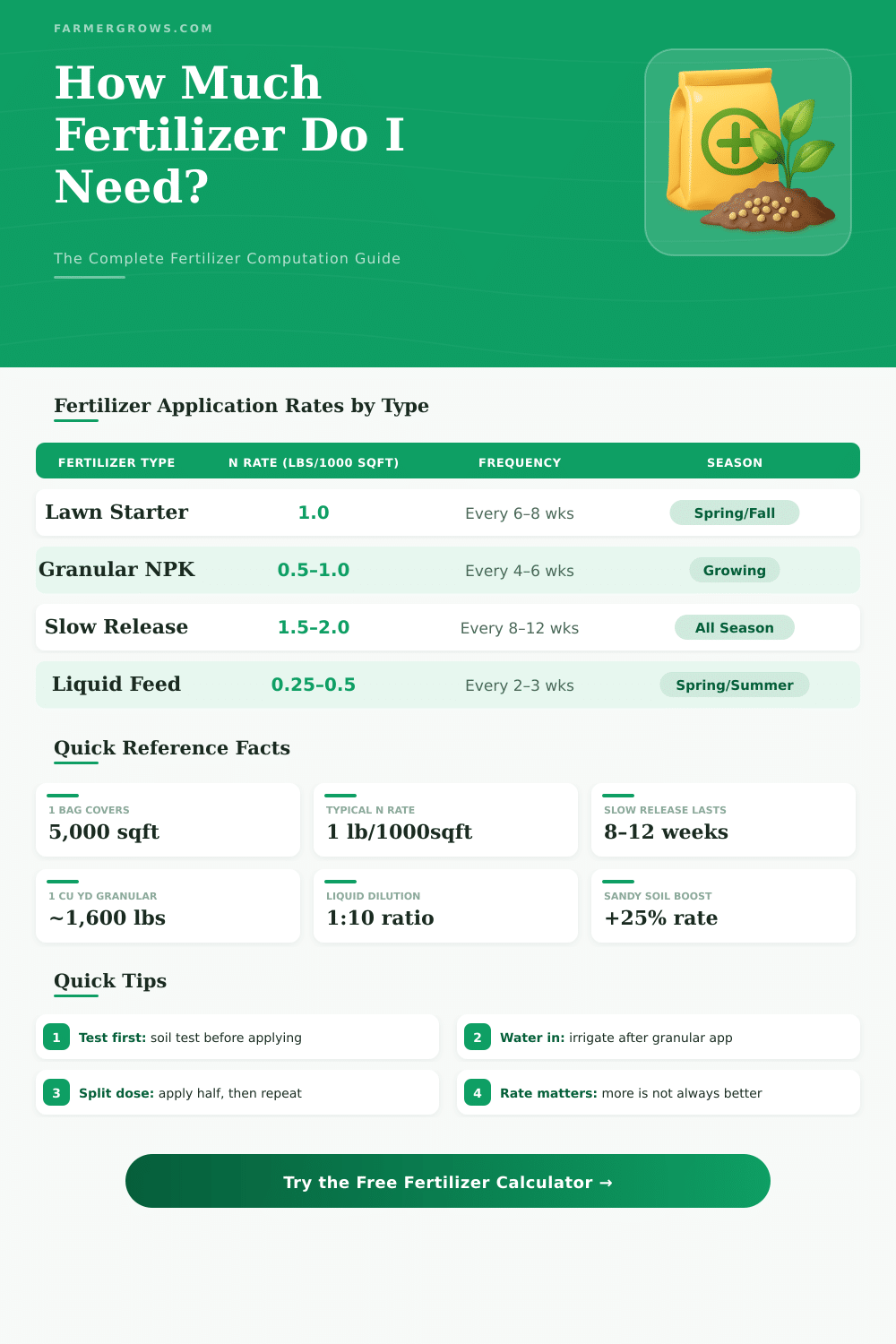
🌿 Fertilizer Computation Calculator
Calculate exactly how much fertilizer your lawn or garden needs based on area, nutrient rate, and fertilizer analysis.
| N Rate (lbs/1,000 sq ft) | Balanced Gran. (10-10-10) | Lawn NPK (30-0-4) | Urea (46-0-0) | Organic (5-3-4) |
|---|---|---|---|---|
| 0.25 lb N | 2.5 lb product | 0.83 lb product | 0.54 lb product | 5.0 lb product |
| 0.5 lb N | 5.0 lb product | 1.67 lb product | 1.09 lb product | 10.0 lb product |
| 1.0 lb N | 10.0 lb product | 3.33 lb product | 2.17 lb product | 20.0 lb product |
| 1.5 lb N | 15.0 lb product | 5.0 lb product | 3.26 lb product | 30.0 lb product |
| 2.0 lb N | 20.0 lb product | 6.67 lb product | 4.35 lb product | 40.0 lb product |
| Bag Size | Fertilizer Type | N Content % | Total N in Bag | Area Covered (1 lb N/1k) |
|---|---|---|---|---|
| 40 lb | Balanced Gran. 10-10-10 | 10% | 4.0 lb N | 4,000 sq ft |
| 40 lb | Lawn NPK 30-0-4 | 30% | 12.0 lb N | 12,000 sq ft |
| 40 lb | Urea 46-0-0 | 46% | 18.4 lb N | 18,400 sq ft |
| 40 lb | Slow Release 24-5-11 | 24% | 9.6 lb N | 9,600 sq ft |
| 20 lb | Organic 5-3-4 | 5% | 1.0 lb N | 1,000 sq ft |
| 50 lb | Amm. Sulfate 21-0-0 | 21% | 10.5 lb N | 10,500 sq ft |
| Project | Area (sq ft) | Area (m²) | Product Needed (lbs) | 40 lb Bags |
|---|---|---|---|---|
| Small Garden 20x10 | 200 | 18.6 | 2.0 lb | 1 bag |
| Raised Bed 15x15 | 225 | 20.9 | 2.25 lb | 1 bag |
| Lawn 50x30 | 1,500 | 139.4 | 15.0 lb | 1 bag |
| Average Lawn 100x50 | 5,000 | 464.5 | 50.0 lb | 2 bags |
| Large Lawn 150x80 | 12,000 | 1,114.8 | 120.0 lb | 3 bags |
| Sports Field 200x100 | 20,000 | 1,858.1 | 200.0 lb | 5 bags |
Fertilizer is made up of any material, natural or artificial, that one uses to feed ground or plant tissues thus give nourishment. Simply said Fertilizer is nourishment for plants. They provide the elements that plants need to grow and stay alive.
When one lays Fertilizer on the ground or soil, it helps plants grow more well.
Fertilizer: What It Is and How It Helps Plants
In most Fertilizer find three main elements, that one shortens to NPK. N stands for nitrogen, that backs general growth and makes leaves green and dense. P shows phosphorus, that leads plant nourishments over there, where they must go.
K stands for potassium, that forms strong shoots and takes care of whole plant health. Nitrogen, phosphorus and potassium commonly lacks in the soil, so one must add them by means of Fertliizer for good growth of plants.
Fertilizer can be organic or mineral. Between organic samples are waste of birds, animals or horses, likewise as bone meal, cottonseed and other natural materials. Mineral Fertilizer are manmade products.
There is not one “best” organic Fertilizer. Rather, good method is a plan to keep the soil healthy and happy. Sometimes one adds minerals as sulphur or potassium together with composting and cover crops, witch is good.
Commercial Fertilizer, that has all three nourishments, is called complete Fertilizer. Fertilizer labelled 10-5-5 stores 10 percent of nitrogen and 5 percent of phosphorus and potassium. Fertilizer with equal amounts, as 10-10-10 or 12-12-12, commonly used for general targets.
14-14-14 Fertilizer has same amounts of the three elements and works well for general use. If one chooses ratio according to the real needs of the plant, results will be better. When growth slows because of absence of one element, too much of other does not help.
Fertilizer comes in various forms, for instance grains, dusts, crystals or liquids. One can spread them above field or spray on plants. No matter what, regardless of the method, there always stays part that does not reach the plant.
Lawn Fertilizer helps grass by means of nourishments and pushes strong, dense growth. They improve the look of the lawn and help ground rest after usage. Good lawn Fertilizer also helps grass fight against disease, unwanted grasses and harsh weather.
Even so, one must mind too much Fertilizer use. Soil that served for crops during years can empty and need new nourishments. Even soil with enough nutrition before can empty over time.
Things as pH andtemperature also affect how many nourishments are there for plants.