⛽ Diesel Fuel Consumption Calculator
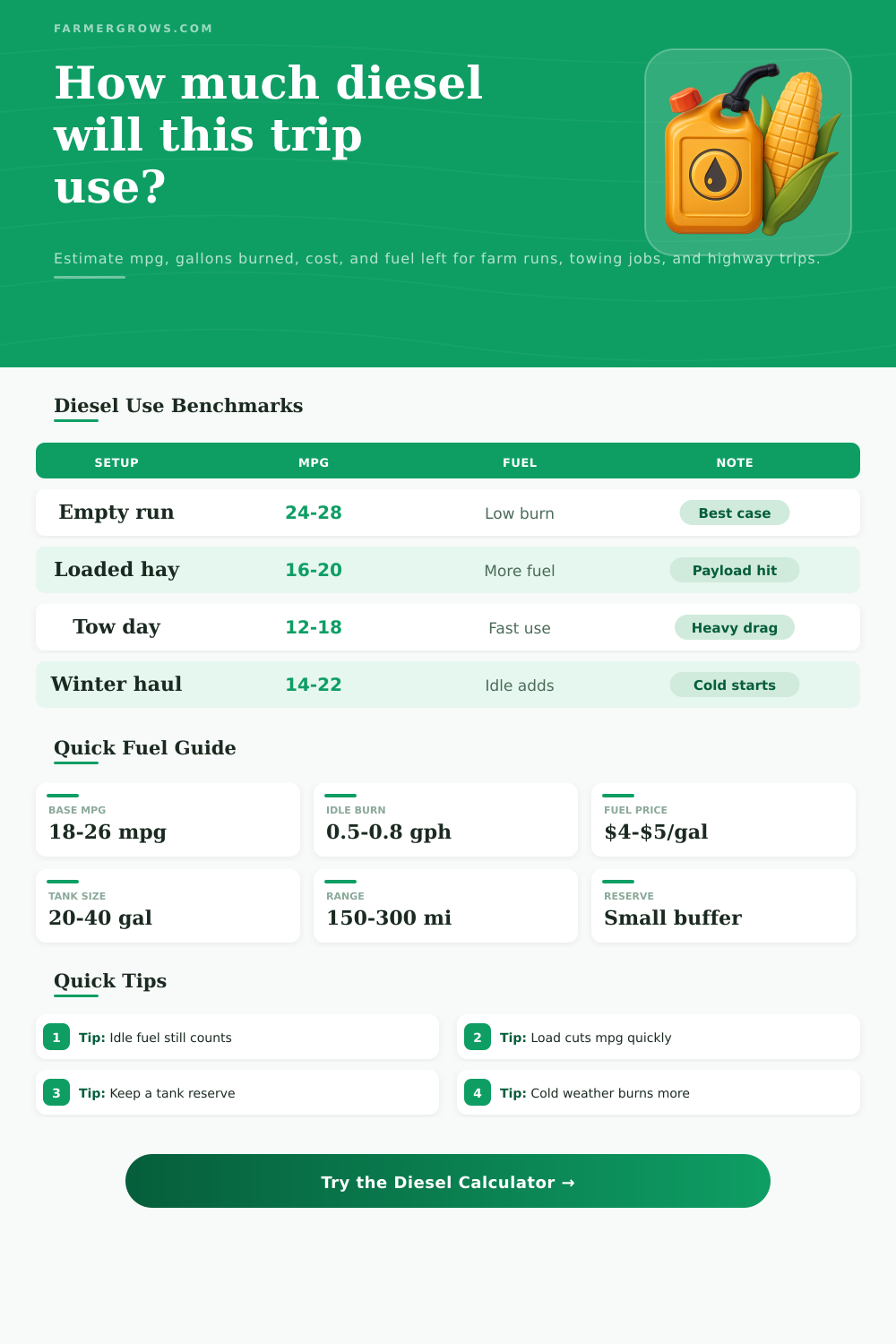
Estimate adjusted mpg, gallons burned, trip cost, and fuel left in the tank for field runs, towing jobs, and highway deliveries.
Empty shuttle
Light loads and steady roads keep diesel burn lower when the truck is not working hard.
Loaded hay run
Payload, stop times, and turnarounds push mileage down before the route ends.
Small trailer tow
Drag from the trailer and hills can raise fuel use even when distance stays short.
Winter road haul
Cold idling and denser air usually make the trip consume more fuel than planned.
| Setup | MPG | Fuel | Note |
|---|---|---|---|
| Empty run | 24-28 | Low burn | Best case |
| Loaded bed | 18-22 | Moderate | Farm haul |
| Towing | 12-18 | Higher | Drag matters |
| Winter idling | 14-20 | Idle adds | Cold starts |
| Factor | Value | Effect | Use |
|---|---|---|---|
| Empty | 1.00 | No penalty | Highway |
| Light | 0.96 | Small drop | Tools only |
| Loaded | 0.90 | Clear loss | Field run |
| Tow | 0.82 | Big drag | Trailer haul |
| Rough | 0.79 | More burn | Soft ground |
| Idle state | GPH | 10 min | Note |
|---|---|---|---|
| Warm engine | 0.50 | 0.08 | Light loss |
| Work idle | 0.58 | 0.10 | Typical |
| Cold idle | 0.70 | 0.12 | More fuel |
| High idle | 0.80 | 0.13 | Fast use |
| Tank | Reserve | Range | Note |
|---|---|---|---|
| 20 gal | 2 gal | Small | Short hauls |
| 24 gal | 2 gal | Mid | Daily work |
| 30 gal | 3 gal | Wide | Long route |
| 40 gal | 4 gal | Big | All day use |
Diesel fuels consumption is a necessary task to perform for all farm operator. Diesel fuel consumption is a factor that will indicate the distance that a truck can travel before it must refuel. To calculate the diesel fuel consumption for a truck, a person must consider various factor that may impact that calculation, such as the weight of the load that a person is to be transported, the terrain of the ground that is to be traveled upon, and the length of time that the truck engine will be idling.
The fuel economy of the truck when it is empty is a starting point for calculating fuel consumption. However, the fuel economy will change when the truck is loaded with addition weight. The additional weight will increase the resistance against the tires of the truck and the resistance against the engine itself.
What Affects Diesel Fuel Use
Thus, the increased weight will lead to a decrease in the number of miles that can be driven with an gallon of diesel fuel. Additionally, the terrain that is driven upon can affect the fuel consumption of the truck. For instance, driving upon hills will require the engine to work more harder then even gradual slopes.
For these same reason, hills will also require the engine to burn more diesel fuel. Additionally, driving upon ground that is soft or become mud can also increase the resistance against the trucks tires, which will decrease the number of miles that can be driven per gallon of diesel fuel. Idling can also contribute to increased fuel consumption by a truck.
Idling is when the engine is running but the truck is not moving. During this mode, the engine will consume a certain amount of diesel fuel each hour that the truck is idling. Thus, an idling engine will consume fuel without adding to the number of miles driven.
Therefore, you can separate fuel consumption from idling fuel consumption. Idling for long periods will consume more fuel then a truck that is not idling for extended periods. Another factor that can impact fuel consumption is the maintenance of the tractor and its component.
For instance, engine air filters that are clogged will force the engine to work more harder to inhale the air that it needs to function. An engine that must work harder will consume more fuel. Additionally, tires that is underinflated will create more resistance against the trucks movement.
This additional resistance will force the engine to work harder to move the truck, and thus it will consume more fuel. Therefore, maintaining proper tire pressure will lead to better fuel economy with the tractor or truck. The number of miles per gallon that a truck can achieve can also change when the truck is tow a trailer.
The additional weight of the trailer will increase the resistance against the tires and the engine. In addition, the trailer will create additional aerodynamic drag for the truck and trailer when moving through the air. Thus, the increased resistance from the trailer will require the engine to use more diesel fuel to move the increased distance.
Therefore, a truck towing a trailer will experience a decrease in the number of miles per gallon of diesel fuel that it can travel. Another consideration for diesel fuel consumption is to always maintain a fuel reserve within the fuel tank. A fuel reserve is used to ensure that there is enough diesel fuel to handle unexpected need.
If fuel is allowed to decrease to low levels in the fuel tank, the sediment that accumulates within the fuel tank may enter the fuel filter. These filters are necessary for the fuel injectors to properly function. Thus, a fuel reserve will allow for a tractor or truck to store enough diesel fuel to perform extra task.
Finally, another calculation that is necessary is to calculate the cost of the diesel fuel per mile. The cost of the fuel can be divided by the number of miles that the tractor or truck traveled. If the number of miles per gallon decreases, then the cost of the fuel per mile will increase.
An increased cost per mile means that the truck will be spending more money on its diesel fuel. Thus, by monitoring the number of miles per gallon that the truck can travel and the idling time for the engine, a driver can control the fuel consumption of the diesel fuel tank.