🐄 Cattle Breed Percentage Calculator
Calculate exact breed composition across generations — F1 crosses, backcrosses & multi-breed blends
Enter the percentage for each breed present in your animal. Total must equal 100%.
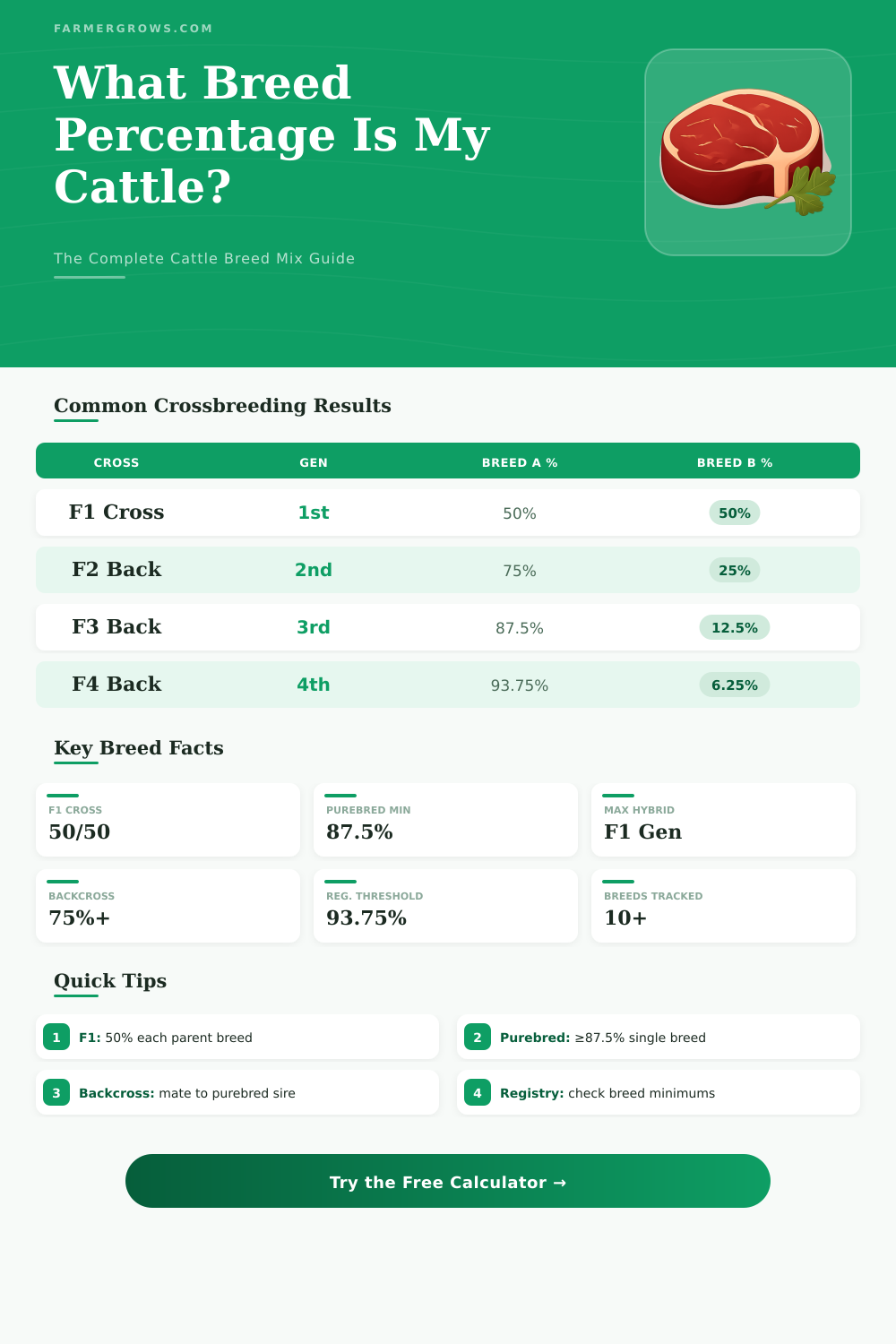
| Generation | Cross Type | Target Breed % | Other Breed % | Registry Eligible? |
|---|---|---|---|---|
| F1 | First Cross (50/50) | 50.00% | 50.00% | Usually No |
| B1 (F2) | First Backcross | 75.00% | 25.00% | Some Registries |
| B2 (F3) | Second Backcross | 87.50% | 12.50% | Often Yes (7/8) |
| B3 (F4) | Third Backcross | 93.75% | 6.25% | Yes (15/16) |
| B4 (F5) | Fourth Backcross | 96.875% | 3.125% | Yes – Purebred |
| B5 (F6) | Fifth Backcross | 98.438% | 1.563% | Yes – Purebred |
| Composite Breed | Breed A | % A | Breed B | % B | Other |
|---|---|---|---|---|---|
| Brangus | Angus | 62.5% | Brahman | 37.5% | — |
| Beefmaster | Hereford | 25% | Shorthorn | 25% | 50% Brahman |
| Santa Gertrudis | Shorthorn | 37.5% | Brahman | 62.5% | — |
| Simbrah | Simmental | 62.5% | Brahman | 37.5% | — |
| Braford | Hereford | 62.5% | Brahman | 37.5% | — |
| Charbray | Charolais | 62.5% | Brahman | 37.5% | — |
| Senepol | N'Dama | 50% | Red Poll | 50% | — |
| Balancer | Gelbvieh | 25–75% | Angus | 25–75% | — |
| Cross Type | Expected Heterosis | Weaning Wt Gain | Reproductive Boost |
|---|---|---|---|
| Purebred (0% hybrid) | 0% | Baseline | Baseline |
| F1 Two-Breed Cross | 100% | +5 to +10% | +5 to +8% |
| F2 (Two-Breed) | 50% | +3 to +5% | +2 to +4% |
| Three-Breed Terminal | 100% | +10 to +15% | +8 to +10% |
| Rotational (2 breed) | 67% | +4 to +7% | +4 to +6% |
| Rotational (3 breed) | 86% | +7 to +12% | +6 to +9% |
| Animal Description | Breed Composition | Fraction Notation | Registry Status |
|---|---|---|---|
| Purebred Angus | 100% Angus | Purebred | Full Registration |
| Angus x Hereford F1 | 50% Angus, 50% Hereford | 1/2 each | Commercial |
| 3/4 Angus Cow | 75% Angus, 25% Hereford | 3/4 & 1/4 | Some registries |
| 7/8 Angus Bull | 87.5% Angus, 12.5% Hereford | 7/8 & 1/8 | Recorded |
| Brangus Female | 62.5% Angus, 37.5% Brahman | 5/8 & 3/8 | Brangus Registry |
| 3-Breed Steer | 50% Simmental, 25% Angus, 25% Hereford | Mixed | Commercial |
| Wagyu x Angus F1 | 50% Wagyu, 50% Angus | 1/2 each | Commercial/Premium |
| Santa Gertrudis | 62.5% Brahman, 37.5% Shorthorn | 5/8 & 3/8 | SG Registry |
Whoever raises cattle for meat or dairy knows that the breed percentage is not trivia. It genuinely matters a lot. Across the world you recognize around a thousand cattle breeds and that diversity has deep sense.
Some breeds adapted naturally to particular climates, while others were picked for separate purposes. When you consider the whole image, the cattle divide into two main groups that are occasionally called related species or subspecies according to the opinion of the person asked. Everything comes down to Bos Taurus and Bos Indicus, each with its own attributes that shine in certain environments and tasks
Why Cattle Breed Percentages Matter
In United States you recognize more than 70 cattle breeds, what gives producers a big range of choices. However the actual population is dominated by far fewer. Incredibly, less than 20 breeds form the biggest part of the creatures in the land.
Only for beef are available above 60 breeds to the ranchers. So, although crossbreeding helps to improve the herds, preserving purebred lines in the mix yet have actual vlaue.
About registration the breed percentage matters genuinely a lot. For instance, the American Simmental Association requires that heifers have at least 7/8 Simmental blood for purebred registration. For demonstration in state contests the limit is even strict: you need 75.1% Simmental or more to compete as purebred.
At dairies the rules differ. Creatures with 94 points or more from the test of five breeds are classified as one-breed and registered as 100% that breed.
When ranchers estimate their herds, around 72% say that their cows have high proportions of one breed. That is common practice, especially with Angus, where high percentage are usual. The breed choice depends strongly on the market.
For freezer sales British breeds answer, because they stay in little frame, entirely other cause than sale to a commercial plant. American breeds, vice versa, operate well in many situations. They thrive in heat and can be purebred, crossed between themselves or mixed with various; only not with high Bos Indicus-percentage.
Gelbvieh cattle attain the ideal balance for good gains together with good fat and good feed conversion. They cross well with island breeds and have commonly calmer characters. The frame size also affects the efficiency.
Large frames gain weight more quickly, and here is the key spot: weights explain around 88% of differences in feed conversion inside a breed, but only 14 to 33% between breeds.
EBV identifies the chance earnestly. Inside one breed you can directly compare all creatures. Bulls of same breed you estimate across herds and years without complications.
Every EBV has accuracy of 0 to 100 percent. The real task for ranchers is to find which breed coincides best with their current genes. Because each breed brings unique qualities, your choice shapes about the whole result.