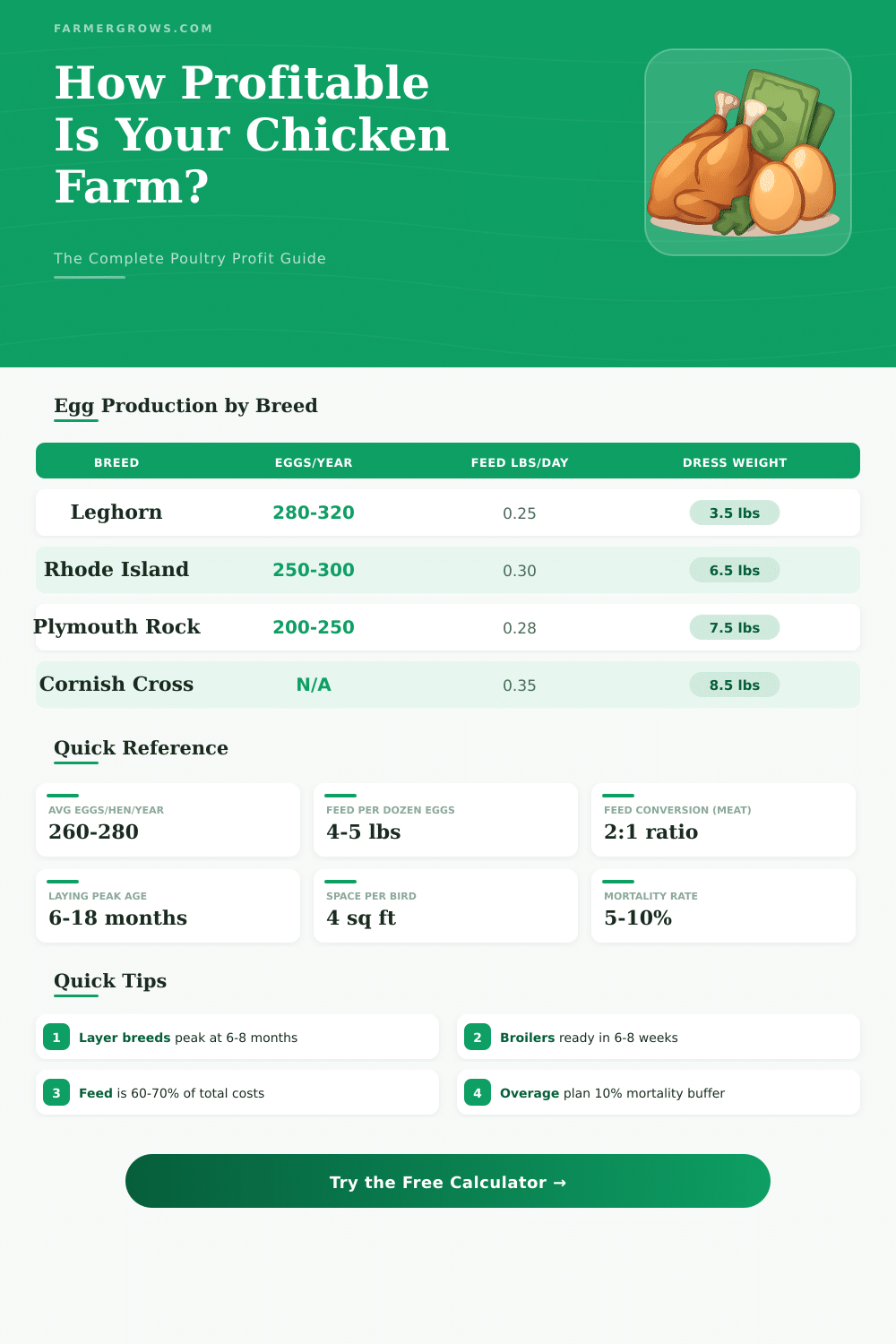
🐔 Chicken Farm Profit Calculator
Estimate your flock's annual egg and meat production, feed requirements, and net profit
| Breed | Type | Feed/Bird/Day | Feed/Bird/Year | Feed per Dozen Eggs |
|---|---|---|---|---|
| White Leghorn | Layer | 0.25 lbs (113 g) | 91 lbs (41 kg) | 3.3 lbs |
| Rhode Island Red | Layer | 0.30 lbs (136 g) | 110 lbs (50 kg) | 4.1 lbs |
| Plymouth Rock | Layer | 0.28 lbs (127 g) | 102 lbs (46 kg) | 4.5 lbs |
| Australorp | Layer | 0.27 lbs (122 g) | 99 lbs (45 kg) | 3.8 lbs |
| Sussex | Dual | 0.28 lbs (127 g) | 102 lbs (46 kg) | 4.0 lbs |
| Orpington | Dual | 0.30 lbs (136 g) | 110 lbs (50 kg) | 4.8 lbs |
| Cornish Cross | Meat | 0.35 lbs (159 g) | N/A (6–8 wks) | N/A |
| Freedom Ranger | Meat | 0.30 lbs (136 g) | N/A (10–12 wks) | N/A |
| Flock Size | Eggs/Year (at 270/hen) | Dozens/Year | Feed lbs/Year (at 0.28) |
|---|---|---|---|
| 25 hens | 6,750 | 563 | 2,555 |
| 50 hens | 13,500 | 1,125 | 5,110 |
| 100 hens | 27,000 | 2,250 | 10,220 |
| 250 hens | 67,500 | 5,625 | 25,550 |
| 500 hens | 135,000 | 11,250 | 51,100 |
| 1,000 hens | 270,000 | 22,500 | 102,200 |
| Breed | Grow-Out Weeks | Live Weight (lbs) | Dress % / Dressed Wt | Feed Conversion Ratio |
|---|---|---|---|---|
| Cornish Cross | 6–8 | 10–12 lbs | 75% / 8–9 lbs | 1.8–2.0:1 |
| Freedom Ranger | 10–12 | 7–8 lbs | 72% / 5–6 lbs | 2.5–3.0:1 |
| Plymouth Rock | 16–20 | 9–10 lbs | 70% / 6.5–7 lbs | 3.0–3.5:1 |
| Sussex | 16–20 | 8–9 lbs | 70% / 5.5–6.5 lbs | 3.0–3.5:1 |
| Orpington | 18–22 | 9–10 lbs | 70% / 6.5–7 lbs | 3.5–4.0:1 |
| Operation | Birds | Annual Feed (lbs) | Annual Eggs (dozens) | Annual Meat (lbs) |
|---|---|---|---|---|
| Backyard Hobby | 10–25 | 900–2,300 | 225–563 | N/A |
| Small Farm | 50–100 | 5,000–10,000 | 1,125–2,250 | N/A |
| Broiler Small Batch | 100/batch | 2,000/batch | N/A | 850/batch |
| Mid-Size Layer | 250–500 | 25,000–51,000 | 5,625–11,250 | N/A |
| Commercial Broiler | 500/batch | 10,000/batch | N/A | 4,250/batch |
| Large Layer | 1,000+ | 102,000+ | 22,500+ | N/A |
A flock of 100 Leghorns eating 0.25 lbs of feed daily burns through roughly 9,125 lbs annually. Thats about 183 bags. At 300 eggs per hen youre looking at 2,500 dozens, which honestly sounds massive until you factor in that 60 to 70% of your revenue goes right back into feed.
Cornish Cross broilers hit 8.5 lbs dressed weight in just 8 weeks with a feed conversion around 2:1, so every pound of chicken takes 2 lbs of grain.
How Chicken Farming Works
The information below does not come from some computer program or automatic translator. It is based on actual research, discussions in forums and experiences of farming communities, that one finds everywhere on the net.
Poultry farming is a kind of animal farming that involves domestic birds like chickens, ducks, turkeys and geese. The main targets are getting meat or eggs for food. Around the world one farms chickens in huge amounts.
Each year one kills more than 60 billion chickens for food. Usually chicken farms belong to one of two kinds: for eggs or for meat. Before starting, it matters to choose the right goals.
A bit of work in truly big measure. One British business feeds 160 000 birds each seven weeks to supply to big stores. Commonly the activity includes four chicken houses, where each carries around 22 000 chickens.
Those buildings equip themselves with heaters, air controls, automatic feeders, automatic water systems and fans. Even bigger businesses exist. For instance, one plan in the district of Lancaster includes five barns, each with 70 000 chickens, what adds up to 350 000 free-range egg layers, together with solar panel setup having more than 55 000 panels.
Even so not every farm is like this. Home garden farms are also popular. More and more city folks keep chickens in little backyard areas.
Simple design for chicken coop can be something based on structure of 48-inch by 96-inch, using whole sheets of plywood. There are also outlines for 12-foot by 20-foot shelter, planned for around 100 birds. Another option is chicken tractors, but moving them commonly turns into a truly difficult task.
Pastured and free-range chicken farming have their own mode. Some chickens walk on meadow have space to move and search insects in mobile chicken tractors, that one moves daily to new soil. They feed themselves with organic feed mixes.
Some farms grow heritage breeds from France, that require more time to mature, but give richer flavor than the usual quick growing chickens. One business from Lancaster works with around 40 little farms in Pennsylvania, that are ready to do that.
Contract chicken farming is a tricky business. According to the documents, a contract farmer could win around two hundred thousand dollars in a year. But commonly the final profit stays at forty thousand or even less, occasionally nothing.
The arrangement lays the biggest risk on the shoulders of the farmers. Also rules are cause for checking before start, because in some places one fully bans chicken farming, while on the other hand one limits the amount or the sex. Even the best operations must deal with random deaths of chickens.
Moreover, chickens can stop laying eggs for some days, if something upsets them. Without proper water and food, they will not produce. Only three chickens in egg-laying age manage too give around twelve eggs during ten days, but only duringpart of the year.