🐄 Cattle Feedlot Calculator
Estimate pen space, daily feed requirements & feedlot capacity for your herd
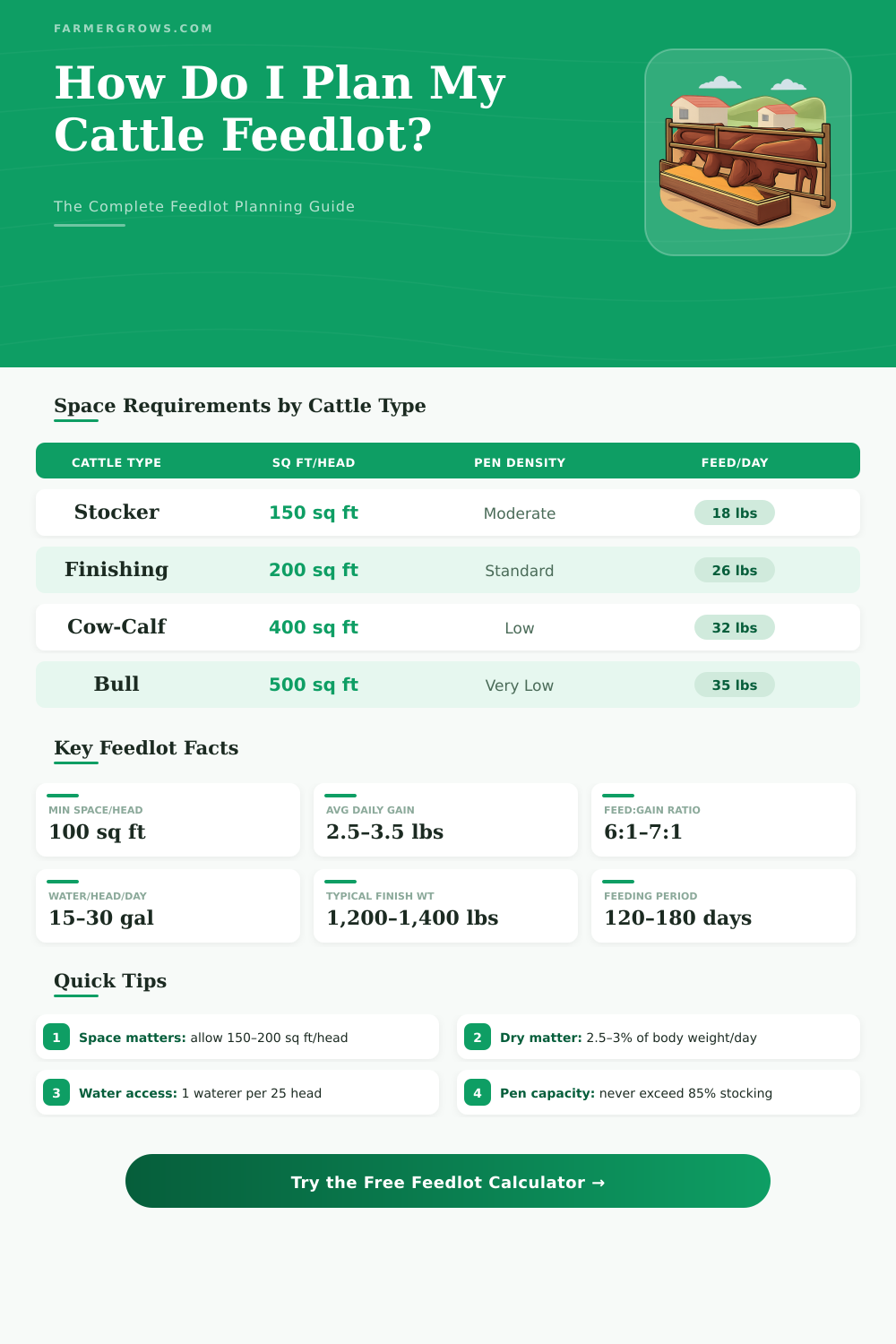
| Cattle Type | Min Sq Ft/Head | Standard Sq Ft/Head | Min m²/Head | Std m²/Head |
|---|---|---|---|---|
| Stocker (400–600 lbs) | 100 | 150 | 9.3 | 13.9 |
| Yearling (500–750 lbs) | 125 | 175 | 11.6 | 16.3 |
| Backgrounding (450–700 lbs) | 120 | 160 | 11.1 | 14.9 |
| Heifer (600–900 lbs) | 150 | 200 | 13.9 | 18.6 |
| Finishing Steer (900–1200 lbs) | 175 | 225 | 16.3 | 20.9 |
| Cow-Calf Pair | 300 | 450 | 27.9 | 41.8 |
| Bull | 400 | 600 | 37.2 | 55.7 |
| Body Weight (lbs) | DMI 2.5% (lbs/day) | DMI 3.0% (lbs/day) | High-Grain Feed (lbs/day) | Water (gal/day) |
|---|---|---|---|---|
| 400 | 10.0 | 12.0 | 13–15 | 10–15 |
| 600 | 15.0 | 18.0 | 18–22 | 13–18 |
| 800 | 20.0 | 24.0 | 22–28 | 16–22 |
| 1000 | 25.0 | 30.0 | 26–32 | 20–28 |
| 1200 | 30.0 | 36.0 | 30–38 | 22–30 |
| 1400 | 35.0 | 42.0 | 34–44 | 25–33 |
| Days on Feed | ADG 2.5 lbs/day Gain | ADG 3.0 lbs/day Gain | ADG 3.5 lbs/day Gain | Typical Feed Use (FCR 7) |
|---|---|---|---|---|
| 60 days | 150 lbs | 180 lbs | 210 lbs | 1,260 lbs |
| 90 days | 225 lbs | 270 lbs | 315 lbs | 1,890 lbs |
| 120 days | 300 lbs | 360 lbs | 420 lbs | 2,520 lbs |
| 150 days | 375 lbs | 450 lbs | 525 lbs | 3,150 lbs |
| 180 days | 450 lbs | 540 lbs | 630 lbs | 3,780 lbs |
| 210 days | 525 lbs | 630 lbs | 735 lbs | 4,410 lbs |
| Cattle Type | Gal/Head/Day (Summer) | Gal/Head/Day (Winter) | Head per Waterer | Trough Size (gal) |
|---|---|---|---|---|
| Stocker / Backgrounding | 15–20 | 10–15 | 25–50 | 100–150 |
| Yearling / Heifer | 18–24 | 12–18 | 20–40 | 150–200 |
| Finishing Steer | 20–30 | 15–22 | 15–30 | 150–250 |
| Cow-Calf Pair | 25–35 | 18–25 | 10–20 | 200–300 |
| Bull | 25–35 | 18–26 | 5–10 | 200–300 |
The capacity of cattle feedlots matter a lot in the world of livestock farming. It shows how many animals you can feed and finish before sale on the market Know as feedlots operate and how big they are help to understand the whole beef industry.
Feedlots you classify according to their size. Little feedlots have place for 1,000 until 7,999 heads of livestock, but big can store 8,000 or more. Only 3.8% from feedlots with more than 1,000 capacity surpasses 50,000 heads, even so they report about 34.8% of the inventory and 35.1% of the markets.
Why Feedlot Size Matters
Around 40% of the fed livestock come from feedlots with 32,000 heads or more. The biggest feedlot in the world accomodate around 85,000 heads, with capacity of 120,000.
The whole feedlot capacity reached 17.1 millions of heads, more than the 16.5 millions in 2000. Percentage of feedlot capacity regarding the cattle inventory grew during the last 25 years until record 19.6% in 2024. Entirely 2,105 feedlots with at least 1,000 heads report about 82.7% of the inventory in January 1st and 87.2% of the whole feedlot product.
Such feedlots represent around 85% of the fed livestock in United States.
Calves require feedlots for their cycle. When young calves weigh between 300 and 700 pounds, you gather them and sell directly to feedlots or send to cattle auctions. The duration in feedlots depend on weight, feed conditions and wanted beef grade, of 90 until 300 days.
In Canada livestock passes most of its life on pasture, only 60 until 200 days in feedlots.
In feedlots proteins and grains form 70 until 90% of the diet. Like this livestock grows in 2.5 until 4 pounds a day. Feedlots stress fast increase and weight gain, what reduces the need for food.
Use of feedlot capacity stayed strong during last years, although high cattle and grain prices reduced profit.
Spatial questions matter also. Space for one head must be at least 400 square feet. For self-feeding the bunk requires 6 inches.
Feedlots are two kinds: outdoor and covered. Outdoor feedlots answer for dry regions. Covered protect against bad weather and keep feed dry together with bedding.
New cattle barn accommodate 1,600 heads and measure 104 by 644 feet. Feedlots with 1,000 or more heads are classed as big CAFOs. The biggest feedlots involve whole quarter of section, so 160 acresground.