🥦 Broccoli Plant Spacing Calculator
Calculate exact plant count, row layout, and spacing for your garden bed or field
| Plant Spacing | Row Spacing | Plants / 100 sq ft | Plants / 10 m² |
|---|---|---|---|
| 9 in (23 cm) | 12 in (30 cm) | ~16 | ~17 |
| 12 in (30 cm) | 12 in (30 cm) | ~8 | ~11 |
| 12 in (30 cm) | 18 in (46 cm) | ~8 | ~9 |
| 14 in (36 cm) | 24 in (61 cm) | ~5 | ~6 |
| 18 in (46 cm) | 24 in (61 cm) | ~4 | ~4 |
| 18 in (46 cm) | 36 in (91 cm) | ~2.7 | ~3 |
| 24 in (61 cm) | 36 in (91 cm) | ~1.7 | ~1.8 |
| Method | Plant Spacing | Row Spacing | Notes |
|---|---|---|---|
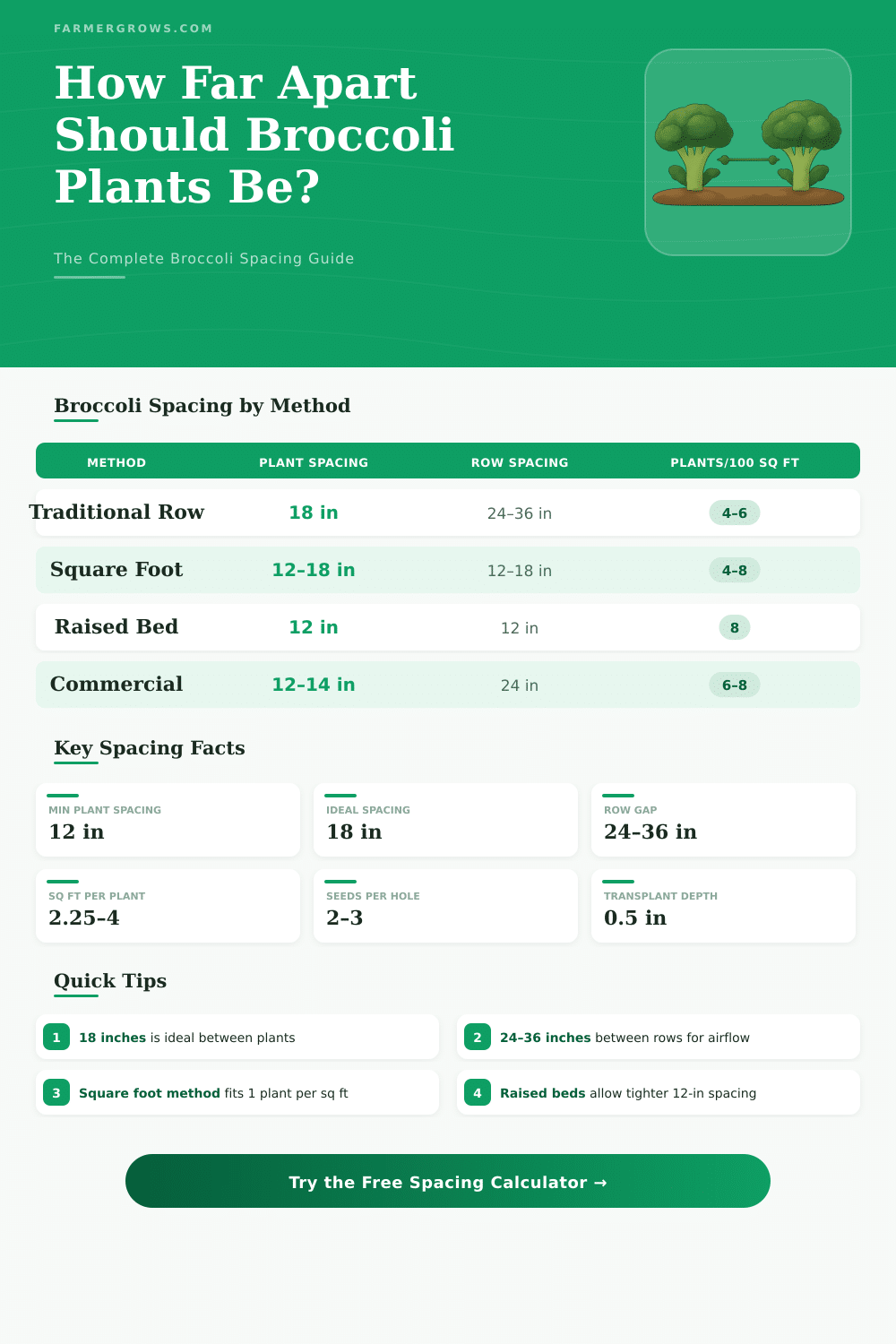
| Traditional Rows | 18 in (46 cm) | 24–36 in (61–91 cm) | Standard home garden |
| Square Foot Gardening | 12–18 in (30–46 cm) | Same as plant spacing | Raised bed intensive |
| Intensive/Offset Rows | 12 in (30 cm) | 12 in (30 cm) | Staggered for density |
| Commercial/Field | 12–14 in (30–36 cm) | 24 in (61 cm) | Maximise yield/acre |
| Container | 12 in (30 cm) | N/A | 1 plant per 12-in pot |
| Broccolini | 9 in (23 cm) | 12 in (30 cm) | Smaller, denser plants |
| Bed / Plot Size | Area (sq ft) | Plants @ 18 in | Plants @ 12 in |
|---|---|---|---|
| 4 x 8 raised bed | 32 sq ft (3.0 m²) | ~5 | ~8 |
| 4 x 12 raised bed | 48 sq ft (4.5 m²) | ~8 | ~12 |
| 8 x 8 raised bed | 64 sq ft (5.9 m²) | ~11 | ~16 |
| 10 x 10 garden | 100 sq ft (9.3 m²) | ~18 | ~25 |
| 10 x 20 garden | 200 sq ft (18.6 m²) | ~35 | ~50 |
| 20 x 30 garden | 600 sq ft (55.7 m²) | ~105 | ~150 |
| 50 x 100 garden | 5,000 sq ft (464.5 m²) | ~875 | ~1,250 |
The Space Between Broccoli Plants matter much more than many folks believe. How far apart the plants, that directly decided the size of the heads. If you plant broccoli at 12 inches between them, it usually gives heads of around 4 inches wide, but at 18 inches apart one can reach even 10 inches wide.
This difference truly impresses.
How Far Apart to Plant Broccoli
Normal Space Between Broccoli Plants are around 18 inches between them. Rows space at 24 to 36 inches. This way the leaves have enough room to expand freely, without them crowding each other.
In usual gardens with rows, where one does not care about saving space, Space Between Broccoli Plants of 18 to 24 inches between plants work great. Seeds enter at quarter to half inch depth.
One can use closer spacing, for instance 1 foot by 1 foot, but then the main size stays small and the side growth limits. Broccoli plants can reach surprisingly big size. They sometimes beat even the cabbage plants, what surprises many new gardeners.
Here because of that they need a lot of space to expand, almost 2 square feet each one.
For broccoli meant for fresh sale, growing on 30-inch beds with two rows works well. In those beds, space the plants at around 15 inches between them. During growing of fall broccoli, one counts backwards from the first late cold and adds around 30 days for the crop.
Sellers that want big single heads can vary the spacing inside rows of 8 to 24 inches, with double rows in 12 inches between them and Space Between Broccoli Plants of 24 too 36 inches.
Spacing at 1.5 to 2 feet between plants gives nice results. Interplanting with lettuce, coriander and parsley on the same day also works well. The spaces between young broccoli plants allow for more quickly growing crops, while the broccoli yet are small.
An experiment about spacing in 2014 compared 18-inch against 12-inch versions. The 12-inch spacing followed advice of Square-Foot Gardening and Johnny’s Selected Seeds. At least one foot between plants is the bare minimum, and even that seems too tight.
Broccoli needs enough room to form good heads.
Wider spacing most commonly gives better results overall. Plants spaced at 24 inches between them produced the biggest heads. Already going from 12 to around 14 inches, one sees clear difference.
In the south, plant as early as cold no longer risks, with 12 to 18 inches betweenplants. Aphids and cabbage worms can become problems, that one must watch. Rows spaced at 3 feet between them deliver a lot of walk-space.
Planting two or three plants beside each other in rows, one shrinks the spaces of walkways while everything stays manageable.