Iris Bulb Planting Depth Calculator
Calculate planting depth, soil cover, crown exposure, spacing, bed capacity, and container fit for bearded iris rhizomes, Dutch iris bulbs, reticulata bulbs, Siberian clumps, Japanese iris, Louisiana iris, and spuria iris divisions.
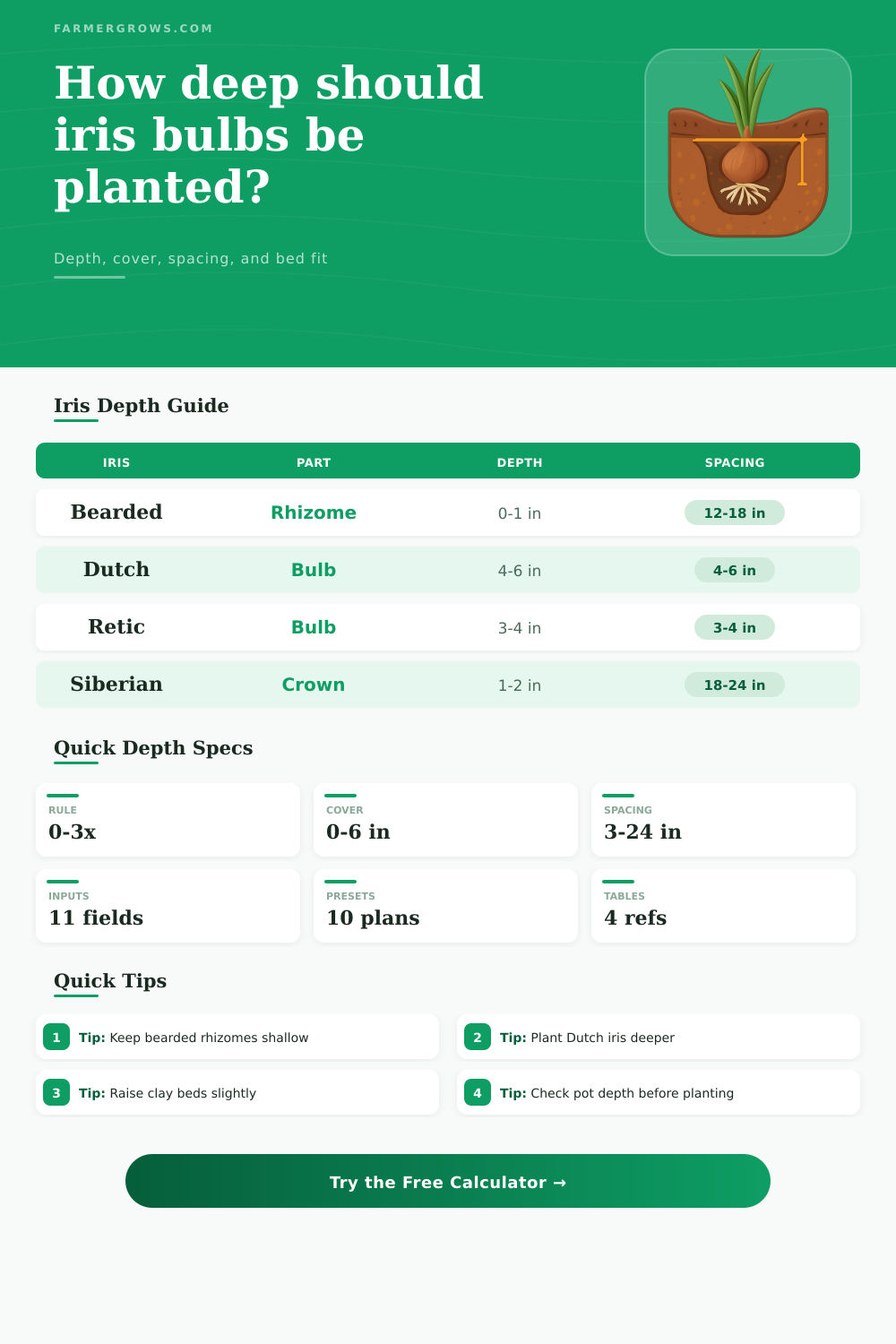
Iris planting is not one-size-fits-all. Bearded iris rhizomes sit almost at the surface, while Dutch and reticulata bulbs need real soil cover. Use the inputs below to tune the recommendation to the iris type, planting part size, drainage, winter mulch, and bed layout.
📋Iris Planting Presets
🌿Iris Depth Rules Compared
⚙Iris Depth Inputs
Iris Planting Depth Result
Calculated planting depth, cover, spacing, and container fit for your iris planting plan.
Calculation Breakdown
📏Iris Type Depth Grid
🔍Iris Planting Comparison Grid
Best for bearded iris in sunny, well-drained beds where rot risk is higher than frost lift risk.
Best for Dutch and reticulata iris bulbs that need soil cover above the bulb tip.
Best for Siberian, Japanese, and Louisiana iris divisions that resent dry exposed crowns.
📚Iris Reference Tables
Planting Depth by Iris Type
| Iris type | Planting part | Typical depth | Top cover target | Best use |
|---|---|---|---|---|
| Tall bearded iris | Rhizome | 0 to 1 inch | Top visible to light dusting | Sunny borders and dry crowns |
| Dwarf bearded iris | Small rhizome | 0 to 0.75 inch | Top visible or barely covered | Front edging and rock gardens |
| Dutch iris | True bulb | 4 to 6 inches | About 3 to 4 inches | Cutting gardens and spring bulbs |
| Reticulata iris | Small bulb | 3 to 4 inches | About 2 to 3 inches | Early spring drifts and pots |
| Siberian iris | Crown division | 1 to 2 inches | Crown covered | Moist borders and massing |
| Japanese iris | Crown division | 1 to 2 inches | Crown covered | Moist beds and pond edges |
| Louisiana iris | Crown division | 1 to 2 inches | Crown covered | Wet soils and rain gardens |
| Spuria iris | Rhizome division | 1 to 3 inches | Light to moderate cover | Dry-summer perennial borders |
Soil and Drainage Adjustment Table
| Condition | Depth change | Bearded iris note | Bulb iris note | Use caution when |
|---|---|---|---|---|
| Sandy or gritty soil | Add up to 0.5 inch | Still keep top near sun | Extra cover reduces drying | Summer heat is extreme |
| Well-drained loam | No change | Standard shallow planting | Standard bulb depth | Mulch is piled on crowns |
| Clay loam | Subtract 0.25 inch | Raise rhizome shoulder | Do not bury too deeply | Drainage slows after storms |
| Heavy clay | Subtract 0.5 inch | Use a ridge or raised bed | Plant shallower with grit | Standing water remains |
| Bog edge | No change for moisture iris | Avoid bearded iris here | Avoid Dutch bulbs here | Water covers the crown |
Spacing and Bed Capacity Reference
| Iris group | Typical spacing | Plants in 4 ft by 8 ft bed | Planting style | Divide or thin |
|---|---|---|---|---|
| Tall bearded | 12 to 18 inches | 14 to 32 plants | Fan rhizomes outward | Every 3 to 4 years |
| Dwarf bearded | 8 to 12 inches | 32 to 72 plants | Front-edge clusters | Every 3 to 4 years |
| Dutch iris | 4 to 6 inches | 128 to 288 bulbs | Tight bulb drift | Refresh as clumps decline |
| Reticulata iris | 3 to 4 inches | 288 to 512 bulbs | Naturalized pockets | Lift only if crowded |
| Siberian iris | 18 to 24 inches | 8 to 14 divisions | Large clump rhythm | Every 4 to 6 years |
| Japanese iris | 18 to 24 inches | 8 to 14 divisions | Moist border groups | Every 3 to 5 years |
Container Depth Reference
| Iris type | Minimum soil depth | Root room below | Container caution | Mulch advice |
|---|---|---|---|---|
| Bearded iris | 8 inches | At least 5 inches | Keep rhizome shoulder dry | Skip or use very light mulch |
| Dwarf bearded iris | 6 inches | At least 4 inches | Excellent shallow pot choice | Keep crown open |
| Dutch iris | 10 inches | At least 4 inches | Drainage holes are essential | Light winter mulch is fine |
| Reticulata iris | 7 inches | At least 3 inches | Small bulbs suit bowls | Thin grit cover works well |
| Siberian iris | 12 inches | At least 7 inches | Keep crowns evenly moist | Light organic mulch helps |
| Japanese iris | 12 inches | At least 7 inches | Needs steady moisture | Mulch to hold moisture |
💡Iris Planting Notes
Measure to the base for Dutch and reticulata bulbs, but use crown or rhizome position for bearded, Siberian, Japanese, Louisiana, and spuria iris. The same number can mean different cover depending on the planting part.
If water stands after rain, reduce depth and improve the bed before planting. Bearded iris rot easily when rhizomes are buried in wet soil, while moisture iris still need oxygen around the crown.
When planting irises, most gardeners treat them like any other project, in one hole and at one depth, as though it’s “one size fits all.” That can result in dead, rotting rhizomes (or sometimes bulbs, but who knows?) never to be heard from again. It help to know how each kind of iris prefers to be planted.
Dutch iris bulbs want more soil over them than their rhizome shoulders. This keeps those parts from being exposed to winter’s freeze and thaw cycles. Bearded irises, however, like their rhizome shoulders exposed to light. People often think their iris failed to grow, but the real reason is that it wasn’t planted at the right depth for its biology.
Why Planting Depth Matters for Irises
Because the tool take into account your specific local conditions (such as the depth of containers or the thickness of winter mulch), it adjusts accordingly for where you live; once you select your iris variety and note the thickness of bulbs or rhizomes, it recommend how deep to plant (it knows that a different inch-depth is needed in sandy soils different than heavy clay). The result tell you just how many inches of cover will be over the top of the bulbs/rhizomes. And how far apart they will be spaced in a couple of years? So you know, no guessing! There are no more vague rules.
The secret to making this work is knowing your soil’s drainage. Bearded iris rhizomes, for example, will rot if they’re planted too deep (the tissue doesn’t get air), and they rot even faster if the soil is heavy and holds water, inviting rot with just an inch of burial. For such a situation, the calculator advise mixing in some gritty material to allow better air circulation; or just raise the level where something would of being planted. With fast-draining sandy soils, by contrast, you could bury bulbs deeper to keep them from drying out during high summer heat. It’s not guesswork; it reflect your local dirt’s water movement.
The other thing where we get tripped up is spacing. We naturaly think about how large we want the bed to look right now, instead of how fast it will grow to fill in. Things like bearded iris (which create tight fans with emerging young shoots in the middle pushing out older ones) can’t take being packed together or they’ll choke themselves in two years’ time. Use the size at maturity numbers in the table to get a good sense of how full to make things. That way your planting scheme will not only work well at first, but age well too. This prevents the whole bed from becoming a solid wall of plants that always need dividing.
Container planting complicates matters because root space is limited. You cannot just keep digging deeper into a pot like you can with garden bed. That’s why the calculator also ensure that whatever container you select will hold all of the recommended soil above and beneath the planting depth, with some margin for the bulbs’ own root growth underneath. Because reticulata and Dutch iris, for example, has fibrous root systems, they also need enough planting depth, or else they risk tipping over (or failing to take hold).
These are the iris-keeping secrets: How do you succeed with iris? Don’t try to force them all to look alike, and learn to respect how they like to grow. Some are happy in the sun with no cover over their backs; some crave shade up near the soil surface. Once you know that, it turns a messy-looking area of struggling plants into a can’t-miss bed. And then, as if that isn’t enough of a reward, a mass of colorful flowers follow each spring when you begin to match what they need to your soil instead of just guessing.