Coconut Trees Per Acre Calculator
Estimate coconut palms per acre, total palms, seedlings to order, productive planting area, row length, and hectare density from coconut-specific spacing and field allowances.
Use plantable land, not just deeded acreage. Coconut groves lose space to drains, paths, houses, headlands, contour strips, wells, and harvest lanes, so the calculator separates gross area from usable area.
Coconut planting density plan
Results update when the calculator runs.
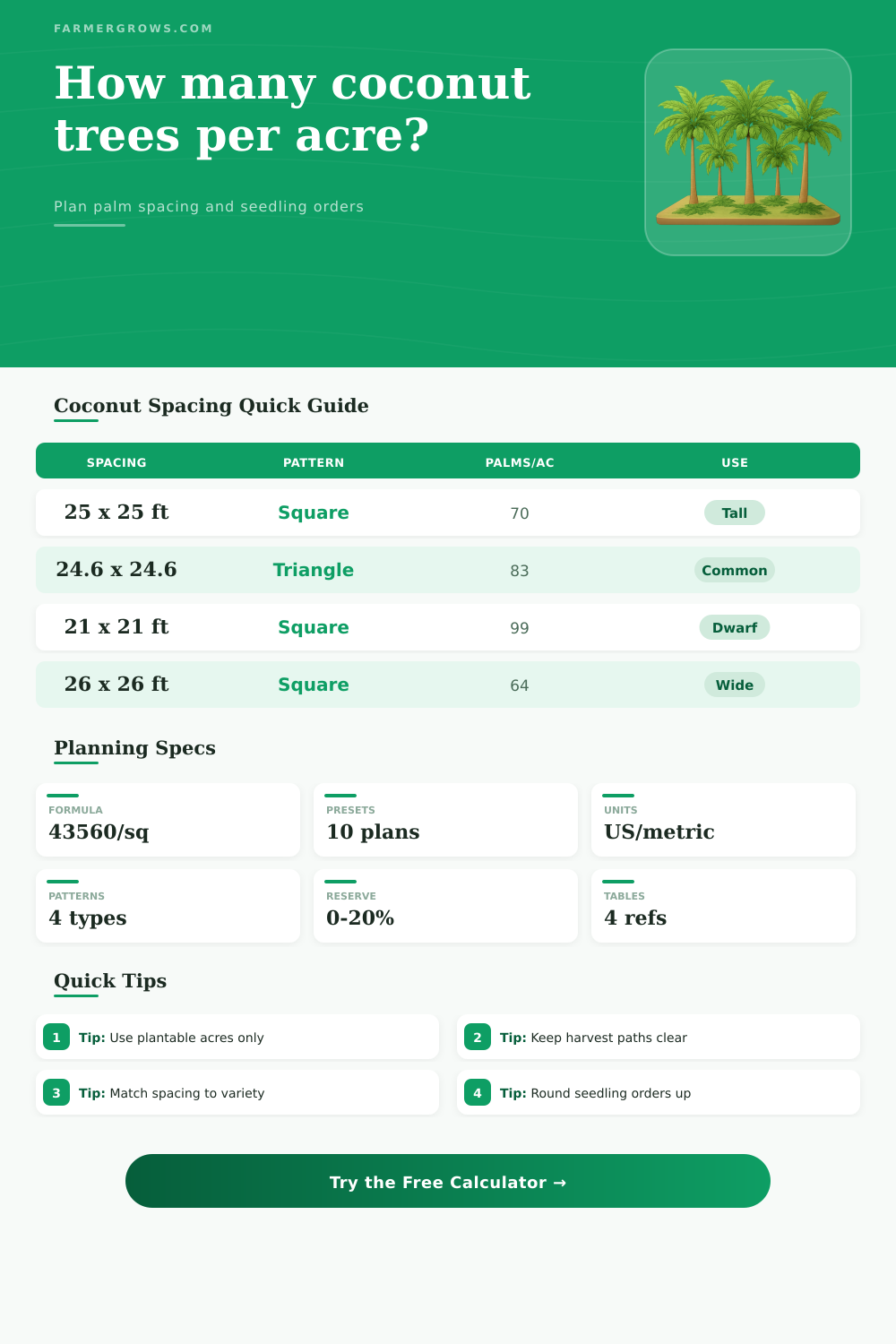
| Spacing | Metric equivalent | Square palms/ac | Triangular palms/ac | Typical fit |
|---|---|---|---|---|
| 20 x 20 ft | 6.1 x 6.1 m | 109 | 126 | Very compact, mainly dwarf or short-term plans |
| 21.3 x 21.3 ft | 6.5 x 6.5 m | 96 | 111 | Dwarf coconut where management is intensive |
| 23 x 23 ft | 7.0 x 7.0 m | 82 | 95 | Hybrid or compact grove spacing |
| 24.6 x 24.6 ft | 7.5 x 7.5 m | 72 | 83 | Common tall or hybrid reference spacing |
| 25 x 25 ft | 7.6 x 7.6 m | 70 | 80 | Traditional tall coconut acre planning |
| 26.2 x 26.2 ft | 8.0 x 8.0 m | 63 | 73 | Wide hybrid or easier harvest access |
| 28 x 28 ft | 8.5 x 8.5 m | 56 | 64 | Dryland, coastal wind, or large canopy sites |
| Planting type | Common row range | Density guide | When to widen |
|---|---|---|---|
| Tall coconut | 24.5 to 28 ft | 55 to 72 palms/ac | Large canopy, dryland sites, harvest machinery, or wind exposure |
| Dwarf coconut | 20 to 23 ft | 82 to 109 palms/ac | Weak soils, poor drainage, or limited pruning and access labor |
| Hybrid coconut | 23 to 26 ft | 64 to 82 palms/ac | High vigor, irrigation lanes, or intercropping during early years |
| Mixed grove | 24 to 26 ft | 64 to 76 palms/ac | Different seed sources, old palms retained, or uneven blocks |
| Intercrop alleys | 25 to 30 ft rows | 48 to 70 palms/ac | Banana, pineapple, cacao, pepper, fodder, or tractor alley plans |
| Plantable area | 25 x 25 square | 7.5 m square | 7.5 m triangle | Order at 10% reserve |
|---|---|---|---|---|
| 0.25 acre | 17 palms | 18 palms | 21 palms | 19 to 24 seedlings |
| 0.50 acre | 35 palms | 36 palms | 41 palms | 39 to 46 seedlings |
| 1.00 acre | 70 palms | 72 palms | 83 palms | 77 to 92 seedlings |
| 2.00 acres | 139 palms | 144 palms | 166 palms | 153 to 183 seedlings |
| 5.00 acres | 348 palms | 360 palms | 415 palms | 383 to 457 seedlings |
| Allowance item | Low | Typical | High | Use this when |
|---|---|---|---|---|
| Field access and drains | 2% | 5% | 12% | Roads, ditches, harvest paths, or irrigation lines cross the block |
| Seedling order reserve | 5% | 10% | 20% | Replants are hard to source or seedlings vary in quality |
| First-year mortality | 3% | 6% | 15% | Use more for drought, salinity, wildlife, or poor transplant timing |
| Boundary setback | Half spacing | One spacing | Custom | Needed near fences, houses, shade trees, and power lines |
| Intercrop alley | 0% | 8% | 20% | Reserve lanes for banana, cacao, pineapple, forage, or machinery |
Use local variety guidance. The calculator gives geometry-based density, but coconut variety, canopy spread, soil moisture, and harvest access decide whether close spacing is practical.
Count only usable land. A one-acre parcel rarely plants like a perfect acre once paths, drains, buildings, corners, and setbacks are deducted.
When you plan a coconut grove, you usually start by looking at the deed and thinking in acres. That’s a problem right away. A legal acre is a nice, neat geometric notion, but a planted acre are a messy reality of corners you can’t really use, of harvest paths and drainage ditches and irrigation lines. The calculator bridges that gap. It forces you to distinguish between gross land area and the actualy space where you have room for palms.
This might sound like an accounting exercise. Yes, but it saves you the expensive mistake of assuming every square foot is plantable, so you order too few seedling. Another big issue is spacing. New growers often hear a number tossed out there (typically around twenty-five feet on center) like it’s some kind of magic bullet. That is great if you have perfect conditions and are planting really tall varieties. But if you use a triangular layout rather than a square grid (easier to do with a tape measure), you can get about fifteen percent more plants onto the same piece of land. It’s simple geometry, and the math add up.
How to Plan Your Coconut Grove
Many smallholders don’t bother, though, because it’s easy enough to set out a square grid; it’s just harder to set out a triangular pattern. Your field configuration take longer up-front. But the payoff makes it worth it. You get more tree per acre without having to expand the size of your land, which is important if you have limited land or pay a lot for it.
Your spacing is as much about variety selection as about your budget. For instance, dwarf coconuts can be spaced closer (sometimes almost 20′ apart) and still grow well because their canopy spreads out less. Give the tall ones some elbow room so they can reach full size with frond and trunk development. This keeps them from fighting other trees for sunlight too much. And if you mix in hybrids, now you’re juggling management ability with vigor. Sure, a high vigor plant may make an attractive row in a dense block at first, but will cause shading problems later on.
The tool on this page lets you adjust density according to your chosen pattern and variety, and see the result. It does not makes a decision for you, but it makes the consequence of each choice clear.
Don’t forget: Reserve stock and don’t forget about mortality. Nobody’s expecting perfection, no zero-transplant shock, no less-than-perfect germination rate. This is a job that accepts first-year losses to drought or other conditions like salinity, or just plain damage from handling. If you only order enough spots for what you calculate will fit in your space, you’re setting yourself up for wasted efforts down the road, with patches here and there throughout a grove. Order a ten to twenty percent reserve with your seedling order. Think of it as an insurance policy against these realities. That way, when Mother Nature inevitable takes her toll on the original planting, you’ve got replacements at the ready.
Then there is the way field infrastructure reduces your density. Every working farm have roads, ponds and buildings, all of which are necessary evils. Add more contour planting requirements, steep slopes and your effective area decrease again. You can subtract those percentages first using the calculator, then run the density numbers. And it keeps the math honest: that edge-to-edge filling in of a field just doesn’t happen with palms. There will be a buffer zone for maintenance and access.
Planting more trees isn’t everything. Planting them correctly so they will thrive together for decades is what it’s all about. Palms planted too closely fights for water and nutrients, producing smaller nuts and declining sooner. They also won’t produce as much as they could on each acre if there are empty spaces between them. There is a sweet spot where agriculture and geometry meet. How do you get enough distance for your harvest hook to pass through with minimal damage to trunks while still giving each tree room to spread its canopy?
Finally, planning is all about setting expectations before the first seedling is in the ground. If you account for eventual losses, variety particulars, even areas where nothing will grow, you make a plan that reflects reality more closely than theory. On paper, ignoring the messiness of farming makes the numbers look better. But the money is in dealing with the mess upfront. Set your baseline with the tool, then tweak accordingly as you witness what your particular microclimate and soil do. A healthy tree is healthier in the long term and easier to livig with day-to-day, especially if you’ve got it spaced out right. Want to know? You should of order that serves the tree, not just the spreadsheet.