Pine Trees Per Acre Calculator
Estimate pine trees per acre, planting positions, seedling order totals, expected live stand, first thinning residuals, row length, and zone counts from spacing, species, and field deductions.
Use productive acres for planting math. Firebreaks, wet spots, turn rows, wildlife lanes, and failed survival can change the practical seedling order more than the spacing formula alone.
Pine stand density plan
Spacing and area results will appear here.
| Spacing | Square feet per pine | Trees per acre | Trees per hectare | Typical fit |
|---|---|---|---|---|
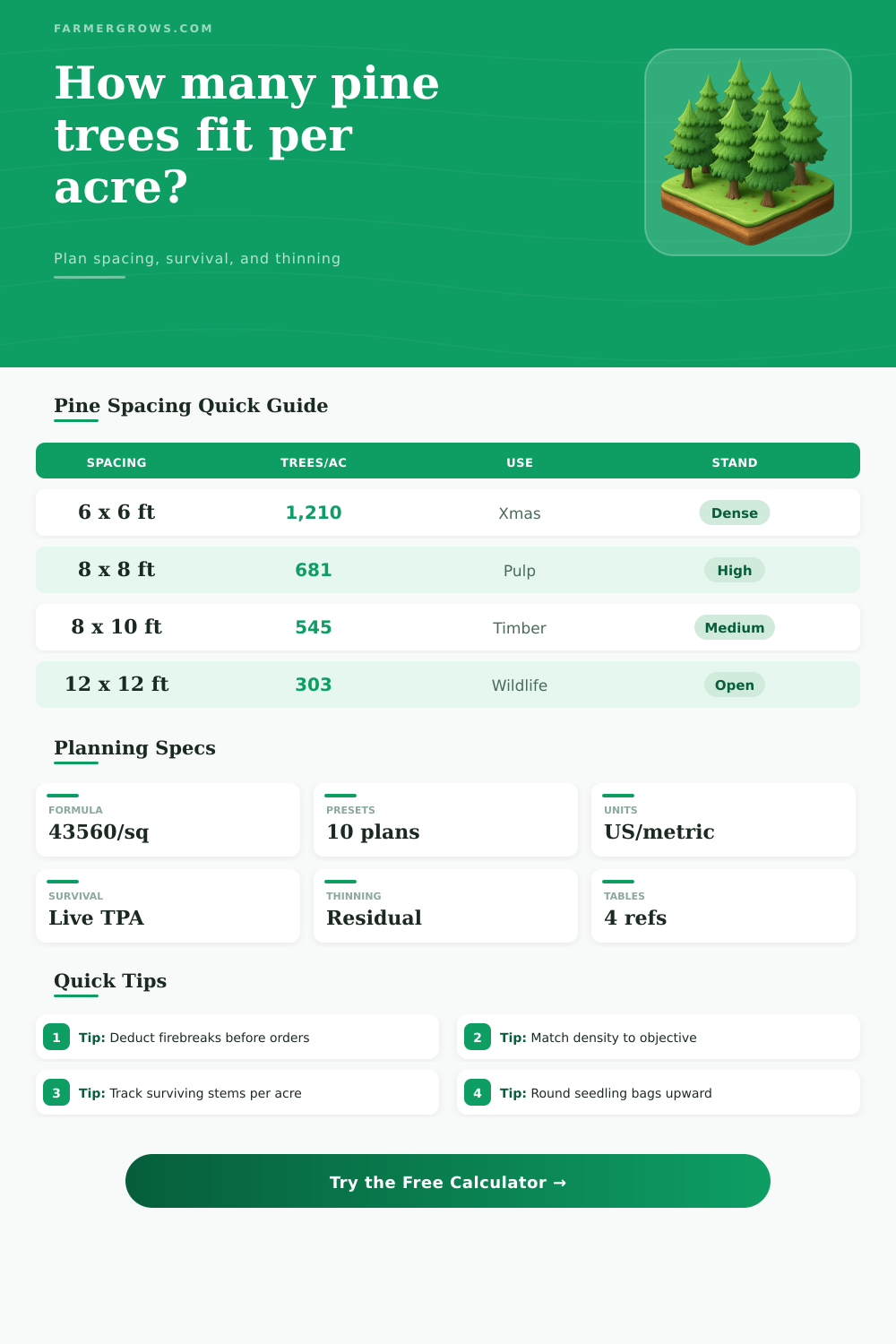
| 6 x 6 ft | 36 sq ft | 1,210 | 2,990 | Christmas trees, dense screening, short rotations |
| 7 x 8 ft | 56 sq ft | 778 | 1,923 | Dense pulpwood or strong early canopy closure |
| 8 x 8 ft | 64 sq ft | 681 | 1,683 | Pulpwood, biomass, or high initial stocking |
| 8 x 10 ft | 80 sq ft | 545 | 1,346 | Loblolly or slash pine timber establishment |
| 9 x 10 ft | 90 sq ft | 484 | 1,196 | Timber stand with moderate early competition |
| 10 x 10 ft | 100 sq ft | 436 | 1,077 | Longleaf, restoration, or mixed pine stands |
| 12 x 10 ft | 120 sq ft | 363 | 897 | Open sawtimber, wildlife lanes, or drier sites |
| 12 x 12 ft | 144 sq ft | 303 | 748 | Wide pine planting and understory objectives |
| Pine type | Common starting range | Survival watch | Thinning note | Planning caution |
|---|---|---|---|---|
| Loblolly pine | 450 to 700 TPA | Check drought and weed pressure | Often thinned after crown closure | Do not ignore roads and firebreaks |
| Slash pine | 500 to 750 TPA | Watch wet-site bedding quality | Thin before over-crowding reduces diameter | Match spacing to drainage and site prep |
| Longleaf pine | 300 to 600 TPA | Grass-stage survival can vary | Open structure may be intentional | Fire access and groundcover matter |
| Ponderosa pine | 250 to 550 TPA | Drier sites need conservative density | Wide crowns may need earlier selection | Use local stocking guidance for arid sites |
| White or red pine | 400 to 800 TPA | Browse and competing brush matter | Thin to favor straight crop trees | Snow, disease, and access can change spacing |
| Field deduction | Low | Typical | High | Use when |
|---|---|---|---|---|
| Firebreaks and boundary lanes | 2% | 5% | 12% | Blocks need burn access, roads, or edge buffers |
| Wet spots, rocks, and skips | 0% | 3% | 15% | Plantable acres are less than mapped acreage |
| Seedling order reserve | 3% | 5% | 15% | Use extra for culls, handling loss, and replanting |
| Expected survival loss | 5% | 12% | 30% | Drought, wildlife, weeds, or poor planting lower live TPA |
| First thinning removal | 15% | 25% | 40% | Use to test residual stocking before marking rows |
| Seedling package | Count | Useful for | Rounding rule | Example |
|---|---|---|---|---|
| Small bundle | 100 trees | Repairs, windbreaks, small plots | Round up to whole bundle | 235 trees needs 3 bundles |
| Nursery bag | 500 trees | Common pine seedling lots | Round up to whole bag | 2,200 trees needs 5 bags |
| Bulk thousand | 1,000 trees | Medium plantations | Round to next thousand | 8,450 trees needs 9 lots |
| Crew zone split | Custom | Daily planting assignments | Divide order by zones | 12,000 trees / 4 zones |
For seedling orders: Calculate spacing on effective acres, then round nursery packaging upward. A few extra seedlings are easier to manage than an under-planted row.
For stocking decisions: Compare planted TPA, expected live TPA, and residual TPA after thinning. Those three numbers tell different parts of the pine stand story.
When most people think about planting pines, they envision the process of dropping seedlings in a tidy row, but it’s not quite so simple: You’re dealing with three variables that change over time. You’re counting trees planted, the trees surviving harsh weather, and the trees left after others was lost to competition for light. Count just the first variable, and you might wind up with either a sparse stand lacking good wildlife habitat or a dense stand that won’t produce quality timber. The trick: Know which number to count at each growth stage.
After entering survival rate and desired spacing, the calculator do all of the math for you, no need to hand calculate your own square feet. And it’s not even about cramming in as many trees as you can fit into a given space. One common mistake among new landowners is thinking they can fill an acre with tree. Half the space could be unusable (due to wet spots or rock outcroppings, firebreaks, etc.). Subtract those sections before you order seedlings, no more money wasted on saplings that won’t go anywhere. People forget this part when first planning.
How to Plant Pine Trees Correctly
What about species? Not all pines is the same. Fast-growing loblolly pines need nutrients and prefer tight spacing to encourage early competition. By contrast, longleaf pine wants space, space to reach its grass stage before putting on a trunk, and therefore requires wider spacing to naturaly succeed. Planting longleaf densely are setting it up for failure. To avoid this, the tool has presets based off typical forestry practice for each species.
Theory meets practice in survival rate. What happens if you plant in sandy soil in rainy weather, versus in wet clay during a heatwave? Do you have to replace any sapling that die? Are deer browsing? Plan for a reserve percentage as part of your order. The last thing you want is to run out and be frustrated with gaps in your order. Five percent might sound wasteful, but it’s insurance against the unknowns of what you find in the field.
Money in a pine stand comes from thinning, but most folks don’t cut trees they paid someone to plant. Thinning mean taking out enough volume to allow the rest to grow in diameter and expand their crowns. Leave them too long, and they gets tall and skinny with less harvest value. Residual stocking numbers should of had space for growing. You’re looking to prioritize residual stocking and room for growth rather than just a maximum count. Timber markets is based off board feet, not headcounts.
Your acre is an active portfolio; how densely planted it is corresponds to your level of risk tolerance. High density takes site resources fast, but competition rises and thinning expenses grows with time. Low density provides lots of room per tree but wastes soil nutrients in waiting for canopy closure. You’re trading off management of the relatively calm middle years when not much appear to be happening up top. Use the spacing grid to check various strategies from a side-by-side perspective.
It’s not hard to plant something. It takes planning to grow a stand of trees that will pay you back financially and ecologocally two decades from now by thinning out. Plan for what will be there when the money appears. Start with land itself. Honor the biology of the species. Don’t cheat yourself on the number of trees you put in because it is the first one. Make your first numbers honest, or else the ground won’t support them all.