Garlic Chive Growth Time Calculator
Estimate garlic chive germination, transplant recovery, division regrowth, first leaf cuts, flower scape timing, clump fill, and repeat harvest windows from start type, weather, spacing, and care.
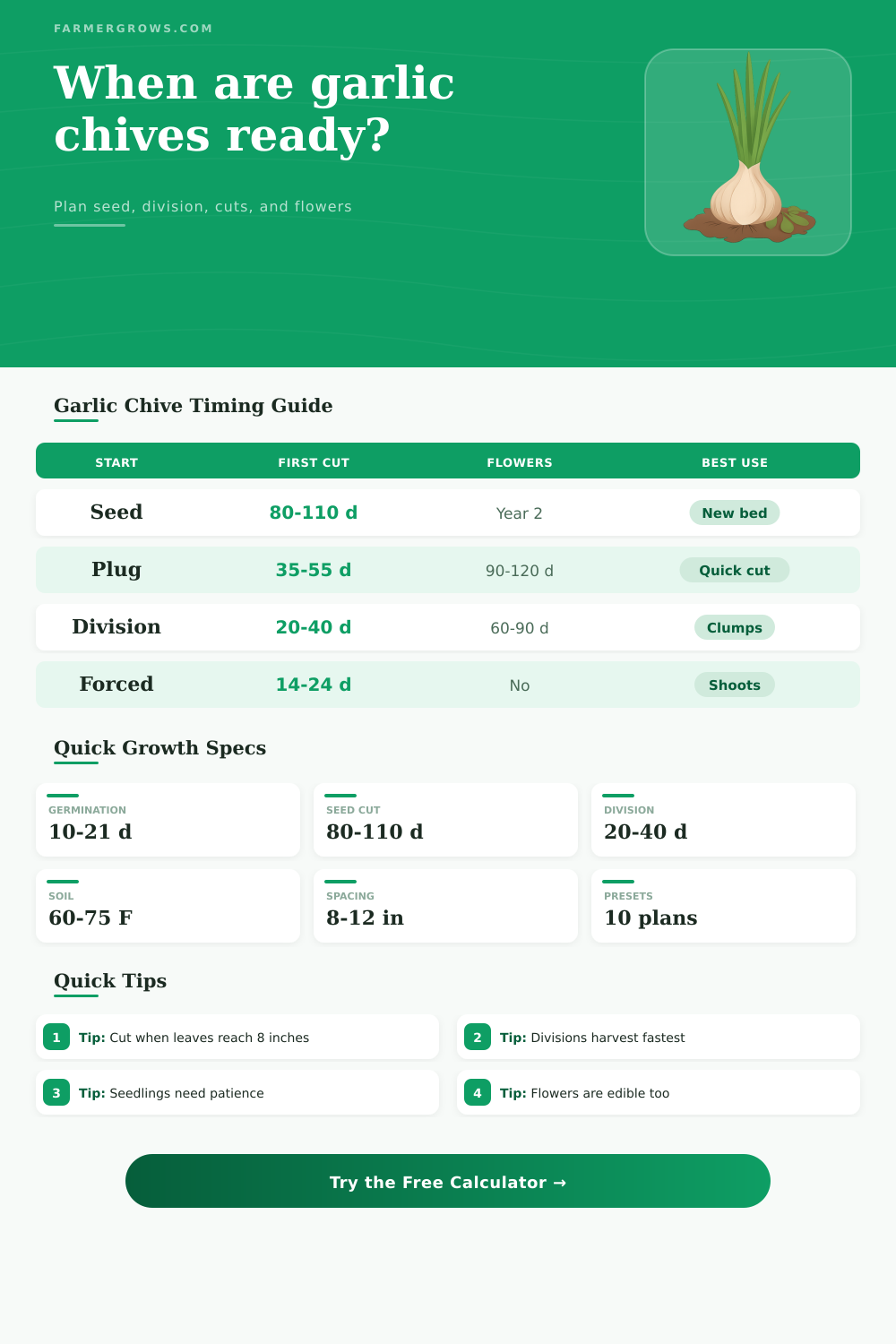
Garlic chives, also called Chinese chives, grow differently from common onion chives. Seedlings are slow, divisions rebound quickly, mature clumps flower in white umbels, and the best leaf harvest comes from cutting flat leaves before they turn tough.
🌿Garlic Chive Presets
⚖Garlic Chive Start Comparison
Best when starting many plants, but first harvest is usually light and later than transplants.
Works in warm soil, though weeds and uneven moisture can stretch the seedling phase.
Established plugs often give a useful leaf cut within several weeks after transplant recovery.
Divisions carry stored energy, so harvest timing depends mostly on root recovery and leaf length.
Dormant crowns under cover can push tender shoots quickly, but flowering is not the goal.
⚙Growth Time Inputs
Garlic Chive Growth Results
Enter a start date and growth profile to estimate the next useful harvest windows.
📊Current Growth Status Cards
📘Garlic Chive Growth Stages
| Stage | Typical timing | What to look for | Garlic chive note |
|---|---|---|---|
| Germination | 10 to 21 days | Thin upright loops or blades | Older seed is slower; keep trays evenly moist. |
| Seedling establishment | 4 to 8 weeks after sprout | Several flat leaves, stronger roots | Do not expect heavy first cuts from tiny seedlings. |
| First leaf cut | 80 to 110 days from seed, faster from plugs | Leaves near 8 to 10 inches | Cut high enough to leave the crown intact. |
| Flower buds | Late summer on mature clumps | Round scapes and white buds | Buds and flowers are edible with mild garlic flavor. |
| Mature perennial clump | Second season and beyond | Dense crown, repeated regrowth | Divide crowded clumps every few years for vigor. |
🌡Temperature and Light Effects
| Condition | Timing effect | Best range | Practical response |
|---|---|---|---|
| Cool soil | Adds 7 to 18 days | 60 to 75°F | Start seed indoors or wait for warmer beds. |
| Hot dry bed | Adds 5 to 14 days | Moist, mild soil | Mulch lightly and water before leaves toughen. |
| Short daylight | Slower leaves, fewer flowers | 12+ hours | Expect stronger leaf growth in spring and summer. |
| Greenhouse forcing | Can shorten shoot harvest | 55 to 70°F | Use rested crowns and harvest tender shoots early. |
| Fall frost pressure | Ends tender leaf harvest | Before hard freeze | Take final cuts early enough for crown recovery. |
🌱Start Method Reference
| Start method | First cut estimate | Strength | Best use |
|---|---|---|---|
| Indoor seed tray | 80 to 100 days after sowing | Good for many plants | Best when you can baby seedlings early. |
| Direct seed | 95 to 120 days after sowing | Low transplant shock | Use warm, weed-free beds with steady moisture. |
| Nursery plug | 35 to 55 days after planting | Predictable first cut | Fast kitchen herb garden establishment. |
| Mature division | 20 to 40 days after division | Fastest regrowth | Refresh old clumps or expand a perennial row. |
| Forced crown | 14 to 24 days after forcing | Tender shoots | Short indoor or greenhouse harvest, not flowers. |
✂Harvest Use and Spacing Guide
| Use | Spacing | Cut rhythm | Quality note |
|---|---|---|---|
| Kitchen leaf cuts | 8 to 12 in clumps | Every 3 to 5 weeks | Harvest before leaves get coarse. |
| Container herbs | 6 to 8 in clumps | Light snips often | Containers dry faster and slow regrowth. |
| Flower buds | 10 to 15 in clumps | Pick as scapes swell | Allow mature clumps to build energy first. |
| Market bunches | 8 to 10 in rows | Cut blocks in rotation | Keep moisture steady after each cut. |
| Division stock | 12 to 18 in clumps | Few hard cuts | Wide spacing builds larger crowns. |
💡Garlic Chive Timing Tips
Garlic chives from seed need time to build a crown. A light first trim is fine once leaves are tall, but repeated hard cuts are better in the second season.
A healthy clump division already has stored root energy, so it can regrow harvestable flat leaves far sooner than new seedlings if kept moist after planting.
Young seedling plants may not flower heavily the first year. Mature clumps under long summer days are much more likely to send edible buds and white umbels.
Leave a short green base so the crown can regrow. Cutting too low, especially before frost or in drought, slows the next harvest window.
Garlic chives seem easy to grow, that’s why so many gardeners begin with this assumption. You can use the flat leaves for cooking or perhaps white flowers for garnish. Great. But when will they be ready? That depends: It can be as little as just over a month from nursery plug to usable foliage…or nearly four months from seed-starting indoors to the same point. Want sturdy plants, not thin ones? Know this. The online calculator on that page will tell you how long based off the way you start it and when.
What it doesn’t do is teach you what to input, as if the numbers are all that count. Germination is often a slower process due to soil temperature: When the ground is still cool, seeds don’t really have the energy to push up and out of the soil. If we experience a late spring cold snap, that’s when things will be delayed; just plan for it.
How to Grow Garlic Chives Well
Divisions are not like seeds, they’re loaded with root energy. That allows them to go straight to business of forming leaves (no vulnerable seedling stage required). How quickly they do so depends partly on light levels. Summer crops will tend to grow faster then spring ones. Longer days mean more leaf production and the clump mature into a good flower-producing plant.
That’s important if you want an edible flower, as opposed to just green parts. The tool takes day length into account when calculating flower time. “Most people think chives flower annually,” many gardeners say, “but when do they bloom depends on when they mature.” First-year seedlings are more likely to focus on developing root systems (they have a lot of work to do!) than flowering in their first year. Expect little or nothing until the plant has lived long enough to bulk up some foliage and fatten its crown. You should of earned those flowers by letting the plant survive and thicken its crown over time.
Moisture conditions also influence its rate of rebound from being cut down. With garlic chives, keep soil moist but not sodden, and keep it even. Fluctuating dryness stresses the plant and it recover more slowly than if well-watered. When you cut off the leaves, the plant is deprived of gathering sunlight, and the crown must rebuild itself right away. If the soil becomes too dry while it does, it won’t grow again. The calculator adds those things into its calculations according to what you enter as moisture. Plants recovering from drought takes longer than hydrated ones.
Spacing matters. In the long term, crowded beds aren’t good. They look nice initially, but will raise disease pressure and compete more for nutrition and space. A wider bed means better air flow, more room for each plant to grow and stronger regrowth. This is reflected in table above on this page; close quarters mean more produce short term, less healthy long term.
Harvest carefully. Again, take it easy, particularly the first year. Cutting too much off a young plant will weaken it (permanently), depleting its reserves before it has time to establish itself. Don’t cut so low to the base: Leave some leaf surface to continue photosynthesizing. Cut too closely and you risk shocking the crown and preventing regrowth.
Over the next several years as these plants grow up, you’ll be able to harvest a bit more. But with all perennials, it’s about building the foundation through patience. Planning how your timing works with garlic chives means finding the balance between what you want immediately versus what’s best for the long life of the plants.
With this info in hand, plot out when you’ll realistically start harvesting, taking into consideration your starting material and weather factors. You’re creating a strong perennial system here, one that serves you year after year. Don’t cut off your nose to spite your face just to get leaves now. Instead, aim for a year-round source that you control by understanding what makes it grow fast or slow. Then you make the calendar work for you.