Dog Poop Composting Time Calculator
Estimate a dog-waste compost batch for carbon mix, hot-compost confidence, cure time, isolation risk, finished volume, and non-food landscaping use.
Dog waste can carry pathogens and parasites that ordinary backyard composting may not reliably destroy. This calculator is intentionally conservative and assumes the finished material is for ornamentals, lawns, trees, shrubs, and revegetation only.
Dog Waste Compost Estimate
Results will update after calculation.
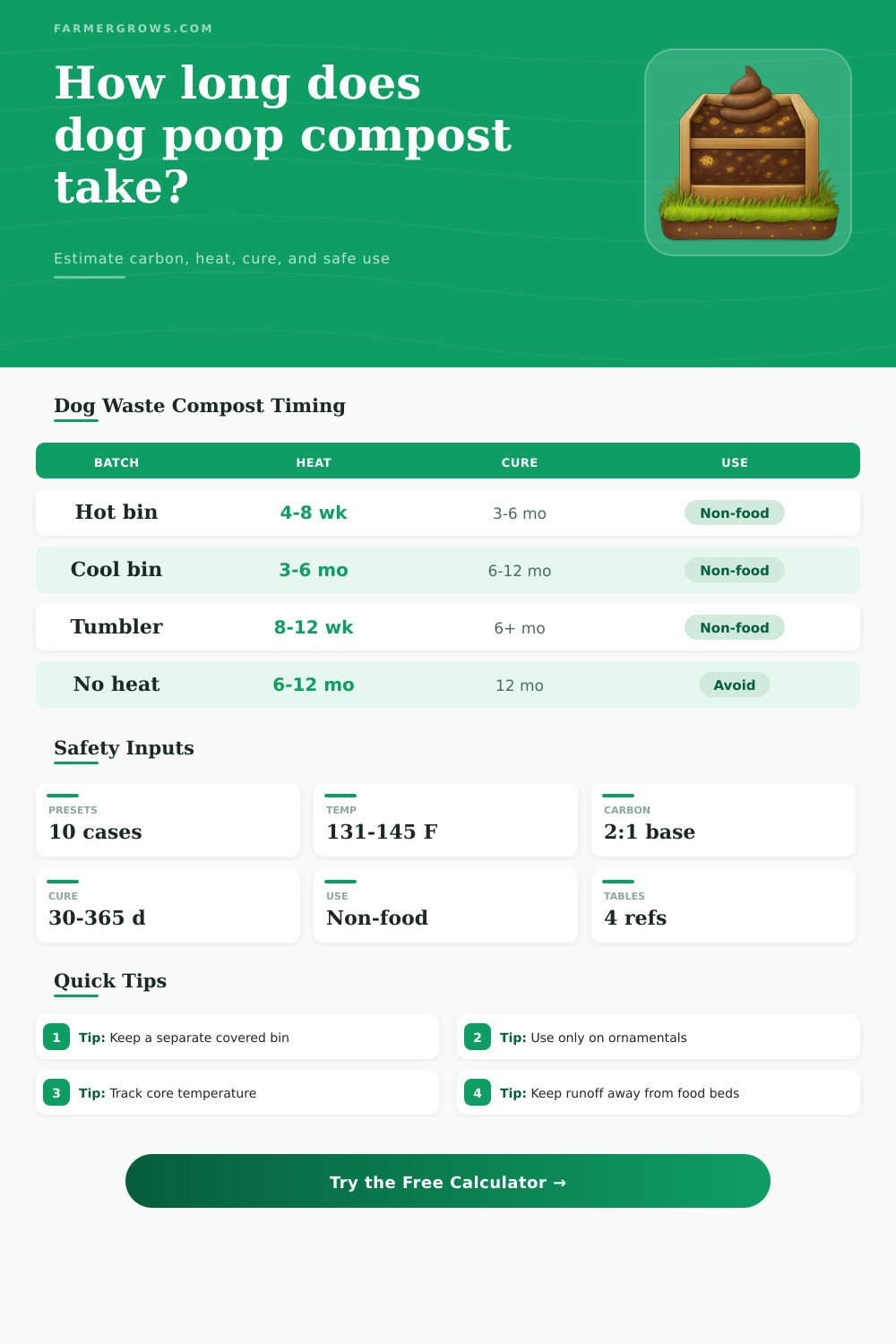
| Temperature record | Calculator treatment | Minimum cure behavior | Use guidance |
|---|---|---|---|
| 145°F for several days, turned | Strongest home confidence | 90 to 180 days | Ornamentals and lawns only |
| 131°F to 144°F for 3+ days | Moderate heat confidence | 120 to 240 days | Non-food landscape only |
| Below 131°F or not measured | Unverified dog waste | 180 to 365 days | Avoid use near people or food |
| Over 160°F | Too hot, needs aeration/water | Extra monitoring | Cool before handling |
| Method | Typical active time | Strength | Main caution |
|---|---|---|---|
| Hot turned wire bin | 6 to 10 weeks | Airflow and heat | Needs enough volume and turning |
| Covered static bin | 3 to 6 months | Containment | Cool edges and long curing |
| Tumbler | 8 to 14 weeks | Contained mixing | Often too small to sustain heat |
| Cold aging only | 6 to 12 months | Low labor | Do not treat as pathogen-safe |
| Use zone | Allowed by this calculator | Suggested blend | Reason |
|---|---|---|---|
| Flower beds and shrubs | Yes, after cure | Up to 25% compost | Non-food ornamental use |
| Lawn and revegetation | Yes, thin topdress | Light surface layer | Low contact after settling |
| Fruit, vegetables, herbs | No | None | Human pathogen and parasite risk |
| Seed starting mix | No | None | Salinity and safety concern |
| Control point | Low-risk practice | Calculator penalty if missed | Why it matters |
|---|---|---|---|
| Bin isolation | Covered, separate, no runoff | Longer cure and lower score | Limits spread to gardens and water |
| Tools and gloves | Dedicated pet-waste tools | Safety warning remains active | Prevents cross-contamination |
| Temperature log | Record core readings daily | Unverified heat classification | Confirms pathogen-reduction conditions |
| Fresh additions | Stop adding when active batch starts | Active clock extends | Fresh waste resets safety timing |
Separate the stream. Keep dog poop compost away from household compost, vegetable beds, edible fruit areas, play spaces, and shared garden tools.
Temperature is not a guarantee. Hot readings improve confidence, but home systems can have cool pockets. Turn outer material into the center.
Use only where contact is low. Prefer ornamentals, shrubs, trees, lawns, and revegetation. Never use it for crops grown for human consumption.
When in doubt, do not apply it. If the batch smelled rotten, stayed wet, attracted pests, or never heated, choose disposal or a restricted landscape area.
A compost heap is no doggy doo disposal system by default. The pathogens found in animal waste, including parasites, Salmonella, and E. Coli, won’t be killed off by typical backyard temperatures, unlike kitchen scraps and fallen fall foliage which nature can handle just fine. E. Coli won’t be killed off by typical backyard temperatures, and these pathogen will also prevent kitchen scraps and fallen leaves from breaking down properly. Consider the compost heap: Your vegetable-garden bounty could be at risk if you treat pet poop as you would food waste. Even if it’s yours to begin with, handle it as you would human sewage.
The key issue is consistent heat. Most home composter think “warm pile = safe pile.” They’re wrong. What’s needed is consistent high temperatures deep inside the composting heap; long enough to kill pathogens. But if your bin’s small or not turned often enough, the cold outside won’t get mixed in with the hot center. Your heap is not composting, it’s aging. The calculator above crunches those numbers for you when you enters the size of your bin and your turning schedule. Avoid guesswork about whether what you’re doing is really breaking down the waste or just hiding it.
Why You Should Not Compost Dog Poop at Home
Many people are excited about composting but do not know much about carbon. Carbon must be dry, while dog poop is wet and full of nutrients. A lot of carbon is necessary to counter-balance that, otherwise the heap will become anaerobic, stinky, and won’t cook well (which makes it unsafe). Coarse materials such as whole branches or straw don’t work because of air gaps, which mean not all particles gets moistened to reach the microbes. That makes cold spots within the pile where pathogens persist. The best option is finely ground material that has lots of surface area for microbe to grab hold of fast, such as fine sawdust or even shredded leaves. You’re looking for the consistency of a wrung-out sponge, moist but not saturated, with no dry areas unclaimed by microbes.
The last step is curing time, and it is the one people skip most often. Just because it stops getting heated, doesn’t mean it’s done. It will still be changing… Chemically and biologically, and must rest a few months to stabilize. If you rush it, compost that will burn plant roots. Or when it reaches the end of its breakdown cycle in your flower bed, maybe, it’ll emit some ammonia. To give you a sense of how long you should of wait until handling the material safely, the tool takes into account the climate conditions you entered and the temperatures you recorded. So you have some idea of what kind of buffer there really is.
There are no shortcuts if you want something that does good rather than harm. The length of time in the heap and location of the eventual use of finished compost are equally important. Even when the compost has gone through a complete hot composting process and sits awhile to cure, most experts recommend not applying it to edible plants. It is too risky with something we’ll eat barely cooked or not cooked at all. Apply this stuff around non-edible plants such as lawns (as a topdress), on bushes where there’s little human contact, or in ornamental beds instead. Separating the compost stream from your main garden-bin stream protects against inadvertent cross-contamination. And if you find yourself reconsidering using it later, it’s more easily disposed of than, too.
I can understand why people think: I am ruining precious soil by applying this rich material to my tomatoes. But safety matters. It is about safety. Preparing a compost heap correctly so that it gets hot enough, managing the carbon-to-nitrogen ratio, curing the heap (these are no small tasks). And unless you can monitor temperature (and know it’s sufficiently high) and you’re sure nothing could escape into edible-garden areas, you might as well just toss the stuff in a separate part of the yard where roots will eventually absorb the goodness, but nobody else eats raw.
Dog poop can be composted, but with discipline, exact record-keeping, and a firm commitment to use only for non-edible purposes. Pathogens don’t allow for any shortcuts; get it wrong, and you’ll have to face that fact.