
Plant it, knowing you will get apples from that Pink Lady tree in October. Tend to it (water it; do some required pruning now). Wait for spring. Wait for the flowers to open. That’s the moment of truth. Will there be fruit? Maybe not. Why? Because unless you have another tree (or an incompatible partner near by) it won’t happen. Pink Lady cannot pollinate itself. It cannot pollinate itself.
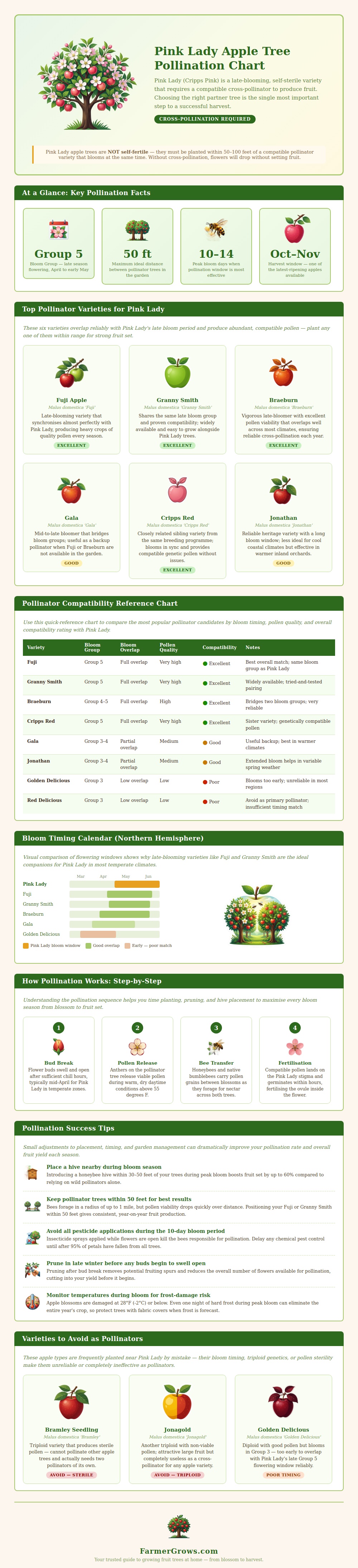
Success comes if you have a compatible tree nearby, a source of pollen. Which ones are best for this? The chart indicates: Pink Lady falls into bloom group five, meaning it flowers late in the season. Why does that matter? Because apples don’t really like to flower unless there’s another one nearby of about the same type that blooms around the same time to pollinate each other well. A tree up the road that blooms three weeks earlier will shed its flowers by the time yours open.
How to Get Apples from Your Pink Lady Tree
According to the chart, Granny Smith and Fuji is right on target (late April to early May). Braeburn are another good bet because it flowers in both group four and five, which gives it some extra time to overlap with the short window when Pink Ladys are fertile. The selection process for all these choices is more a matter of individual preference (not necessarily biology). If you’re planning an orchard, Fuji is a reliable choice, sets heavily, and is pollen compatible with the others. Likewise, Granny Smith will never let you down, and it’s widely sold at nurseries. Cripps Red is a cousin to Pink Lady; it flowers right on time with her and also has proven to be a great partner. In most cases, these two is sure bets for home gardener.
Backups? Why not try Jonathan or Gala. Though realize that neither one may yield 100 percent crop overlap if your climate is cool and spring comes very late. That’s what the colors in the graphic are there to help you avoid having to guess about.
As with any tree, you also need to understand what not to plant alongside it. The familiar names like Red Delicious and Golden Delicious is favorites of many gardeners. Wrong! In fact, all of group three (the ones who bloom earlier) has flown the coop before Pink Lady awakens. Two others; Bramley Seedling and Jonagold, are triploids, meaning their pollen can’t be used to fertilize other trees. They are a waste of precious garden space.
How far? Contrary to intuition, not very: A bee will fly a mile, but pollen viability plummets with greater distance. Being fifty feet from a pollinator is ideal. This keeps a bee around to frequently visit both trees, ideally with some viable pollen grains for transfer. During the full-on bloom period (which lasts about ten days), having such close proximity results in a thick cloud of activity, which greatly enhances fruit set relative to the level achievable if relying only on wild pollination. If you have a hive, place it near one or the other of your Pinks during the bloom timeframe and see the payoff, increased yield.
This is all so delicate: For the anthers to let go their pollen, the weather has to be right. Warm and dry and above fifty-five degrees Fahrenheit. Cold snaps and rain wash it away (or freeze delicate parts before they can do their job). It’s a tense time when you’re watching the weather in late April; one night of a hard frost could mean no more blossoms (and therefore no year’s crop).
Don’t cut back in springtime as buds start swelling (you’ll remove the chance at fruit-bearing spurs). No pesticide sprays when the blooms are open (you want the bees!). The success of a bumper crop isn’t so much a matter of good fortune as it is of careful logistics: matching bloom dates, observing distance restrictions, and providing protection for pollinators. When you have all those factors down pat, the trees will do their thing. And oh, what a payoff it is to bite into your first crispy apple in November.