
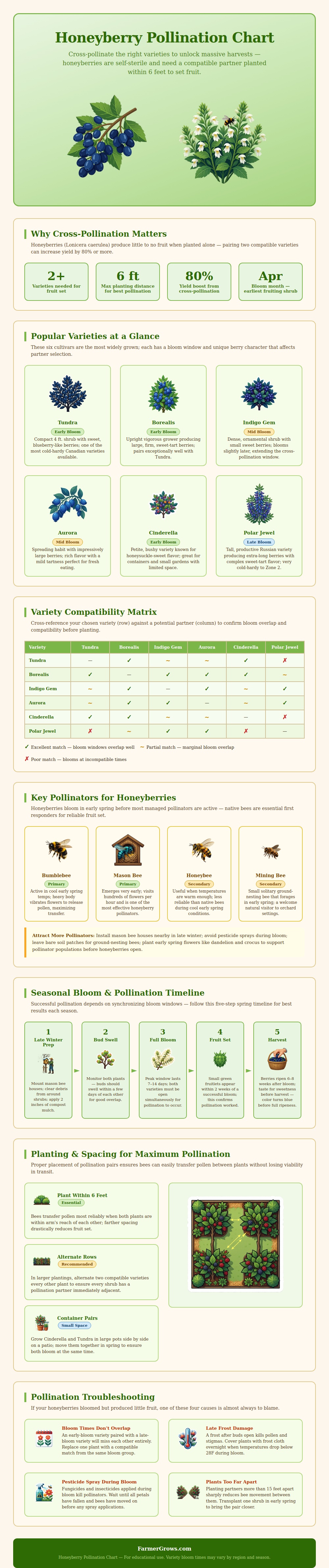
The promise of the honeyberry: Plant your bush, wait for the harvest, and then get no berries, even though the shrub bloom in early spring and even tempts the bees. Honeyberries is self-sterile; they don’t pollinate themselves. They requires a second bush nearby with compatible pollen to produce any dark blue fruit at all; not just pretty flowers, but some food you can eat.
So you must plant two compatable varieties together, close enough for their flower to cross-pollinate. The key to success is planning. The other thing is when they bloom. It’s not so much what they taste like. It’s about which one are blooming at the same time, so you can pick ones that let a bee get pollen from both.
How to Grow Honeyberries
If one blooms in April and one blooms in May, for instance, no dice. That won’t work. Here’s a visual of how various cultivar interact according to their bloom times. Avoid selecting two bushes that don’t overlap.
Borealis (and also Tundra) combine nicely with another early variety such as Borealis for most garden situations: Both flower at the same time. Combining an early and a late flowerer (such as Borealis and Polar Jewel, above) will result in lower yield unless you live in a place where spring lingers a bit and extends length of bloom cycle. No guessing necessary, though, the chart indicate compatible combinations by using these symbols. Borealis, for example, pairs up well with many varieties.
Pollination is less efficient at distance; bees don’t make long flights between plant. A gap of twenty feet between the bushes reduce transfer greatly. Plan for compatibles to be no more than six feet apart so that the mason bees and bumblebees can slip around from one to the next. In big gardens, try staggering them in a row.
For patios and small areas, grow two varieties side-by-side in a single large container, such as with Cinderella and Tundra. It’s how balcony gardeners gets fruit despite lack of space. Honeyberries flower very early, too early for managed bees, but not too cold for native pollinators like bumblebees or mason bees. By putting up your bee houses in late winter, those guys get an early jump on things once the shrubs begins to show buds.
And remember (no pesticide use during blossom time); those insect-killing sprays will be lethal to the very creature whose work is required to set fruit. Wait till after bloom (after the petals fall) if treatment is necessary. Why didn’t it produce well? You can troubleshoot common issues like frost damage. Do they has other blooms at an incompatible time?
You can solve the “who goes with whom” part in minutes by consulting a compatibility matrix. Were the plants too far away for bees to shuttle between effectively? Fix those things and presto (much more bounty).
You will see everything from bare branches to baskets of sweet-tart berries that is half-raspberries and half-blueberries. Plan properly; reap abundantly.