Broccoli Microgreen Growth Time Calculator
Plan broccoli microgreen tray timing from sowing to harvest using tray size, seed density, blackout, light days, harvest height, ambient temperature, media, light level, rinse method, and sanitation routine.
This calculator is for indoor broccoli microgreens harvested at the cotyledon stage, not field broccoli heads. It scales the common 10 x 20 tray benchmark to your tray area, then adjusts timing and yield for temperature, media, light, seed density, rinse handling, and sanitation risk.
Broccoli Microgreen Results
Results will appear here after calculation.
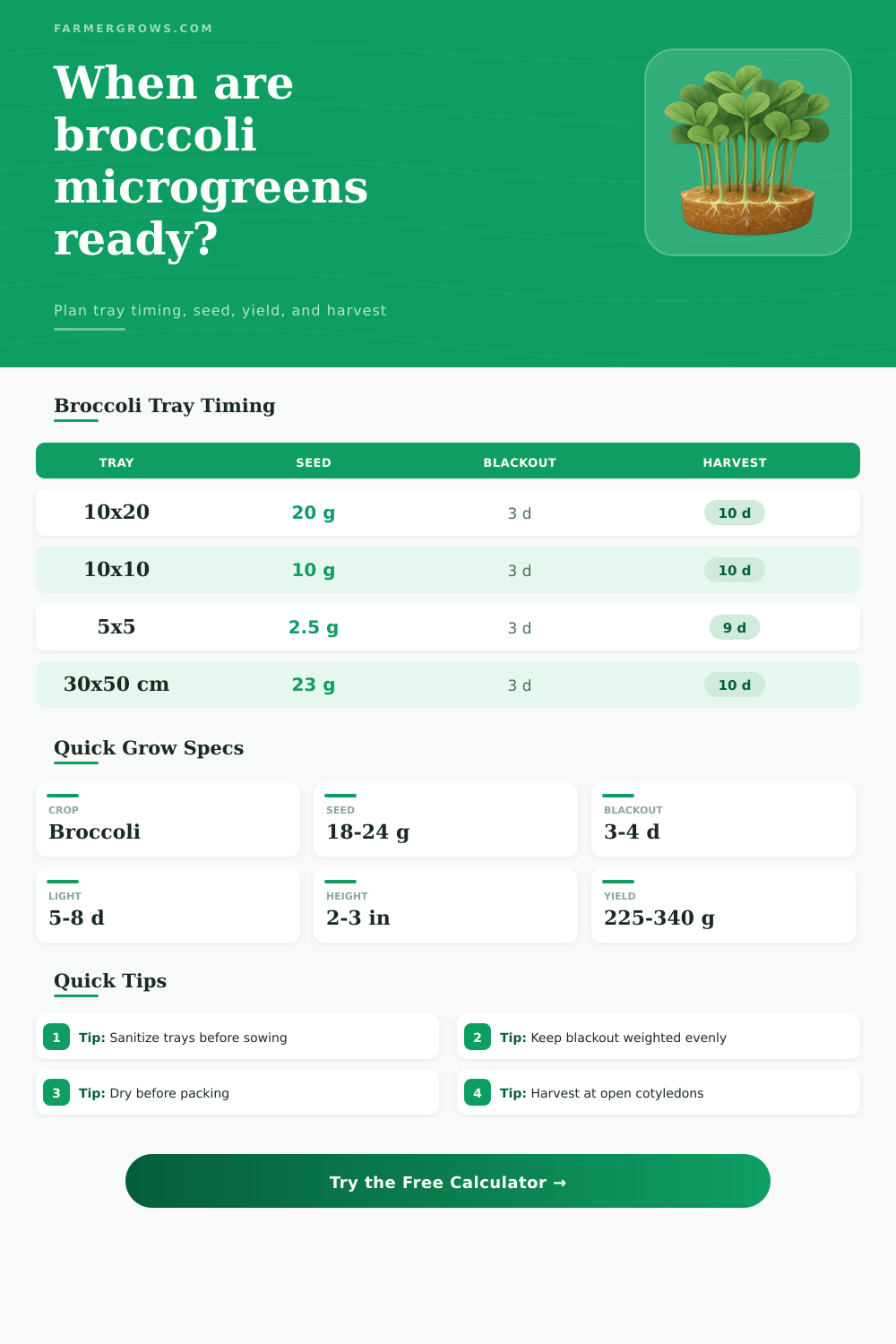
| Broccoli tray | Inside area | Seed at 20 g per 1020 | Typical fresh yield | Best use |
|---|---|---|---|---|
| 5 x 5 sample | 25 sq in | 2.5 g | 28 to 42 g | Seed lot and sanitation tests |
| 10 x 10 half tray | 100 sq in | 10 g | 113 to 170 g | Small restaurant or home batches |
| 10 x 20 standard | 200 sq in | 20 g | 225 to 340 g | Main broccoli production flat |
| 12 x 24 large tray | 288 sq in | 28.8 g | 325 to 490 g | Large rack systems |
| 30 x 50 cm tray | 232.5 sq in | 23.2 g | 262 to 395 g | Metric greenhouse tray |
| Ambient temperature | Timing effect | Blackout cue | Broccoli risk | Grower action |
|---|---|---|---|---|
| 58 to 63 F | Add 1 to 2 days | Slow lift | Uneven germination | Use warmer germination shelf |
| 64 to 72 F | Normal 9 to 11 days | Even dome lift | Low risk | Keep airflow after light move |
| 73 to 76 F | Fast 8 to 10 days | Quick stretch | Higher mold pressure | Shorten blackout and increase airflow |
| 77 to 82 F | May look ready early | Rapid stem length | Slimy stems if wet | Lower density or cool the rack |
| Media | Broccoli performance | Moisture note | Yield effect | Sanitation note |
|---|---|---|---|---|
| Fine potting soil | Steady stems and roots | Holds water well | Baseline yield | Use clean seed-starting mix |
| Coconut coir | Clean mat and easy cut | Even moisture after soak | Slightly higher clean pack | Pre-moisten with clean water |
| Hemp mat | Fast handling | Can dry at edges | Small yield penalty if dry | Use once, then compost |
| Jute mat | Good root grip | Needs full pre-wet | Similar to coir | Avoid reused wet mats |
| Paper fiber mat | Light and clean | Lower water reserve | May be lighter | Watch for surface drying |
| Handling step | Calculator input | Typical value | Why it matters | Result impact |
|---|---|---|---|---|
| Blackout | Blackout days | 3 to 4 days | Builds upright stems before light | Too short reduces height, too long weakens stems |
| Light finish | Light days and PPFD | 5 to 8 days, 120 to 180 PPFD | Greens cotyledons and firms stems | Changes harvest date and readiness score |
| Harvest height | Target height | 2 to 3 inches | Matches cotyledon-stage broccoli quality | Taller cuts may add days and stem weight |
| Rinse and dry | Rinse method | Dry cut or light rinse | Moist packing shortens shelf life | Adjusts yield and safety score |
| Sanitation | Tray sanitation routine | Wash plus sanitizer | Broccoli is dense and humidity-prone | Adjusts warning and risk score |
Blackout tip: Keep the weight even during blackout and move broccoli to light when the tray lift is uniform. Overlong blackout gives height but can weaken the canopy.
Rinse tip: If you rinse at harvest, spin or rack-dry before packing. Broccoli microgreens hold water in the canopy, so wet clamshells lose quality quickly.
Broccoli microgreens is fast-growing, so they save time, but pay attention: If the growing environment isn’t managed properly, it will affect your yield. Darkness (and temperature) makes or breaks the difference between a great harvest and a bad one.
Use this handy calculator to figure out how long something will take based off growing conditions, and translate that to weight and date. No more hoping when planning your harvest.
How to Grow Broccoli Microgreens Successfully
Growing Broccoli is all about the blackout phase. Here’s where you fool the seed into developing strong stems that shoot up in the dark. This period. Known as the blackout duration, is important: Too long, and the plant wastes precious calories looking for sunlight, with weak stems and pale color; too little, and you’ll get shorter plants which don’t impress the chef.
Length depend on temperature, so the tool will adjust according to what the room feel like. Warmer (like in your house) equals more rapid growth. Cooler (like in your basement), less so.
How long should they be exposed to light after going into blackout? How bright is “bright enough?” Broccoli doesn’t like very bright light all day. In fact, it’s a shock to its leaves. They will go white and curl rather than get nice and dark green.
The calculator base this estimate on your set PPFD level. Then, it calculates how many days of light are required based off your desired final height. Don’t want to burn electricity? This is why: balancing light period and desired height.
Nobody talks about good leaf quality; they only talk about yield. The concept of “seed density” makes intuitive sense, until it doesn’t work out, as I’ve found. Sowing too thin wastes my money and space. Or sow them too thickly making the canopy dense enough to prevent airflow. Stagnant air is a breeding ground for mold.
The tool will scale seed density according to its weight and tray size. It will adjust for germination rate, enabling you to guess at the number of sprouts, not just the number of seeds, and calculate how much edible biomass there’ll be. That’s useful if you’re growing multiple tray per week, which helps control costs.
How you handle harvest will make or break all that growing effort. Because broccoli is a sponge for water, wet microgreens go bad quickly. Your rinse method affect weight, and the calculator factors this in. A really hard rinse adds extra weight at first. However, it typically results in higher trimming losses and shorter shelf-life if the cut greens aren’t completely dry. Cutting dry is neater, but yields less. Volume vs. Longevity: How soon do you need to eat/sell those greens?
Each batch of microgreens are subject to the environment (including sanitation). Pathogens love moisture and will multiply on dirty trays. To alert you to risk, the tool has a cleaning input. It prompts: “Washing trays must happen.” This isn’t an option. The calculator factors in time for safety, too. Washing tray ensures that your schedule and temperature don’t get messed up.
In broccoli microgreens growing, it’s all environmental control: controlling time, moisture, light and air in a tiny space. With the calculator, the variables is no longer guesswork and you have an adjustable map to guide your way. It transforms what could of been complicated into a clear set of instructions. Because you know what each variable does entering it becomes strategic. That way, you can use your seed to get consistant results.