Spanish Onion Growth Time Calculator
Estimate timing for large Spanish onion bulbs from seed, transplants, direct seeding, or sets through daylength-triggered bulbing, neck fall, curing, and storage readiness.
This planner is for Spanish-type bulb onions grown for large yellow or white bulbs. It is not a short-day winter onion, bunching onion, green onion, or color-specific red onion calculator.
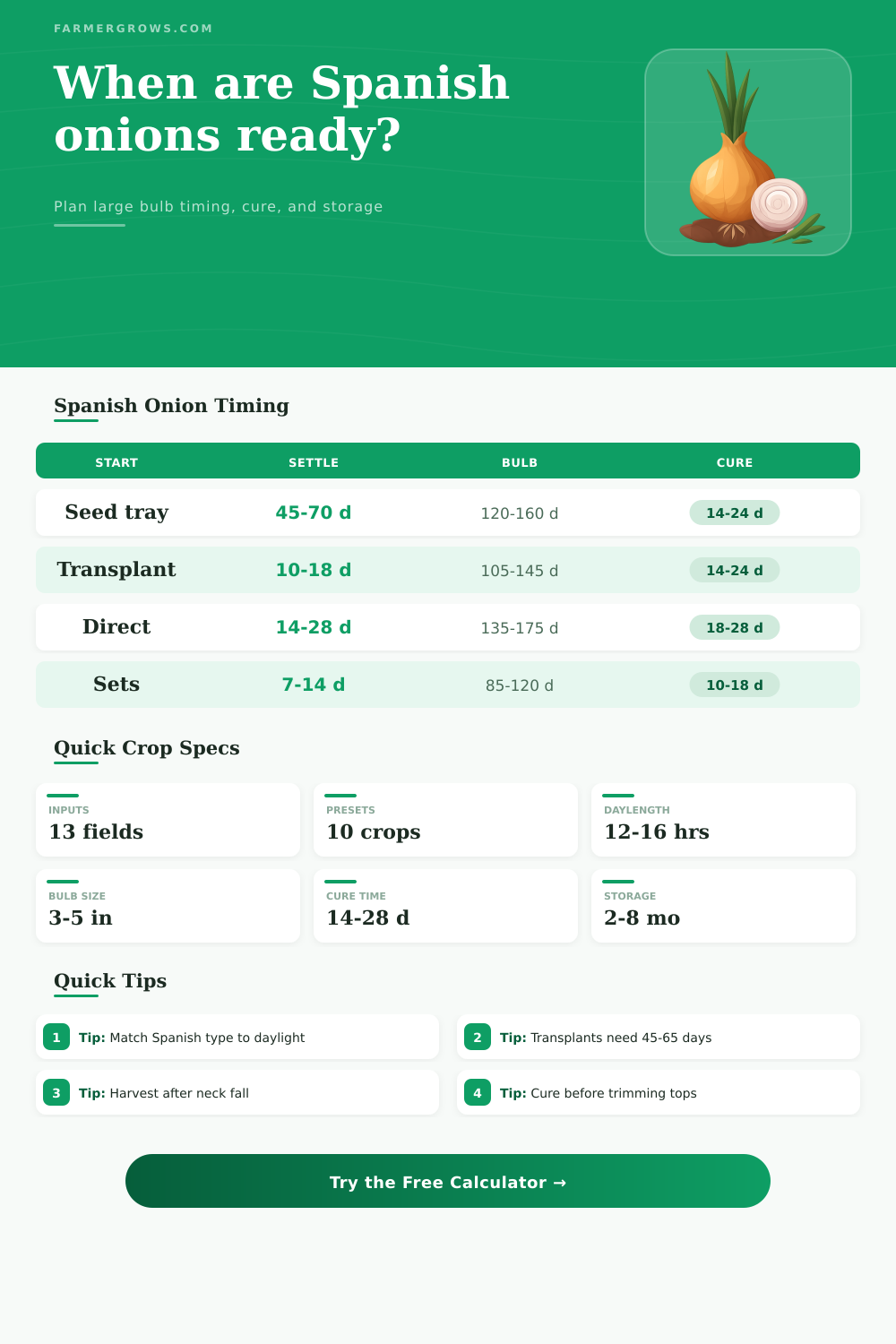
Spanish Onion Growth Timeline
Dates include establishment, daylength-triggered bulb swelling, neck fall, curing, and storage readiness.
| Starting approach | Establishment stage | Typical field days | Spanish onion timing note |
|---|---|---|---|
| Seed-started transplants | 45 to 70 days in trays before setting | 110 to 150 days after field date | Best control for large, uniform Spanish bulbs |
| Bare-root transplants | 10 to 18 days to re-root | 105 to 145 days after setting | Reliable for long-day and intermediate Spanish crops |
| Direct seeded field bed | 14 to 28 days to stand and thin | 135 to 175 days after sowing | Slowest route but avoids transplant shock |
| Spring sets | 7 to 14 days to root | 85 to 120 days after setting | Fast but less ideal for very large storage bulbs |
| Spanish onion class | Bulbing trigger | Named examples | Best use |
|---|---|---|---|
| Intermediate-day Spanish | About 12 to 14 hours | Valencia-type, adapted Spanish hybrids | Middle-latitude large bulbs with moderate storage |
| Long-day sweet Spanish | About 14 to 16 hours | Yellow Sweet Spanish, White Sweet Spanish | Northern large bulbs with mild flavor |
| Long-day storage Spanish | About 14.5 to 16 hours | Utah Yellow Spanish strains | Firm-necked yellow bulbs after full cure |
| Borderline fit | Trigger may arrive too early or too late | Catalog-dependent regional strains | Use variety listing and local trial notes |
| Spanish onion target | Typical spacing | Leaf goal before bulbing | Timing effect |
|---|---|---|---|
| Market large bulbs | 4 to 5 inches | 7 to 9 strong leaves | Baseline harvest estimate |
| Large kitchen Spanish bulbs | 5 inches | 8 to 10 strong leaves | Often adds 3 to 8 days for full size |
| Jumbo Spanish bulbs | 5.5 to 6.5 inches | 10 to 12 strong leaves | Adds 10 to 22 days and needs steady water |
| Firm storage Spanish bulbs | 4 to 5 inches | 8 to 11 strong leaves | Wait longer for full neck fall and skin set |
| Harvest or storage goal | Neck fall cue | Cure focus | Expected keeping |
|---|---|---|---|
| Fresh sweet Spanish | 50% to 65% tops down | 10 to 14 days, gentle shade airflow | 2 to 4 months |
| Large kitchen Spanish | 65% to 80% tops down | 14 to 21 days until necks dry | 3 to 5 months |
| Storage yellow Spanish | 75% to 90% tops down | 18 to 28 days, papery skins before trim | 5 to 8 months |
| Warm or humid storage | Harvest dry, sort heavily | Extra airflow and frequent checks | 1 to 3 months |
Build leaves first: Spanish onions need strong top growth before the daylength trigger. Thin spacing, weeds, and dry soil before bulbing usually mean smaller bulbs.
Cure for storage: Lift after neck fall, cure with airflow, then store only firm bulbs with dry necks and papery skins. Thick-necked bulbs should be used first.
What began as a good idea soon become another story. To have giant, delicious onion to slice into salad, you head out in early spring to buy some sturdy Spanish onion sets or seedlings, or maybe even packet of seed. Sounds easy: Plant those babies; water; wait until summer rolls around; eat onions.
That vision gets interrupted by reality fast. Onions is solar clocks. They measure daylight hours very accurately. This means if you plant a long-day variety where the days aren’t long enough, the onion won’t form bulbs; they will just produce green tops. The math? Once you input your location data and which cultivar you’re sowing, the calculator will do it for you. No more guesswork about whether your summer days is long enough to make bulbs.
How to Grow Onions
Which brings us to the first decision that affects everything: How do you begin the crop? You can start from seed, which gives you complete control over the eventual size of the plant (remember: it forms a good root system right from the beginning). In the field, this can be a long process sometimes not even finished until late summer or early fall.
But during all that time, bulbs really grow. Transplants speed up the growing season by eliminating the time wasted waiting for plants to sprout their first leaves and establish themselves outdoors. Sets bypass the seedling phase completely, so there’s no faster way to harvest than buying sets. Small sets will rarely produce market-size jumbos. Speed versus volume; it’s always a matter of give-and-take.
To have enormous onions, you must sacrifice time in the soil. The secret variable that trips up most gardeners is daylength. Spanish onions is generally intermediate or long-day varieties. These require about fourteen to sixteen daylight hours as their cue to cease leaf growth and begin bulbing belowground. There is no negotiating this biological fact.
When the long days occur too soon during the growing season where you live, the onion hasn’t developed enough leaf mass. So it remains puny. Where the days don’t lengthen enough prior to arrival of fall chills, the plant fails to trigger into bulbing entirely. To prevent ordering a northern type if you’re a southerner (or vice versa), match your onion genetics’ expectations with your actual light cycle at your latitude. The reference tables on the page will break it all down.
Once the bulbs begin to swell, the plant focuses entirely on growth and moisture consistency becomes very important. The green tops is feeding every ounce of their power to pump up the bulb underground. Whatever stresses the plant during this period, whether it’s drought, weed competition, nutrient starvation… Is going to directy impact the size of your onions. Even water means even growth, no big surges and lulls; you want a nice even pace all along.
And spacing also enters the picture: If the plants is too close together, they’re competing for space rather than stretching out to grow. With about four to six inches between them, each onion will stretch to its fullest potential, free from neighbors.
Knowing when to harvest isn’t so much a matter of calendar date as understanding how the plant behaves. If it flops over on its own and the tops fall down, that’s the signal. You’ve got it now. No more energy is flowing from the plant into the bulb. Time to turn off the tap, and let it dry out.
Letting those papery skins complete their sealing (called curing) is not an afterthought. It’s what enables us to store it at all. Generally, two or three weeks with good air circulation would of done the trick. Push too hard and you’ll have moldy onions before winter sets in. Stored well in a dry, cool spot, a properly cured Spanish onion will last for months.
What was once a summer crop becomes a source of wintertime goodness. All that waiting (and watching), is part of the cycle. It is rewarding to have a supply of sweet onions right at home.