Romaine Lettuce Growth Time Calculator
Estimate romaine harvest timing from variety, head size, direct seeding or transplanting, spacing, temperature, heat days, and succession interval.
🌱Named romaine presets
Pick a real romaine scenario, then adjust the weather and spacing to match your bed, field block, or protected row.
⚙Romaine timing inputs
Romaine harvest timing estimate
Calculated from romaine days to maturity, base 40°F growing degree days, head size, plant spacing, transplant age, and heat pressure.
Full romaine timing breakdown
📊Romaine timing anchors
🥬Romaine variety and season comparison
Reliable full heads in cool spring beds; expect about 70 days from seed under mild weather.
Compact heads finish sooner and tolerate closer spacing for quick heart harvests.
Best choice in this calculator when daytime highs push into the upper 70s or low 80s.
Needs room and steady moisture; late cuts can gain size but carry extra heat risk.
Compact cos type suits low tunnels and cool shoulder-season harvest windows.
Red romaine types often look best in cool weather with moderate growth speed.
📋Reference tables
| Romaine variety | Common full-head days | Best season fit | Timing note |
|---|---|---|---|
| Parris Island Cos | 68-72 days | Spring or fall | Classic upright cos; good baseline for full heads. |
| Little Gem | 50-55 days | Spring, fall, protected | Mini romaine hearts finish earlier than large cos heads. |
| Jericho | 58-62 days | Late spring or warm fall | Bred for stronger heat tolerance than many romaines. |
| Coastal Star | 65-70 days | Field rows, spring or fall | Large green romaine, useful for market-size heads. |
| Cimmaron | 62-68 days | Cool color season | Red romaine color is strongest in cooler weather. |
| Winter Density | 52-58 days | Low tunnel or fall | Compact cos habit with good cool-season value. |
| Harvest target | Typical days from seed | Suggested in-row spacing | Use in calculator |
|---|---|---|---|
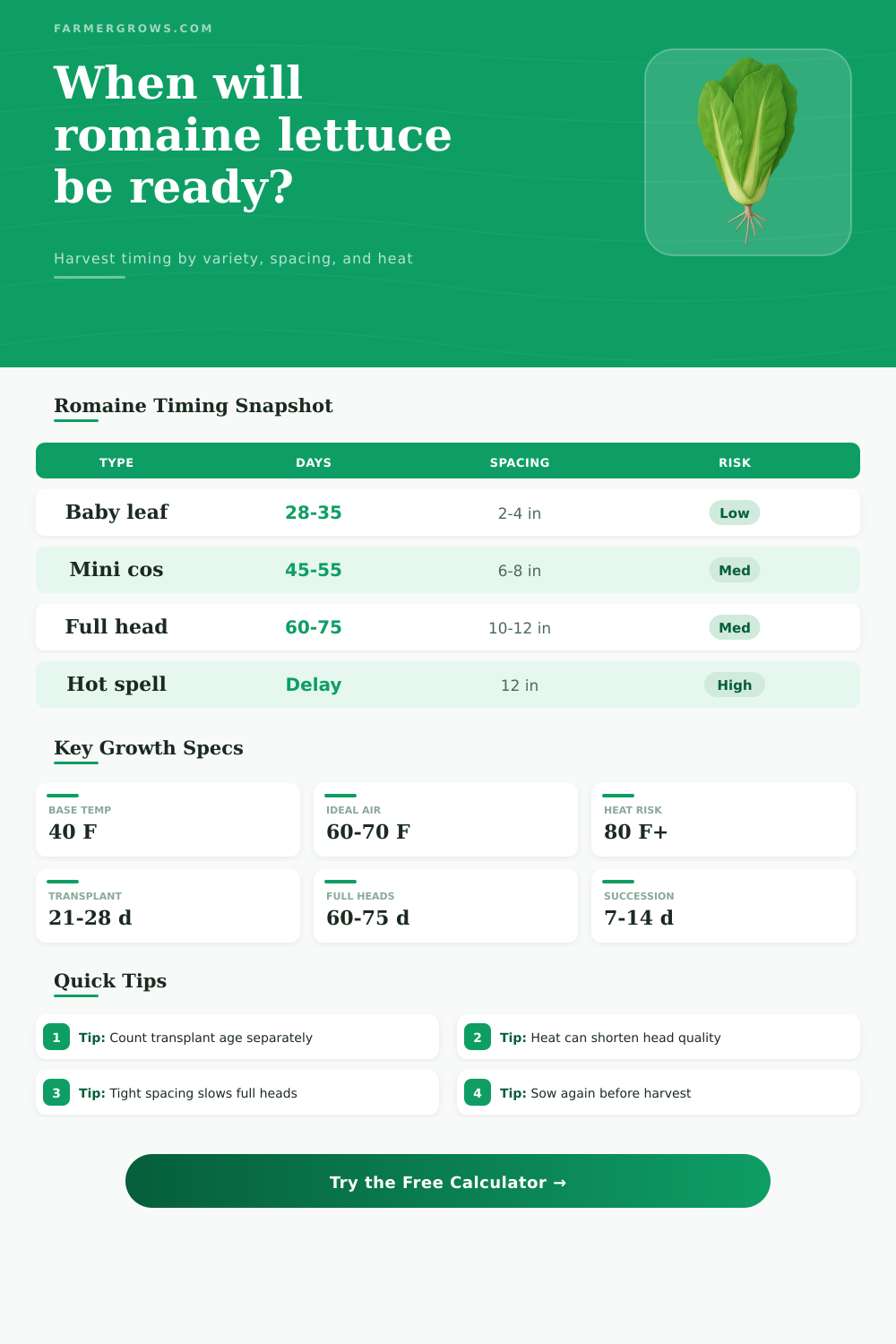
| Baby romaine leaves | 28-35 days | 2-4 in / 5-10 cm | Fast cut, minimal heading time. |
| Mini romaine hearts | 45-55 days | 6-8 in / 15-20 cm | Shorter field time and moderate density. |
| Full romaine heads | 60-75 days | 10-12 in / 25-30 cm | Best for classic upright cos heads. |
| Large dense heads | 70-85 days | 12-14 in / 30-36 cm | Needs cool weather and extra room. |
| Temperature pattern | Approx daily GDD, base 40°F | Romaine response | Planner adjustment |
|---|---|---|---|
| 55/40°F days | 7.5 GDD | Slow but quality is high | Expect longer harvest windows. |
| 65/50°F days | 17.5 GDD | Good cool-season growth | Near standard packet timing. |
| 72/55°F days | 23.5 GDD | Fast sizing if moisture is steady | Watch heads closely near maturity. |
| 82/62°F days | 32 GDD before heat penalty | Fast but bolting risk rises | Harvest smaller or use shade. |
| Start method | Calendar advantage | Best romaine use | Timing caution |
|---|---|---|---|
| Direct seed | No plug age subtraction | Baby leaf, dense rows, fall beds | Add emergence time, especially in cold soil. |
| 21-day transplant | Moves harvest about 10-15 field days earlier | Mini hearts and spring heads | Needs hardening off before cool nights. |
| 28-day transplant | Moves harvest about 15-20 field days earlier | Full heads, market plantings | Older plugs may pause after setting out. |
| Protected transplant | Helps cold starts keep growing | Fall, winter, and early spring | Vent tunnels before warm afternoons. |
💡Romaine timing tips
Transplant tip: Packet days usually count from sowing. This calculator subtracts part of the plug age, then adds a small shock delay so outdoor field days are not overstated.
Heat tip: Romaine can grow quickly in warm weather, but head quality may drop before size peaks. When risk is high, harvest mini hearts or shade the block.
Most gardeners learn the hard way that romaine is a bolt-prone lettuuce, meaning that even though you sow seed hoping for a head of crispy lettuce, by the time summer comes around, they’re more likely to be tough stalks of bitterness than anything else. The trick is knowing what makes all the difference between sweet hearts and woody waste.
It is about timing. It matters less when you plant, and more when those seeds emerge and how warm they stay until harvest. If you know what we call “thermal accumulation,” you’ll have a good idea precisely when your lettuce will be prime. It depends on whether spring arrive early in your area or not.
How to Grow Romaine Lettuce Successfully
Now all you have to do is enter your local weather pattern and variety into the calculator above, which does the rest of math for you. That’s what eliminates any guesswork about how many more days until harvest. Growing degree days based off a base of forty-degree Fahrenheit determine when it’s time for romaine to go. Regardless of calendar days, the plants requires a certain number of warmth units to reach maturity.
Mild days of sixty-five will coax them along. But hot days beyond eighty really speed up metabolism, with consequences in quality nearly right away. By entering those higher temperatures (or expected heat waves), the calculator can adjusts timing accordingly. You’ll know not to wait longer for a head that has entered its reproductive cycle.
The basic decision to grow baby greens or full-size heads also mean managing your beds differently. And picking a different harvest size will guide everything else. Baby leaves take just three or four weeks; sow many seeds across narrow rows and then cut back early when they are small enough (before problems with flavor occurs). A head requires much larger growing space, sometimes as wide as 10 or even 12 inches apart, for its tight core structure to develop without bolting or rotting out. Too crowded and you’ll have a bunch of weak inner leaves competing for light and moisture against a few big outer ones.
The tables on the page spell it all out: For instance, mini hearts compromise on the “big harvest” side but not so much on the “quick turnaround” side. That information help you determine whether to go for one big crop, or plan multiple small crops over time.
Direct-seeding doesn’t provide this extra level of control, but transplanting does. You can start your plugs indoors for a headstart of one, two, or three weeks, depending on your timing. This is important when the full heads may take longer than frost-free days. By doing this, you essentially subtract that period of indoor life from the number of days your transplants will actualy be in the ground.
But don’t forget that transplant shock slows things down for awhile; the calculator accounts for a slight setback between the day the plugs are set out and when the action starts again. Don’t assume they’ll catch right up size-wise, or you would of overestimated their rate of recovery. And remember: Hardening off is required, too; a cold, blustery first outdoor exposure can slow them down even more then such math-based predictions expect.
Genetic selection makes a big difference, varieties differs widely in their heat tolerance. For instance, choosing a heat-tolerant type like Jericho will help it keep its flavor better under stress than some standard spring varieties. Red romaine types is especially nice in cool weather; they may get quite bitter as the temperature rise during their development stage.
The calculator warns you about the risk of bolting. This helps you decide how to handle it: use shade cloth, or just harvest early and small to keep things sweet.
That’s the last part of the equation, what to do so there’s always something coming on: succession planting. With multiple sowings spaced weeks apart rather than a giant heap all at once (which would outstrip any fridge space), there’ll be fresh greens every week, not just every month or two. The tool lets you enter the gap between sowings, which then visually shows where one batch stops and another start. No more empty spots in the garden or overlap between plant. One seamless progression, visualized, and you’ve got yourself a schedule to follow.
A schedule to trust.
A game no longer of chance but of clockwork.
From chaos, lettuce grows.