
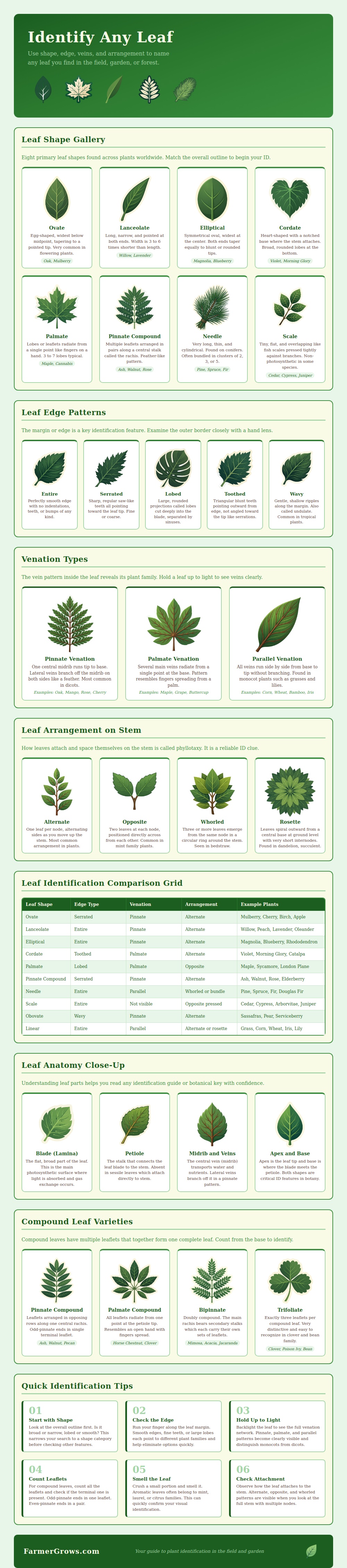
When you see A TREE’s LEAVES, you can’t help but feel that each is familiar-yet-different, so why would you ever be able to name the plant? It turns out that there are clues (patterns in nature) if you know where to look. The infographic below helps you break down those patterns and shows where to focus first based off what you’re holding.
This is shape of the entire leaf. This is perhaps the simplest starting point, since it immediately sets limits to where you’re looking. Many flowering plant have an egg-shaped leaf, meaning widest beneath the midpoint and narrowing toward the tip. Lanceolate, a shape typical of lavender or willows, is long and narrow with both ends tapering to points. Knowing the difference can help you understand how the plant evolved to capture sunlight and reduce wind resistance.
How to Identify Leaves
Then feel it: Feel the edge next with your finger. Most often there’s no clean line. Most leaf edges is more saw-toothed, like a blade with teeth pointing toward the tip, or lobed, where deep indents create round shapes like an oak or maple leaf. The point of this? It provides more surface area for photosynthesis without making the stem too heavy to support. It is not decoration. Tiny detail, but important if you’re ID’ing two very similar-looking thing in thickets.
Now examine that leaf more closely: Hold it up to the light and look into its veins. What you see, its inner pattern, tell you literally what family tree this plant comes from. Monocots (like lilies or grasses) has a special kind of vein pattern called parallel venation, where all the veins run straight from bottom to top without many branches. Dicots (such as cherries and roses) have pinnate venation, meaning they have a main middle vein, the so-called “midrib,” with smaller ones branching out like ribs of a feather. Knowing this can help you distinguish between broadleaf trees and wildflowers before you even crack open your field guide.
Look closely at how leaves are attached to the stem (called phyllotaxy). You might not notice this detail, but it’s a strong confirmation clue. The most common natural arrangement is called alternate, where there’s just one leaf per node on the stem and they switch positions side-to-side going upward on the branch. Opposite means there are two leaves positioned right across from each other at exactly the same point on the stem (common in mint-family plants). And whorl-leaf plants has rings of three or more leaves coming off the stem in some striking symmetry, difficult to miss if you’re familiar with what you’re looking at.
When it comes to leaves with compound parts, counting leaflets: To start, each of the smaller leaflets on a leaf like this is called a what? You’re right: The key to identifying these plants correctly is to count how many leaflets there are, and understand their arrangement. This is a pinnate (feathery) compound leaf, meaning there is a main stalk and several leaflets on either side of it. A palmate (hand-shaped) compound leaf would have the leaflets radiating out from one point, almost like fingers of an opened-up hand. Think of a clover leaf or horse chestnut. Then there is bipinnate (double-feathered). In this type, the main stem has secondary stems coming off it. These secondary stems also has leaflets, resulting in a fine-textured foliage like that of many acacias. Counting leaflets and understanding their arrangement is essential to knowing just what kind of plant we’re dealing with. Leaflet confusion, a rookie mistake, is also one way to get misled into thinking the leaf itself is something differnt.
Surprisingly, smell and touch also come into play. Rub a bit of a fragrant plant between your fingers and you’ll know at once whether it’s a member of the citrus family, say, or of the mints. That’s no coincidence: Scent glands are concentrated in certain tissues that reflect the plant group the plant is in. Add that smell test to what you see, and suddenly identifying things doesn’t seem like a rote exercise but intuitive. You should of tried it.
Once you master this, what was once a baffling mess of green becomes a code that is easy to read. Rather than having to memorize all species, we now have an understanding of the parts from which they are built. Go out and look again the next time you’re out there, see how each leaf is arranged, follow its veins, and note its shape. One leaf at a time, the forest will begin to speak your language.