
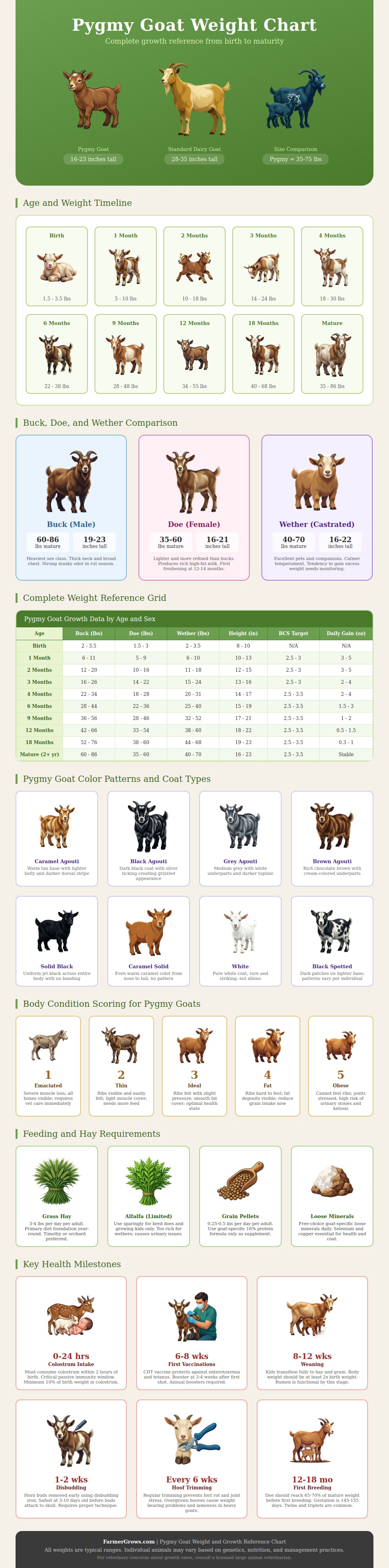
Tracking the growth rate of your pygmy goat will give you some useful advice as a pet owner, and it’s something you should of do anyway. Depending on lineage, food, and gender, different goats can end up different adult sizes. Knowing what to expect in terms of weight will tell you if one of your kids are doing well or not. It also saves you some guesswork about when to bring your animal into vet, feed them more hay, etc. The chart lays out all of that in an easy-to-understand way.
Pygmy goats were originally developed in West Africa for meat and dairy. They was small enough to fit into villages and were very efficient. That made them efficient when they came to the U.S. They also became pets. Now the result is that pygmy goats pack on pounds easily if allowed excess rich forage. They also go out-of-condition rapidly if sick or in drought conditions. So not only are those pounds of data on the scale something to know, it’s an early warning system.
Why You Should Track Your Pygmy Goat’s Weight
Early years set the direction for good or bad health later in life. Within two hours of being born, a baby must be fed colostrum to build the immunity it needs to survive the stressful period before its own immune system matures. After two hours, the window is shut and it will take longer to gain at a slower pace each day. Any lost ground can be hard to make back. At a month old, they have started eating hay and grain, too, and you’ll see the chart where their weight has taken off. If they miss that step, they’ll typically end up skinnier yearling that never catches up with other goats.
As animals move closer to breeding age, you start to see sex differences. Bucks has added muscle to their shoulders and necks; it’s not fat, just extra weight. Once does give birth, their body stays light while they produce milk; that’s where their energy goes. Between those two groups is the wether, who will tend to be between the two extremes, but will probably also be overweight since he doesn’t have the hormonal urge to keep him trim and his owner tends to treat him like a lawn ornament. The table has a column for each of those classes, so you can identify if your wether is outside the healthy limits.
Weight is relative More important than absolute body weight are body condition scores. While your goat might weigh a perfectly normal amount on the scale, it may be harboring extra abdominal fat (around the heart and kidneys). You can check your goats’ body condition by running your hands down their side, feeling for ribs, and following up the back with your fingers against the spine. Your goat’s body condition should fall within the middle of the pack, typically ranging from 2.5, 3.5 on this simple 1-to-5 scale. If it’s higher than 4, you’ll want to give your goat some extra exercise and cut back on grain intake in order to avoid causing joint strain or urinary calculi.
The diet is based off good grass hay all year. It provides rumen-friendly fiber. If deficiencies show up as poor hoof quality or a dull coat, you can supplement the missing ingredients with loose minerals. Feeding alfalfa, though helpful in small amounts for growing kids or pregnant does, will get you into trouble if offered free choice to wethers. The chart doesn’t specify how many pounds of feed per day, but it does tell you something about the pattern: Kids grow rapidly in the beginning, then slow down at nine months and beyond, telling you when to reduce rich supplements.
According to the data, growth in pygmy goats is slow. Lots of people think a goat’s a year old when she’s done growing, when according to the graph, she’ll continue to fill out until 18 months or longer. Slow finishing helps explain why you want your doe to get up to about two-thirds of her adult size before breeding her for the first time. Breeding too early results not only in small (and therefore more difficult to raise) offspring but also a stunted momma.
So do those other seemingly mundane tasks like regular hoof trimming and vaccinating kids in time so they aren’t suddenly sick and dead within 24 hours. Overgrown hooves throw off how their weight is distributed and show up on the scale as slow gain and unwillingness to move. The six- to eight-week CDT vaccine prevents the sudden bellyaches that can wipe out an otherwise healthy kid overnight. Seems insignificant until you see it protecting that consistent rise the chart is recording.
The numbers are simply a conversation starter between you and the animal. If the goat matches the chart predictions then you know that you’re doing something right regarding their diet and care. If it doesn’t match, then the chart will point you in the direction of your next question rather than having you wondering “What is normal?”