How Much Herbicide per Gallon of Water Calculator
Estimate fluid ounces per gallon, total tank concentrate, water displacement, surfactant, active ingredient concentration, and spot-spray coverage from a percent mix or a label rate.
Strict label and safety caveat: This calculator is only arithmetic. The pesticide label, local law, crop/site restrictions, maximum seasonal rate, PPE, reentry interval, grazing interval, weather limits, water setbacks, and tank-mix order always control. Do not use any mix that conflicts with the label.
| Target solution | Herbicide per gallon | Metric equivalent | Tablespoons per gallon | 4 gal backpack total |
|---|---|---|---|---|
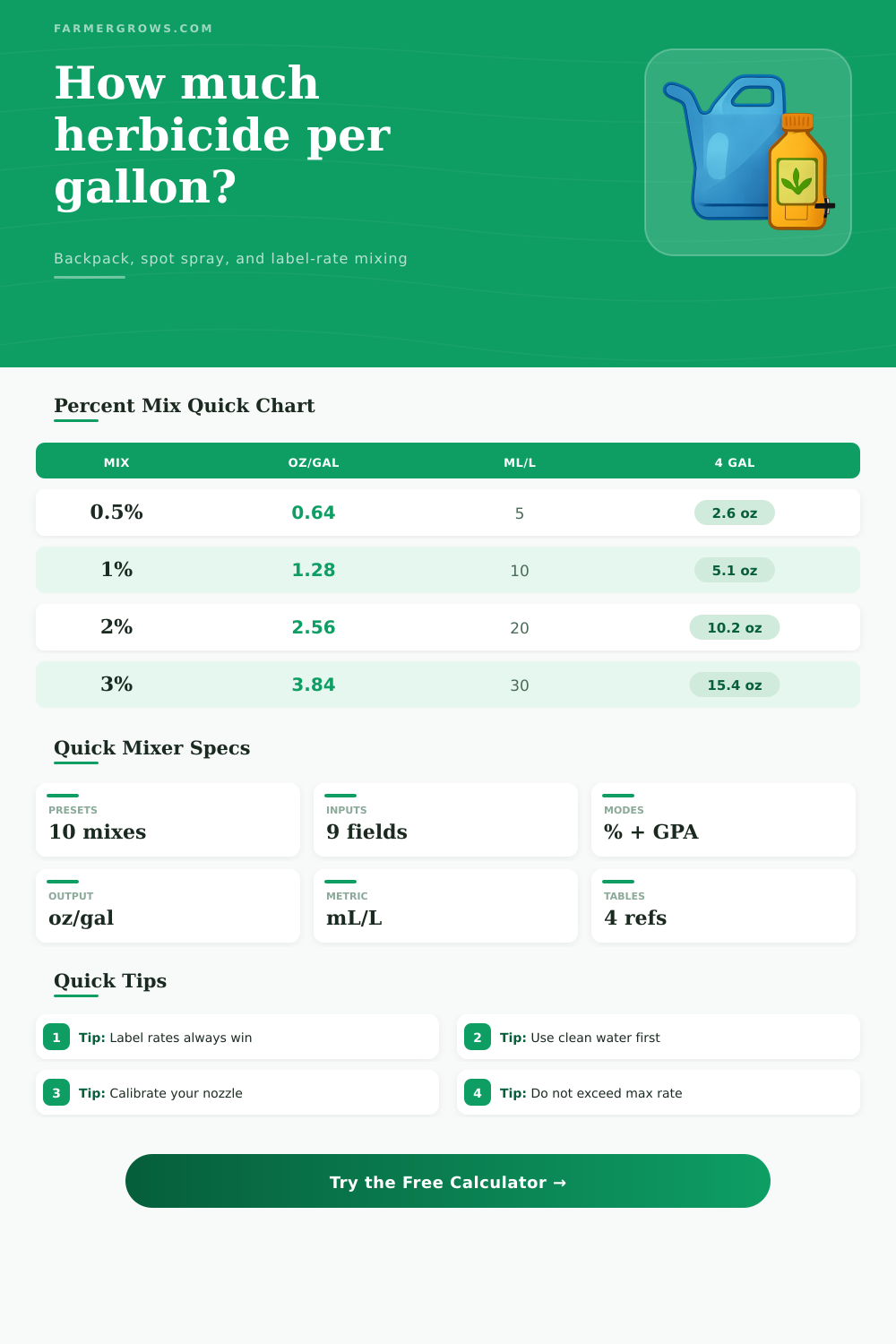
| 0.25% product solution | 0.32 fl oz/gal | 2.5 mL/L | 0.64 tbsp | 1.28 fl oz |
| 0.5% product solution | 0.64 fl oz/gal | 5 mL/L | 1.28 tbsp | 2.56 fl oz |
| 0.75% product solution | 0.96 fl oz/gal | 7.5 mL/L | 1.92 tbsp | 3.84 fl oz |
| 1% product solution | 1.28 fl oz/gal | 10 mL/L | 2.56 tbsp | 5.12 fl oz |
| 1.5% product solution | 1.92 fl oz/gal | 15 mL/L | 3.84 tbsp | 7.68 fl oz |
| 2% product solution | 2.56 fl oz/gal | 20 mL/L | 5.12 tbsp | 10.24 fl oz |
| 2.5% product solution | 3.20 fl oz/gal | 25 mL/L | 6.40 tbsp | 12.80 fl oz |
| 3% product solution | 3.84 fl oz/gal | 30 mL/L | 7.68 tbsp | 15.36 fl oz |
| 5% product solution | 6.40 fl oz/gal | 50 mL/L | 12.80 tbsp | 25.60 fl oz |
| 10% product solution | 12.80 fl oz/gal | 100 mL/L | 25.60 tbsp | 51.20 fl oz |
| Tank capacity | Total at 1% | Total at 2% | Total at 3% | Clean water before concentrate |
|---|---|---|---|---|
| 1 gal hand sprayer | 1.28 fl oz | 2.56 fl oz | 3.84 fl oz | Start with about half tank water |
| 2 gal pump sprayer | 2.56 fl oz | 5.12 fl oz | 7.68 fl oz | Agitate after concentrate goes in |
| 3 gal backpack | 3.84 fl oz | 7.68 fl oz | 11.52 fl oz | Top to final 3 gal mark |
| 4 gal backpack | 5.12 fl oz | 10.24 fl oz | 15.36 fl oz | Do not add 4 gal water first |
| 5 gal backpack | 6.40 fl oz | 12.80 fl oz | 19.20 fl oz | Leave room for adjuvant volume |
| 15 gal spot tank | 19.20 fl oz | 38.40 fl oz | 57.60 fl oz | Use measured tank markings |
| 25 gal ATV tank | 32.00 fl oz | 64.00 fl oz | 96.00 fl oz | Recirculate or agitate if labeled |
| Final spray volume | Coverage at 15 GPA | Coverage at 20 GPA | Coverage at 30 GPA | Coverage at 40 GPA |
|---|---|---|---|---|
| 1 gal | 2,904 ft² | 2,178 ft² | 1,452 ft² | 1,089 ft² |
| 2 gal | 5,808 ft² | 4,356 ft² | 2,904 ft² | 2,178 ft² |
| 3 gal | 8,712 ft² | 6,534 ft² | 4,356 ft² | 3,267 ft² |
| 4 gal | 11,616 ft² | 8,712 ft² | 5,808 ft² | 4,356 ft² |
| 5 gal | 14,520 ft² | 10,890 ft² | 7,260 ft² | 5,445 ft² |
| 15 gal | 43,560 ft² | 32,670 ft² | 21,780 ft² | 16,335 ft² |
| 25 gal | 72,600 ft² | 54,450 ft² | 36,300 ft² | 27,225 ft² |
| Surfactant rate | Per gallon | Metric equivalent | 4 gal backpack | Use note |
|---|---|---|---|---|
| 0.125% v/v | 0.16 fl oz/gal | 1.25 mL/L | 0.64 fl oz | Very low adjuvant rate if label allows |
| 0.25% v/v | 0.32 fl oz/gal | 2.5 mL/L | 1.28 fl oz | Common nonionic surfactant starting point |
| 0.5% v/v | 0.64 fl oz/gal | 5 mL/L | 2.56 fl oz | Higher adjuvant rate for tougher wetting needs |
| 1% v/v | 1.28 fl oz/gal | 10 mL/L | 5.12 fl oz | Strong adjuvant load; confirm crop and label safety |
Per-gallon math: For percent solutions, 1% equals 1.28 fl oz of product per final gallon because one gallon contains 128 fl oz. Multiply the percent by 1.28.
Label-rate math: For acre rates, divide fl oz per acre by calibrated GPA. A 32 fl oz/ac label rate at 20 GPA equals 1.6 fl oz per gallon.
Getting the correct dose of herbicide in each gallon of sprayed-on water sounds easy enough, yet how do you measure that if a label calls for ounces per acre, or says to use 1 ounce of active ingredient per gallon of spray? Or maybe it’s listed as a percent by volume? Turns out that’s where many people go wrong: trying to apply what the label calls for in the tank.
What’s the problem with that? Well, different rates delivers different results, which I will explain below. They also has a different potential for damage to things you don’t want killed. A low concentration, like a half-percent solution, might be good for killing young annual weeds, but will do nothing on woody brush plant.
How to Mix Herbicides Correctly
Once you select one rate type or another from the options, the calculator does all the math for you. Don’t throw away the label; just ditch the arithmetic and concentrate on whether or not your number make sense for the job.
Another practical variable is tank size. A four gallon backpack seems doable… Until you run out of water mid-tank and need to refill several times. You can plug in finished mix volume, and the calculator will show you how much concentrate that actualy requires. This figure can then be used as a comparison to max-seasonal dose listed on label. When your calculations reaches close to the annual limit by only a couple refills, you know it’s time to step up to a higher-volume carrier, or back off down to dilute solution.
The other puzzle is surfactant rate (most folks simply go with the quarter-percent each time, but labels will ask for a bit more on waxy leaves or less on tender growth). The tool treats it as its own input. You will see how much extra liquid that adds to the tank and then the water volume will adjust too match. As you watch those two numbers jostle back and forth, it becomes clear what happens when you over-dose your adjuvants: You end up short on your total spray volume.
Same idea goes for coverage estimates and then the square feet per tank that’s shown once you enter gallons per acre. Now you know if you’ll run out of mix before completing your task or if you’re about to under-apply. It also warns you if the gallons per acre you’ve selected are too small to actualy be used on a backpack sprayer; very low carrier volumes is difficult to achieve with hand-held equipment.
I included the reference tables on the page in case you find yourself wanting to double check one of more commonly used percent solutions without running through the entire calculator. It’s just a table listing how many fluid ounces per gallon are used most often, and then you’d look at it to make sure that your math seemed correct before proceeding.
The real discipline part comes in recalling that nothing replaces checking the label for what the law says, the weather, or the growth stage of the plant. The calculator takes away guessing so that we can pay attention to those bigger variables instead.
You should of checked the label first.