Manure Calculator
Estimate manure production, compost or storage losses, first-year nutrient credits, and practical application rates for livestock pens, gardens, hay fields, and crop ground.
Use this planning calculator with book values for common manure types. Manure analysis, soil test results, crop need, setback rules, weather, slope, and local nutrient management requirements should guide final spreading decisions.
Manure and Nutrient Estimate
Results use book-value manure analysis, storage loss factors, first-year availability, and the rate limits you entered.
| Manure source | Typical output | Bulk density | Moisture | Best calculator use |
|---|---|---|---|---|
| Lactating dairy cow | 150 lb/head/day | 1,600 lb/cu yd | 85% to 88% | Short-term barn collection, scrape lots, slurry packs |
| Beef feedlot animal | 60 to 70 lb/head/day | 1,300 to 1,500 lb/cu yd | 65% to 75% | Open lot scrape manure and winter feeding areas |
| Horse stall with bedding | 45 to 55 lb/head/day | 800 to 1,000 lb/cu yd | 55% to 65% | Bedded stall manure and compost piles |
| Finishing swine slurry | 12 to 15 lb/head/day | About 8.4 lb/gal | 90%+ liquid | Pit or tank inventory converted to tons and gallons |
| Layer hen manure | 0.20 to 0.30 lb/bird/day | 1,100 to 1,300 lb/cu yd | 45% to 60% | Coops, high-nutrient garden amendments, covered piles |
| Broiler litter | 0.15 to 0.25 lb/bird/day | 900 to 1,100 lb/cu yd | 20% to 35% | Poultry house cleanouts and dry litter spreading |
| Manure or compost | Total N | P2O5 | K2O | First-year N availability |
|---|---|---|---|---|
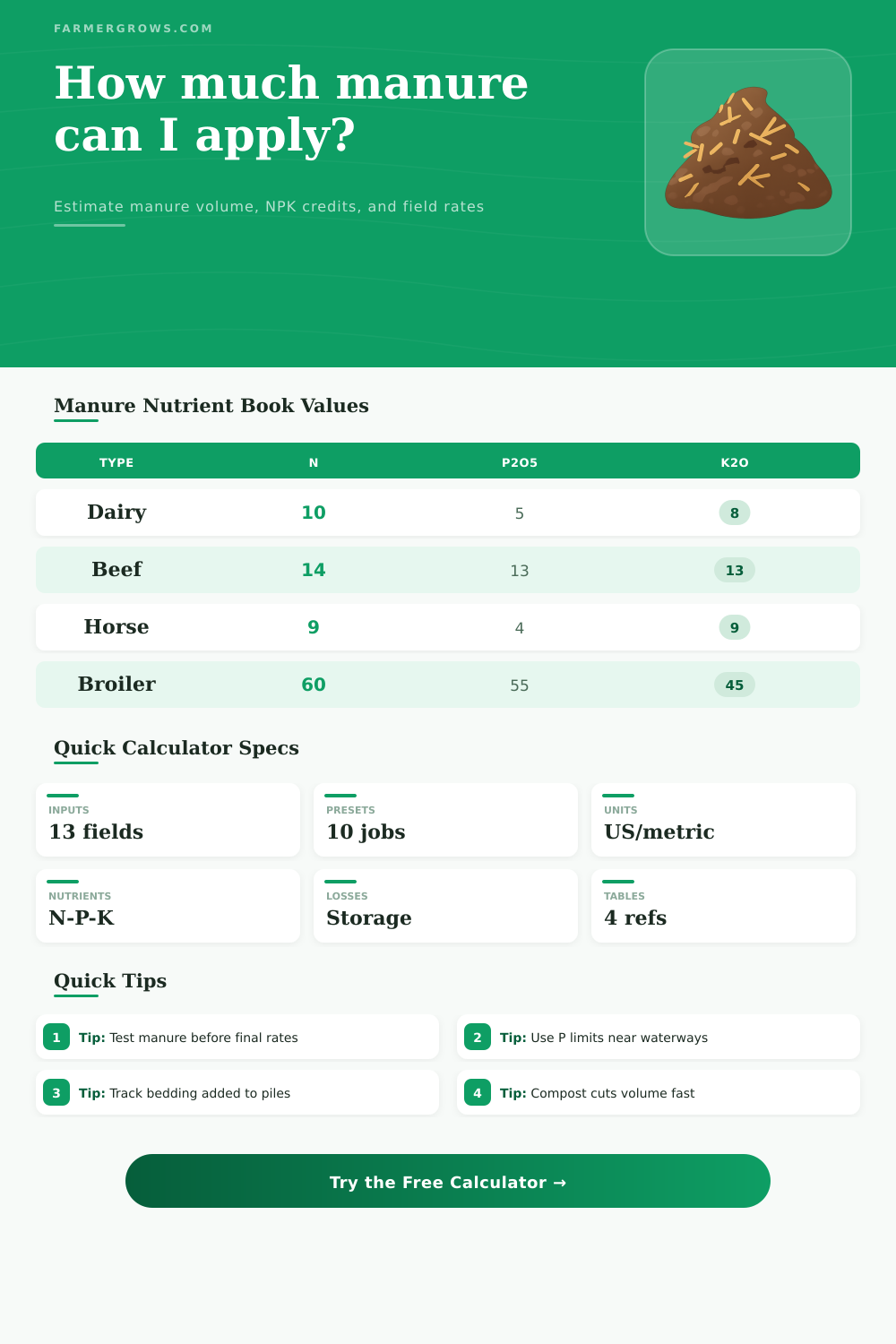
| Dairy cow manure, as applied | 10 lb/ton | 5 lb/ton | 8 lb/ton | 30% to 40% |
| Beef feedlot manure | 14 lb/ton | 13 lb/ton | 13 lb/ton | 25% to 35% |
| Horse manure with bedding | 9 lb/ton | 4 lb/ton | 9 lb/ton | 20% to 30% |
| Swine finisher slurry equivalent | 12 lb/ton | 6 lb/ton | 7 lb/ton | 45% to 55% |
| Layer hen manure | 30 lb/ton | 25 lb/ton | 18 lb/ton | 45% to 55% |
| Broiler litter | 60 lb/ton | 55 lb/ton | 45 lb/ton | 45% to 60% |
| Finished cattle compost | 20 lb/ton | 12 lb/ton | 16 lb/ton | 10% to 20% |
| Handling method | Mass retained | N retained | Expected volume change | Planning note |
|---|---|---|---|---|
| Fresh, spread soon | 100% | 85% | Little shrink | Fast use preserves more ammonium N |
| Covered stack or roof | 92% | 80% | Small shrink | Limits rain dilution and runoff risk |
| Open stockpile | 80% | 65% | Moderate shrink | More ammonia loss and leaching potential |
| Turned compost windrow | 55% | 55% | Often half volume | Stabilizes material but loses more N |
| Deep-bedded pack | 115% | 72% | More bulk from bedding | Good organic matter, lower nutrient density |
| Liquid or slurry storage | 98% | 75% | Little mass loss | Agitation and uniform sampling matter |
| Use case | Typical rate range | N concern | P concern | Soil amendment guidance |
|---|---|---|---|---|
| Vegetable garden compost | 0.25 to 1 inch layer | Avoid fresh high-N manure near harvest | Repeated compost can build P | Blend into top 4 to 6 inches when appropriate |
| Hay or pasture | 5 to 15 tons/ac solid | Match available N to yield goal | Watch P on long-term manure fields | Spread evenly to avoid smothering regrowth |
| Corn or silage ground | 10 to 25 tons/ac solid | Credit first-year and residual N | May become P-limited before N need | Incorporate when possible to conserve N |
| Poultry litter on crop land | 1 to 4 tons/ac | High available N per ton | P2O5 often sets the cap | Calibrate spreader for low-tonnage rates |
| Tree fruit or berries | 2 to 8 tons/ac compost | Use mature compost to reduce burn risk | Track long-term soil P | Keep material off stems and crowns |
Sampling tip: Book values are useful for planning, but actual manure can shift a lot with feed, bedding, rain, storage time, and scraping method. A lab analysis is the better number before final application.
Application tip: When both nitrogen and phosphorus limits are entered, use the lower resulting tons per acre. That keeps the plan conservative when manure is nutrient dense.
Plugging in: Manure looks easy until you want to figure it out. Knowing how much of it you have (or think you’ll have) is one thing. Making it work in a field is another matter entirely. It involve everything from the volume and the nutrient loss rate to weight of bedding and available post-storage nitrogen. The calculator takes care of the arithmetic if you input variables; no guessing necessary, no conversions or coefficients.
Those are the first inputs: what was collected from whom, at what time. That’s important because a layer hen produces different material than a dairy cow, and they both produce differently on any given day. Multiply that by number of days by the percent collected, and it becomes significant. Use the bedding percentage to show that pile has increased in size but not in nitrogen, which means its nutrient density per ton decrease. Alternatively, you might know how many tons there is rather than how many animal contributed, and you can skip ahead to the known tons field.
How to Use the Manure Calculator
The next topic are storage options. These affect available nitrogen, and also its mass. A covered stack will retain more ammonia then an open stockpile. Turned compost will retain even less because it breaks down faster when aerated frequentely. The timing selector changes first-year availability even more. Since surface application retains less nitrogen than incorporation do, the calculator reduces its credit accordingly.
So then it’s a question of planning goals: How many total nutrients? Then how to spread them out? Nitrogen-rich plans push the rate until it reaches enough pounds per acre. Manures with plenty of P2O5 pulls the rate back to no more P than is safe for field. If your goal is organic matter, favor lower rates spread over more acres; if it’s an inventory, divide amount you’ve got by number of acres to cover. The calculator shows the tighter of those two limits so you don’t mess up by chasing one nutrient while exceeding its tight cousin.
However, in reality on a farm, things is never quite so black-and-white as the tool will assess based off the book values. The actual analysis also depend on factors like feed, rain, and how often you clean out the manure. This is why reference tables are starting points, not final answers. Usually there’s a quick lab test that tells if your material goes over/under average of those references.
Similarly, if you are trading or buying manure, use the same logic: Broiler litter might appear pricey by the ton until you consider what it will do with a positive nitrogen credit compared to cost of commercial fertilizer. Horse manure (the bedded type) might seem inexpensive, but a lot of what it weigh is shavings, which tie up the available nitrogen over time. Run both possibilities through the calculator before the truck pulls in.
And then there’s what no tool can calculate: the final step. You must consider weather windows, slope, setbacks from water, and local rules. All beyond the calculation of anything. Now that we know how fast we can safely spread… Now it comes down to you. Is it a good day? Will the crew have time to get manure applied ahead of rain? Those are judgments that farmer who makes them will always keep to himself.