Pipe Bedding Calculator
Estimate trench width, bedding below the pipe, haunching, sidefill, initial cover, aggregate volume, and delivered tons for farm drainage, utility, and culvert trenches.
Use this estimator for planning quantities. Final bedding depth, aggregate gradation, cover, and trench width should follow the project drawings, pipe maker instructions, and local authority details.
Pipe Bedding Results
Calculated from trench width times bedding zone depth, minus pipe displacement where the pipe occupies the embedment zone.
| Pipe outside diameter | Side clearance often used | Stable-wall minimum width | Metric width | Field note |
|---|---|---|---|---|
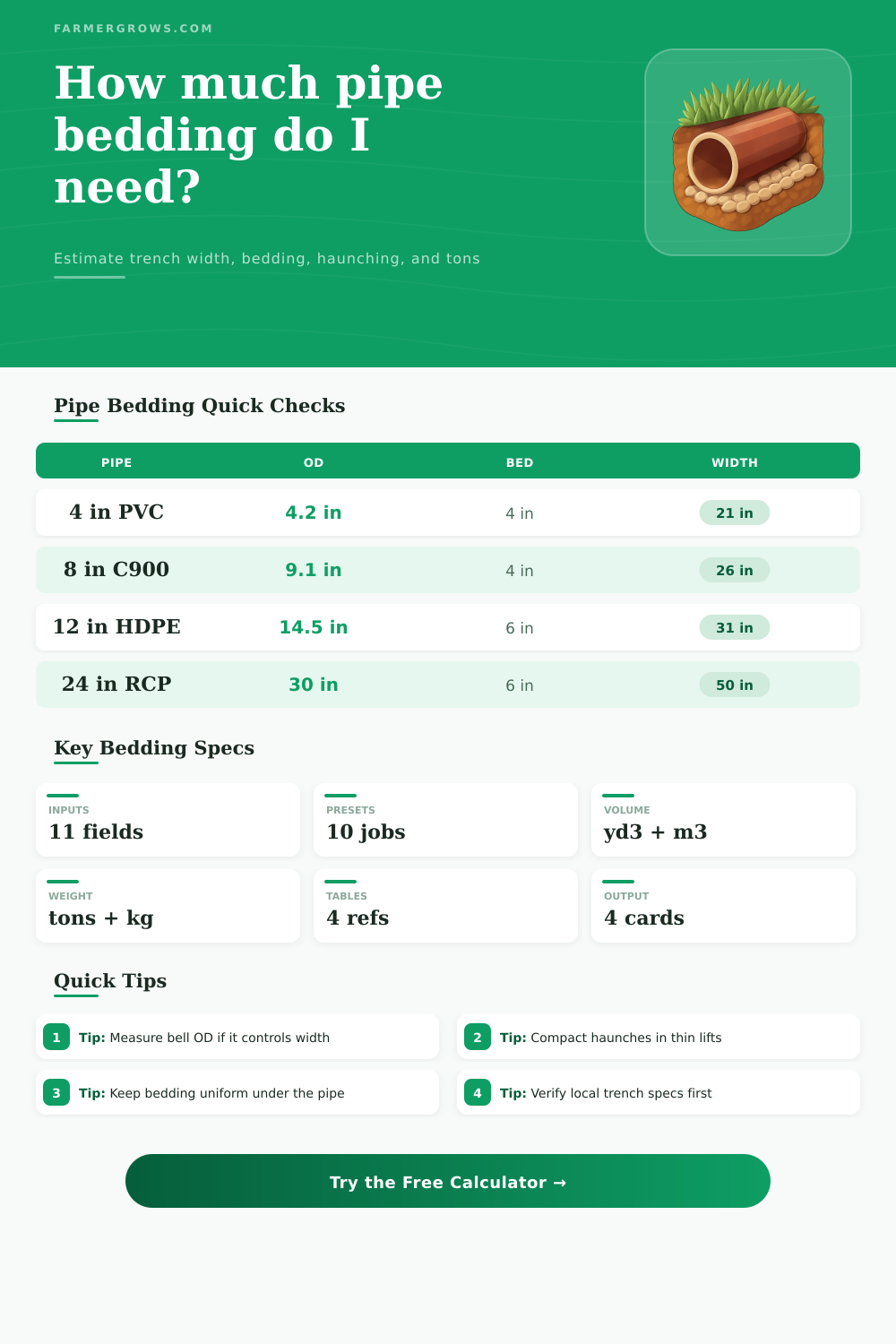
| 4.2 in PVC sewer | 6 in each side | 21 in | 53 cm | Small laterals are often governed by bucket width and bell clearance. |
| 6.3 in PVC sewer | 6 in each side | 23 in | 58 cm | Stable-wall rule uses the larger of OD + 16 in or 1.25 x OD + 12 in. |
| 12.5 in PVC sewer | 8 in each side | 29 in | 74 cm | Leave room for haunch tools on both sides of the pipe. |
| 18 in pipe barrel | 8 to 12 in each side | 35 in | 89 cm | Wider trenches may be needed for man entry or shield use. |
| 24 in pipe barrel | 12 in each side | 42 in | 107 cm | Check trench box width against required embedment placement. |
| 36 in pipe barrel | 12 in each side | 57 in | 145 cm | Large pipe needs enough side room for lift placement and compaction. |
| Condition | Bedding below pipe | Haunching target | Initial cover | Placement note |
|---|---|---|---|---|
| Small PVC or HDPE in firm soil | 4 in minimum | Compact to springline | 6 to 12 in above crown | Shape bedding uniformly so the barrel is supported, not just the bells. |
| Pipe 24 in and larger | 6 in typical | Work both haunches evenly | 12 in above crown | Place lifts thin enough for the tool to reach the lower quadrant. |
| Rock trench bottom | 6 to 8 in cushion | No hard points under pipe | 12 in above crown | Remove protruding rock and maintain a continuous bedding layer. |
| Wet or unstable bottom | 8 in or engineered foundation | Use free-draining embedment | Project detail controls | Geotextile may be needed to keep fines from pumping into stone. |
| Concrete or rigid pipe | 4 to 6 in granular bed | Support lower third | 12 in above crown | Do not leave voids below haunches or under bell recesses. |
| Material | Typical density | Metric density | Loose allowance | Common bedding use |
|---|---|---|---|---|
| Washed bedding sand | 2,700 lb/yd³ | 1,602 kg/m³ | 10% to 15% | Small pipe bedding where clean sand is permitted. |
| Pea gravel | 2,800 lb/yd³ | 1,661 kg/m³ | 5% to 10% | Self-consolidating bedding around smaller utilities. |
| No. 57 crushed stone | 2,850 lb/yd³ | 1,691 kg/m³ | 5% to 10% | Drainage pipe and culverts where angular stone is allowed. |
| Dense graded base | 3,300 lb/yd³ | 1,958 kg/m³ | 15% to 20% | Strong compacted support when fines are not restricted. |
| Flowable fill | 3,500 lb/yd³ | 2,077 kg/m³ | 0% to 3% | Utility conflict zones, abandoned trenches, and hard-to-compact spaces. |
| Nominal size | PVC SDR35 sewer OD | C900 PVC water OD | HDPE dual-wall typical OD | RCP typical OD |
|---|---|---|---|---|
| 4 in | 4.215 in | 4.800 in | 4.8 in | Not common |
| 6 in | 6.275 in | 6.900 in | 6.9 in | Not common |
| 8 in | 8.400 in | 9.050 in | 9.3 in | Not common |
| 10 in | 10.500 in | 11.100 in | 11.4 in | Not common |
| 12 in | 12.500 in | 13.200 in | 14.5 in | 16 in |
| 15 in | 15.300 in | Not standard | 18.0 in | 19 in |
| 18 in | 18.701 in | Not standard | 22.0 in | 23 in |
| 24 in | 24.803 in | Not standard | 28.0 in | 30 in |
| 30 in | 30.984 in | 32.000 in | 36.0 in | 38 in |
| 36 in | 37.083 in | 38.300 in | 42.0 in | 45 in |
Haunches matter most: The lower side zones carry much of a flexible pipe's support. Place material evenly on both sides and work it under the springline before covering the crown.
Width can change fast: Trench boxes, bells, fittings, dewatering stone, and inspection access can exceed the calculated minimum. Measure the controlling width before ordering bedding.
While the decision of how to bed a pipe is often made in the field by looking at the trench and making an estimate of how much stone will be required for the job, making an estimate of the amount of stone required can result in a person ordering too little stone or a person ordering too much stone. If a person orders too little stone, the stone delivery will be short of what is required to complete the job. If a person orders too much stone, however, the crew will have to spread the stone into the trench in which it is to be installed.
A persons understanding of the embedment zones of the pipe prior to starting the job determines these two options. Bedding is the zone of the pipe located directly under the pipe barrel, and helps to even the invert of the pipe. If the bedding is too shallow, the pipe may rock or settle unevenly within the trench.
How to Estimate Stone for Pipe Bedding
If the bedding is too deep, however, then a person is paying for stone that dont provide any additional utility to the installation once the haunches are filled with stone. The stone calculator allows for a person to adjust the depth of bedding, as well as measure the side clearance that will be established on each side of the pipe. Haunching is the zone of the pipe that is worked into the lower quadrants of the pipe, and which carries a significant amount of load of the pipe.
On flexible pipe, the haunching resists deflection of the pipe. On rigid pipe, the haunching prevents point loading of the pipe at the invert. The calculator accounts for this by subtracting the displacement of the pipe from the area of the trench multiplied by the length of the pipe, and then adding back the amount of stone that will fill the haunches.
The calculator uses this calculation to prevent the error that can occur if a person order enough stone to fill the entire rectangular area of the trench. The width of the trench in which the pipe will be installed is not always a set measurement. The width of the trench can vary according to the rules that will be used in the installation of the pipe.
For instance, one set of rules may state that the width of the trench should be the outside diameter of the pipe plus sixteen inches, while other rules may state that the width of the trench should be the outside diameter of the pipe multiplied by 1.25, plus twelve inches. Other rules may require only a minimum amount of side clearance of the pipe. Each of these different methods can be selected in the stone calculator, so that the width of the trench used in calculating the volume of stone required will match the rule that the inspector will enforce.
Using different methods to calculate trench width will impact the amount of stone that is calculated for the job, which often surprises those who is familiar with the calculator. Another factor to consider is the type of stone that will be used in bedding the pipe. For example, rounded pea gravel tends to flow into tight spaces, but can migrate within the trench if the soil within the trench is loose.
Angular crushed stone tends to lock into the trench better than rounded pea gravel, but requires more effort to compact the stone to a specific density. Both types of stone have specific densities associated with them, which is entered into the calculator. In addition, the calculator also allows for the individual that is using the calculator to enter a loose-to-compacted factor of the stone.
By utilizing each of these factors within the calculator, the tonnage of stone that is displayed for the job is the tonnage of stone that the supplier of the stone will deliver. While many of the calculations and factors are accounted for in the calculator, the actual jobs that are performed often do not match the specifications of the calculator. For instance, the areas where pipes are joined (bell joints) may take up some of the space within the trench.
The space that is used by dewatering stone and trench boxes also may reduce the amount of space for the bedding of the pipe. It is always more cost-effective (and less labor intensive) for a crew to take a quick measurement of the width of the area that will be cleared for the installation of the pipe, then order that amount of stone, than to rely solely upon the stone calculator. The calculator provides a starting point for those who must install pipe, and allows those who is installing the pipe to make the adjustments to that starting point.
The goal of all of this is to make sure that the crews has the correct amount of stone at the end of the day. It is desired that there be the right amount of stone left on the truck, and that there be no stone left over that must be moved by hand. Entering the outside diameter of the pipe, the length of the pipe that is to be installed, and the zone that is to be filled in advance of calling for the delivery of the stone can best ensure both of these outcomes.
You should of used the calculator to help with teh estimation of the stone needed for the job. Its important to remember that the stone quantity can be alot different than what you think based off of the trench size.