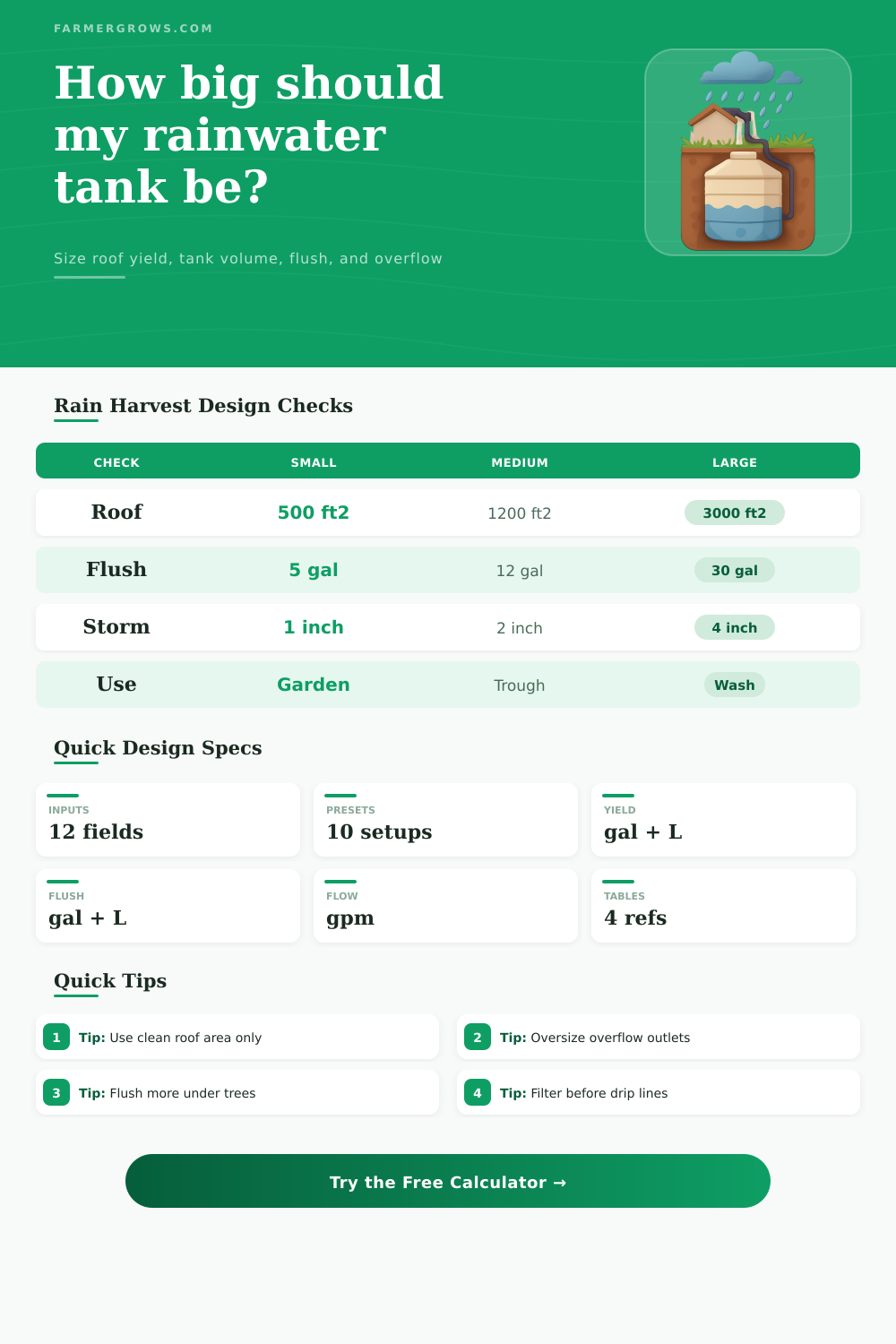
Rainwater Harvesting Design Calculator
Size farm roof catchment, tank storage, first flush diversion, downspout count, filter flow, and overflow capacity for practical rainwater harvesting layouts.
Use clean catchment area only. Results are planning estimates for irrigation, livestock, washdown, and non-potable farm storage; potable systems need local code review and treatment design.
Rainwater Harvesting Design Results
Volumes use 0.623 gallons per square foot per inch of rain, adjusted by catchment runoff, first flush diversion, and collection losses.
| Catchment surface | Runoff coefficient | Water quality note | Best farm use |
|---|---|---|---|
| Clean painted or galvanized metal roof | 0.90 to 0.95 | High yield, low grit when gutters are screened | Garden, livestock, greenhouse storage |
| Greenhouse poly film or rigid panels | 0.85 to 0.95 | Smooth surface, check algae and dust buildup | Nursery benches and drip irrigation |
| Clay or concrete tile roof | 0.75 to 0.90 | More texture, more splash and retained water | Landscape and orchard irrigation |
| Asphalt shingle roof | 0.75 to 0.85 | More fines; use stronger pre-filtration | Non-potable garden and washdown |
| Shade cloth, net house, or lath cover | 0.50 to 0.70 | Partial capture; wind loss can be significant | Supplemental crop irrigation only |
| Compacted yard apron or paved pad | 0.45 to 0.65 | Higher sediment and contamination risk | Settling basin before non-contact reuse |
| Peak rain intensity | Flow from 1000 ft² | 2x3 downspout check | 3x4 downspout check | Design note |
|---|---|---|---|---|
| 1 in/hr | 10.4 gpm before runoff coefficient | Usually 1 | Usually 1 | Common light storm design check |
| 2 in/hr | 20.8 gpm before runoff coefficient | Usually 1 | Usually 1 | Good minimum for small farm roofs |
| 4 in/hr | 41.6 gpm before runoff coefficient | Often 2 | Usually 1 | Use for heavy thunderstorm conveyance |
| 6 in/hr | 62.3 gpm before runoff coefficient | Often 2 | Usually 1 | Keep leaf screens clear at this rate |
| 8 in/hr | 83.1 gpm before runoff coefficient | Often 3 | Often 2 | Split flow and oversize overflow paths |
| Roof condition | First flush rate | Metric equivalent | Use this when |
|---|---|---|---|
| Clean metal roof, open site | 5 gal per 1000 ft² | 20 L per 100 m² | Low leaf load and frequent collection |
| Typical farm roof | 10 gal per 1000 ft² | 41 L per 100 m² | Normal dust, pollen, and gutter debris |
| Roof below trees or grain dust | 15 gal per 1000 ft² | 61 L per 100 m² | More organic matter or dusty operations |
| Potable pre-treatment planning | 20 gal per 1000 ft² | 82 L per 100 m² | Use only as a pre-design value before code review |
| Very small clean shed | 2 to 5 gal total | 8 to 19 L total | Do not undersize below practical diverter volume |
| Component | Design data | What to check | Farm note |
|---|---|---|---|
| Leaf screen or rain head | Size for peak gpm, clean at 1/8 in to 1/4 in openings | Bypass path during clogging | Place where it can be reached from the ground |
| Settling or calm inlet | Keep inlet below splash level and above sediment zone | Prevent stirring settled fines | Useful for drip and greenhouse tanks |
| Drip irrigation filter | 120 mesh or about 130 micron is common | Emitter requirement and pressure loss | Flush filter after dirty storm periods |
| Overflow pipe | Use equal or larger capacity than peak inlet flow | Screen outlet and route away from foundations | Calculator adds 25% flow margin |
| Tank usable drawdown | 85% to 95% of nominal volume | Outlet height, sediment space, pump cutout | Use less usable volume for shallow tanks |
For storage sizing: Design the tank around the dry spell and daily demand, then compare that need with realistic monthly harvest. A huge roof cannot help during a dry month unless water is already stored.
For conveyance: Size inlet screens, downspouts, and overflow for peak rain intensity, not average monthly rainfall. Overflow should leave the tank without backing up into gutters.
Rainwater harvesting systems often fail because a person size the rainwater harvesting system for average rainfall instead of sizing the rainwater harvesting system for long periods without rain. A person must size the system for the number of weeks in which it dont rain, not for the average amount of rainfall. While the calculator will perform the mathematical computations necessary to size the system, the calculator will allow you to avoid guesswork in the process by using your roof size and rainfall data to create a plan.
You must understand each of the inputs that is required as well as the implications of each of the results that the calculator provides. The type of material that covers your roof will impact the amount of water that your rainwater harvesting system provides to you. Metal roofs will shed almost all of the rainwater that falls on them.
Size your rainwater system for weeks without rain
Asphalt shingle roofs will hold onto some of the dust and fines that accumulate on those roofs, however, and will provide less usable water. Furthermore, if your yard aprons is compacted or if they are shade with shade cloth, even more of the water will be lost to evaporation and splash loss. While the calculator will account for these factors, you must make a decision about whether the effort required from your roof is worth the collection of rainwater.
If your roof is dirty, covered in pollen or shaded by trees, you will collect less water then the calculator calculates, and you will need a more powerful first-flush system to keep sediment from entering your tank. A first-flush system is used to divert the water that falls during the initial minutes of precipitation events. During these initial minutes, precipitation will typically fall with high velocity and will carry leaves, dust and other particulates that will not be useful in your end use of the water.
A first-flush system will divert this water away from the tank. The calculator will allow you to set the number of gallons of rainwater that will be diverted per square foot of rooftop area. While the number of gallons of water that will be diverted may seem small, those gallons will be multiplied by the number of storms that falls during the month.
The water that a first-flush system diverts is water that will never be stored in your tank, but it is the price that you pay to ensure that the water that is stored in your tank is usable. Many people make an error in the sizing of the rainwater tank for the length of dry spells without rain. People often size there tank according to the size of their roof.
Instead, however, the tank should be sized according to the length of dry spells. While your roof may be large enough to provide water for your needs during periods of rainfall, it will not be able to provide water to you during drought periods if your tank is empty. The calculator will ask for the daily demand for water as well as the number of dry days per year.
The percentage of the tank that is usable for drawdown is another important input in sizing your tank. Instead of wanting to draw all of the water in your tank, you will save some of the water for other uses. Furthermore, the volume of the tank will impact the amount of water that is usable; if your tank is shallow, you can reduce the percentage of the tank that you drawdown.
You can also reduce the percentage of the tank that will be drawn down to create a safety margin for your pump. The last component of the system is the conveyance system that will move the rainwater from the rooftop area to your storage tank. Conveyance systems are typically neglected in the planning of a rainwater harvest system until a heavy storm arrives at the property.
Instead of planning for the intensity of rainfall each month, it is necessary to plan for the number of gallons per minute during the peak intensity of storms. The calculator will provide recommendations for downspouts based on the number of gallons per minute that will flow from your roof. Furthermore, it is a recommendation to provide an overflow system for your downspout that can handle more than the number of gallons per minute that your tank will store.
Should the overflow system become backed up due to high amounts of rainfall, the damage to your foundation is likely to be much higher than the cost of an overflow system that can handle excess rainwater. The tables that are provided for reference will provide information about the types of surfaces, intensities of storms and recommendations for the components of your system. These tables exist to allow you to determine whether your roof, filter and overflow system is reasonable before you purchase the components necessary to create your system.
You should use these tables after you create your system with the calculator; the numbers in the tables can change based on the adjustments that you make to the inputs for your system. These reference tables will allow you to understand the implications of the adjustments that you create to your system. This calculator is a starting point for creating your rainwater harvesting system, but it is not the final answer.
For instance, you may want to adjust the length of dry spells that you provide for your system to the length of dry spells that are experienced in your area. Similarly, you may want to increase the amount of rainwater that is diverted during initial minutes of storms if your rooftop area is exposed to trees. If your rainwater tank will be placed on uneven ground, you may want to reduce the percentage of water that is usable in your tank.
These types of adjustments will ensure that your rainwater harvesting system is accurate for your own situation and your own rooftop area. A system that does not take into account the structure of your roof or your area’s rainfall will fail to provide you with the water that you require, forcing you to carry water in buckets to attend to your needs.